

Can Not Accept to Languish
 North East Integration Rally
Let us start with the UK, where cities have impeccable crafts. People are talking about craft clusters, but it has been in existence in the UK for the last two to three centuries. The crafts were part of the industrial revolution, and a part mainstream industry sector,unlike India, where it is still a cottage industry, despite second largest employment provider.
In the UK, they call it the creative economy sector; the approach is completely different, bringing the voice and recognition of the craft sector under an ambit,whereas the voice of the Indian artisans is yet to be heard by the government, and the reason is that they donot see them as revenue generators or earners for the country.
The British Council, Report October 2023, Crafts in the age of climate crisis, brings to light that an overwhelming number of craft workers in India, estimated at around 200 million, with women comprising 56.13 per cent of this demographic, face varying degrees of risk from climate change, directly or indirectly.
On the one hand, climate change is impacting the traditional craft sector in unimaginable ways, and on the other hand, crafts-based employment is becoming unappealing to the next generation. India’s Craft-led future must be reoriented to face the looming threats of languished. The report endorsed that climate resilience through craft is a path to sustainable fashion in India.
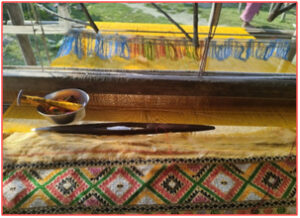
We know the handicrafts are the artefacts made by hand with hand tools that encompass culture, local narratives, and tradition. However, as per the Government data, India has seven million artisans, around 50 million employed in the sector, which is many times less than the report of the British Council.
The Government record says a total of exports around USD 10 billionand the total domestic around USD 15 billion, with average wages of just Rs. 5,000 to 10,000 monthly.
Let’s compare it with the UK. In the UK, the creative sector employs approximately 1.9 million people. They generate revenue of more than £124.6 billion (Rs. 1445.5 Lakh cr.) with monthly earnings of Rs 2.50 Lakh on average. The inclusion of the craft sector in industry and commerce is important. The dichotomy is ironic.
Our crafts have to move upwards, bringing decent earnings and the dignity of life. We have a long way to go in this direction. India yet has to create a dedicated craft infrastructure that brings Indian artisans under one roof, offering them complete infrastructural support and financial assistance through a non-profit initiative. The goal is to provide these talented individuals with a platform to showcase their art and achieve true financial independence and due recognition, too.
With our genuine will, this concept can be scaled up significantly. The government’s involvement has to ensure that it avoids wasting time and makes the resources available. The knowledge of this sector is unmissable; if lost once, we lose our pride, our culture and our identity.
The culture sector has regional sensibility and sensitivity;the North East Region, in particular, deserves special mention.The North East is a confluence of several tribes and cultures, and this is reflected in the traditional crafts.We must ensure that the originality of a craft is not lost in trade and translation.
We need to find ways and means for our young minds to work towards elevating the status of these indigenous and heritage crafts. It is an important perspective. Until Indian crafts are positioned as part of our creative economy rather than a cottage sector, artisans will remain under-recognised. It is the peak time to turn heritage into innovation.
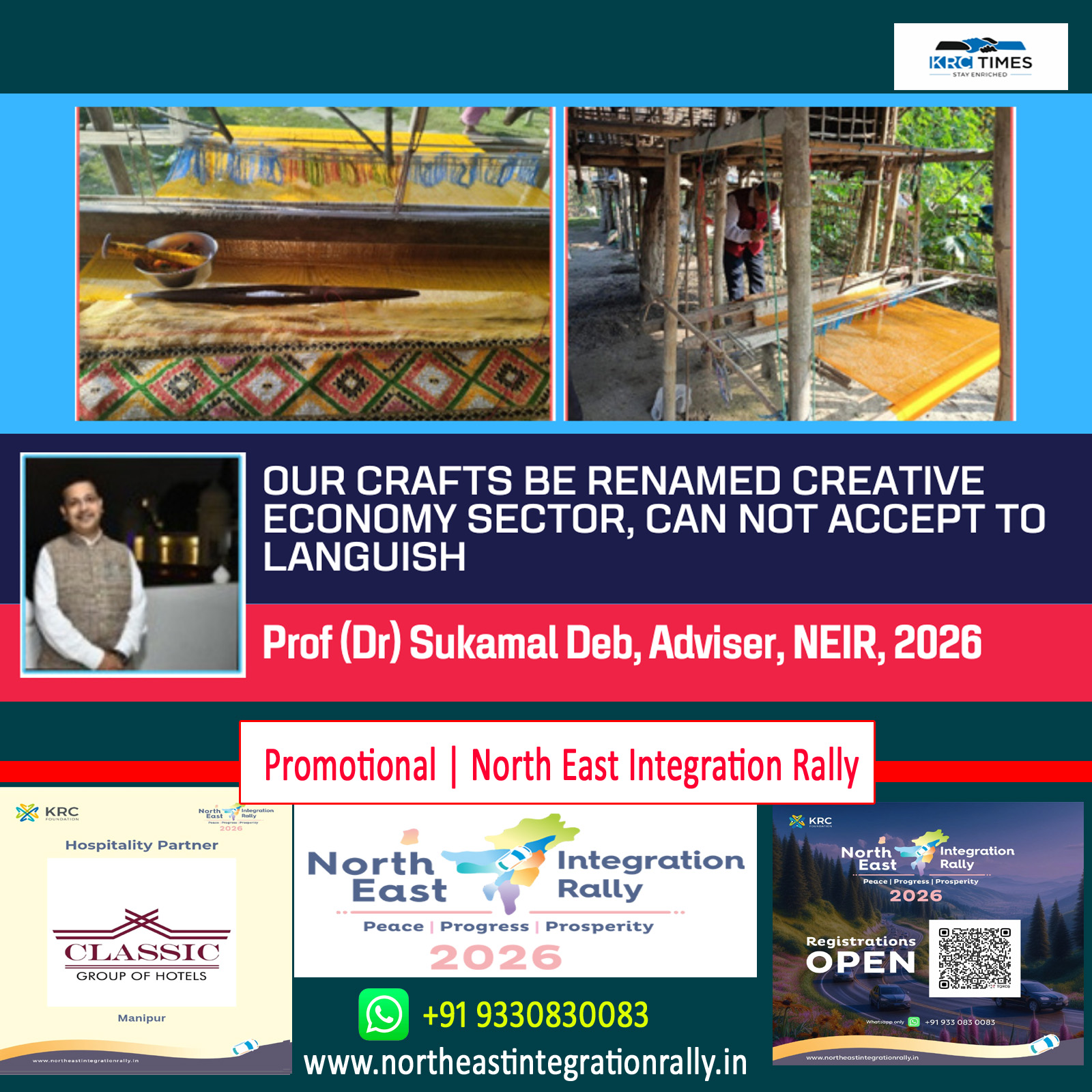
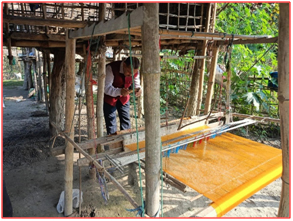
Paksang, a languishing weaving craft of the Mising Tribe, Assam, atKartik Chapori (low river bank), a lesser-known village on the other side of the Brahmaputra from Jorhat. The author took a photo of the traditional loom (right side) on 24.02.2024 in the village.

Indian market remains largely price-sensitive, but with growing awareness and consumer education, there is an emerging audience that truly appreciates niche, high-quality crafts. The younger generation should begin to see these crafts as generational treasures, a living heritage to be preserved and carried forward.
This is something Montek Singh Ahluwalia, then deputy chairman Planning Commission of India, highlighted in 2006. Every handmade item carries hours of labour, years of learning, and generations of traditions. Craft is more a history than a product, an ingenuity, and the soul of an artisan.
When we bargain, we unknowingly undervalue that heritage and make artisans feel their craft is not worth it. Let’s shift our mindset. We are not just customers; we are custodians of culture and patrons of tradition. So next time you buy, support with pride. Pay them fairly. Because when artisans are valued, their children see a future in their craft.
We can do our bit in a couple of ways, one of which may be not to bargain with artisans when buying. Today the fast fashion and cheap imports dominate, pushing handmade, local, and slow crafts out of the mainstream market. This is a dominating challenge of our time.
Our accomplishments should be to document, support, nurture and disseminate knowledge of craft and traditional systems.The North East Integration Rally, 2026, opts for this task. In the days to come, this pioneering initiative will be proven to be visionary.