


A Cultural, Historical Reflection from a Soldier-Historian’s Walk through Kamarupa, Assam
 KRC TIMES Desk
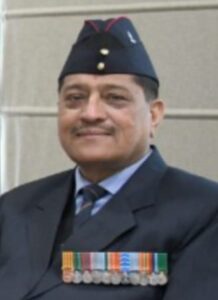
Col (Dr.) AKS Machhral MiD, VSM (Retd)
Abstract : This study examines the cultural presence of Bhagwan Shri Rama in Assam (ancient Kamarupa) through textual sources, regional traditions, and lived experience. While the Valmiki Ramayana does not explicitly record Rama’s visit to Assam during his fourteen-year banwas (exile), Assamese literature, folk memory, sacred geography, and royal inscriptions preserve a continuous remembrance of Rama as an ethical ideal rather than a territorial conqueror.
This paper further integrates the author’s on-foot journeys across Assam, undertaken as a soldier, and devotee, to explore how Rama’s exile offers enduring lessons in leadership, obedience, restraint, and moral command qualities essential both to kingship and to military life.
- Rama’s Banwas: Exile as Ethical Discipline.
In the Valmiki Ramayana, Rama’s exile (vanavasa) is not punishment but chosen obedience. He does not argue law, he fulfils it. When commanded to leave Ayodhya, Rama replies not as a prince defending rights, but as a soldier receiving orders, “I obey.”

This obedience transforms exile into moral training, where authority is internalized rather than exercised.
The Araṇya Kaṇḍa situates Rama among forests, hermitages, tribal communities, and river systems spaces beyond state control but central to civilizational balance. The epic thus allows Rama’s presence to travel beyond named geography into cultural memory.
- Assam (Kamarupa) in Early Indian Consciousness.
Assam, historically known as Kamarupa, is referenced in early Sanskrit literature as a recognized eastern domain, not a fringe wilderness. Texts such as the Mahabharata and Kalika Purana situate Kamarupa within India’s sacred and political geography. By the early medieval period (7th-10th century CE), Kamarupa had, Structured kingdoms. Brahmanical learning. Strong Shakta Vaishnava synthesis.
It is within this milieu that Rama’s story was received, adapted, and localized, not imposed.
- Folk Memory of Rama’s Stay during Exile.
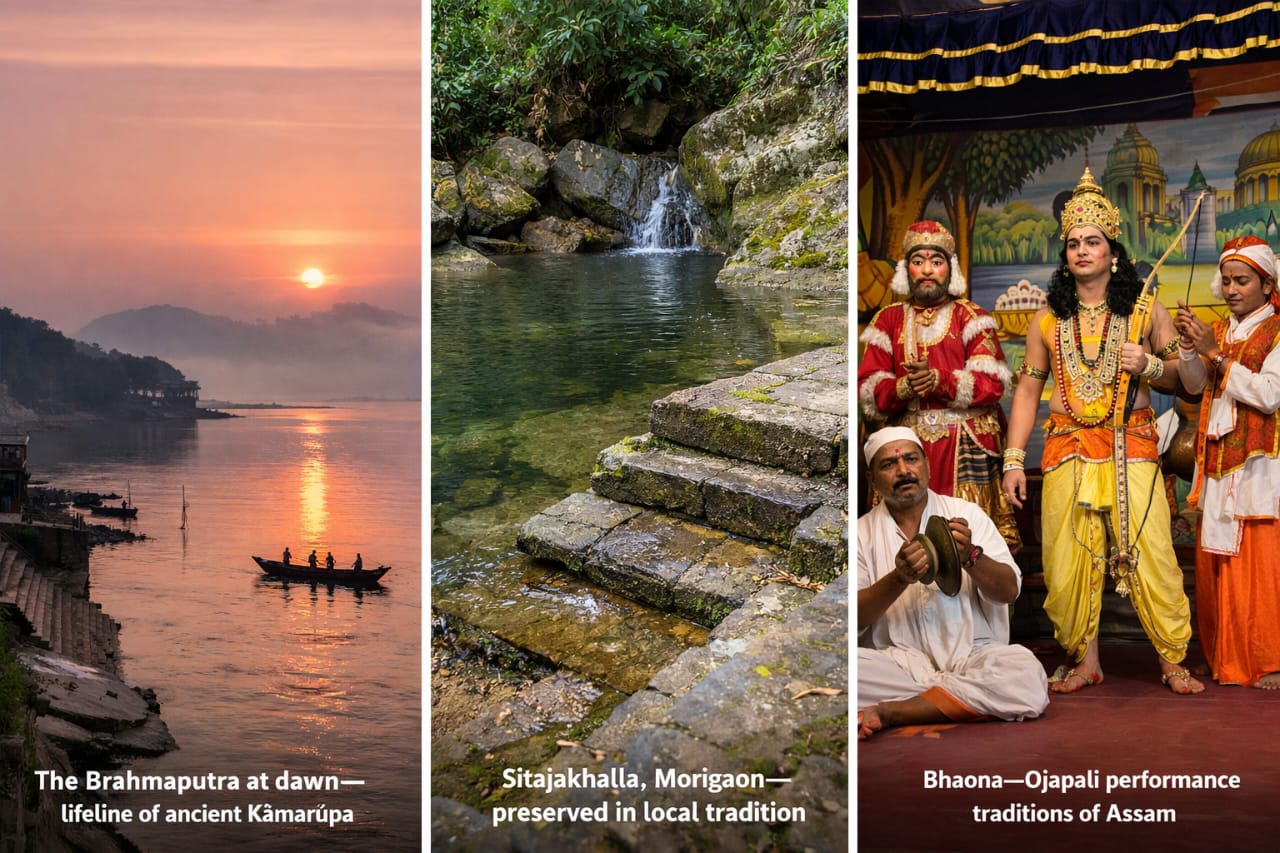
Sitajakhala: Where suffering became sacred
At Sitajakhala (Morigaon district), local tradition holds that Sita bathed and rested during exile. Stone steps descending into water are revered not as monuments, but as witnesses.
As a historian, one must state clearly:
There is no epigraphic proof of Rama or Sita’s physical presence here. Yet as a cultural observer and as one who has stood barefoot at this site the continuity of belief carries anthropological and civilizational weight.

Such places arise not through royal decree, but through women’s memory, village ritual, and repeated telling across generations. Rama among Forest Communities. Among Karbi, Rabha, Tiwa, and Bodo traditions.
Rama appears:
Not as an imperial figure
But as a forest-dweller,
A moral traveller,
A companion of the dispossessed,
Karbi oral epics like Sabin Alun narrate a long forest journey that closely mirrors Rama’s exile, blending tribal migration memory with Ramayana narrative.
This is not cultural appropriation, it is cultural convergence.
- Rama and the Old Kingdoms of Assam.
Copper-plate inscriptions of Kāmarūpa kings (notably Bhaskaravarman, 7th century CE) compare rulers to Rama, Dasharatha, and Janaka, indicating Rama’s ethical kingship as a political ideal.
Crucially, these references emphasize:
Justice over conquest,
Dharma over expansion,
Protection over domination,
Assamese kings adopted Rama as a model of restraint, not triumphalism.
- The Assamese Ramayana: Madhava Kandali.
The Saptakanda Ramayana (14th century) by Madhava Kandali marks a decisive moment in Assam’s civilizational history. Written in Assamese, it presents:
A human Rama,
A suffering Sita,
A morally tested Lakshmana.
Later refined by Srimanta Sankardeva and Madhavdev, this tradition ensured that Rama lived not only in scripture, but in village theatre (Bhaona) and public moral discourse.
- A Soldier’s Walk: Personal Pilgrimage and Historical Inquiry.
During my first visit 1992 on postings and later independent study visits to Assam, I walked not ceremonially, but deliberately through:
Riverbanks,
Temple ruins,
Forest paths,
Remote villages.

I did so not as a tourist, but as a curative historian one who believes history must heal, not inflame.
Walking these landscapes on foot clarified one truth,
Rama’s exile is remembered in Assam not as arrival, but as alignment.
As a soldier, Rama’s life offers three enduring principles:
Obedience without bitterness,
Command without arrogance,
Power restrained by duty.
As a commander, I found in Rama the archetype of leadership:
Who listens before ordering,
Who sacrifices privilege,
Who returns to rule only after proving restraint.
- Heritage Policy Reflection: Why This Matters Today.
India’s cultural heritage policy must move beyond:
Monumental exclusivity,
Chronological absolutism,
Assam’s Rama tradition teaches us that:
Cultural memory can exist without archaeology,
Sacred geography can be non-exclusive,
Faith and history need not compete.
Preserving sites like Sitajakhala, oral traditions, and performance arts is civilizational defense, not mythology management.
- To sum up, Rama as Commander, Not Conqueror.
Assam does not claim Rama through stone or sword.
It remembers him through,
Songs,
Silence,
Forest paths,
Ethical kingship
For those in uniform and those who gover, Rama’s exile remains the highest training ground.
A king who cannot obey cannot command.
A soldier who cannot renounce cannot lead.
This is Rama’s lesson.
This is Assam’s gift to India.
Footnoted References:-
Valmiki, Ramayana, Araṇya Kāṇḍa, Critical Edition, BORI, Pune.
Mahabharata, Sabha Parva; references to Kāmarūpa.
District Gazetteer of Assam; local tradition of Sitajakhala, Morigaon.
Verrier Elwin, Tribal Myths of the North-East Frontier of India.
K.L. Barua, Early History of Kāmarūpa.
Madhava Kandali, Saptakanda Ramayana (14th c.); Assamese literary history.
Kalika Purana (10th–11th century), Kāmarūpa recension.
S.K. Chatterji, Kirata-Jana-Kriti.
Romila Thapar, Cultural Pasts.
IGNCA, Living Traditions of Ramakatha in North-East India.
Disclaimer: This article draws upon classical texts, regional literature, folk traditions, and the author’s personal field observations in Assam. References to Lord Rama’s association with Assam during the period of exile (banwās) reflect cultural memory and regional belief, and are not presented as established archaeological fact unless specifically stated.
Personal reflections are offered from the perspective of a soldier, historian, and devotee of Lord Rama, with the intent of highlighting ethical and cultural values rather than asserting historical finality or political positions. The piece aims to encourage heritage awareness and thoughtful engagement with India’s civilizational traditions.