


A Soldier’s Reflection on History, Civilisation, and Missed Resolve
 KRC TIMES Desk
Col (Dr.) Ashwani Kumar, M-in-D, VSM (Retd.)
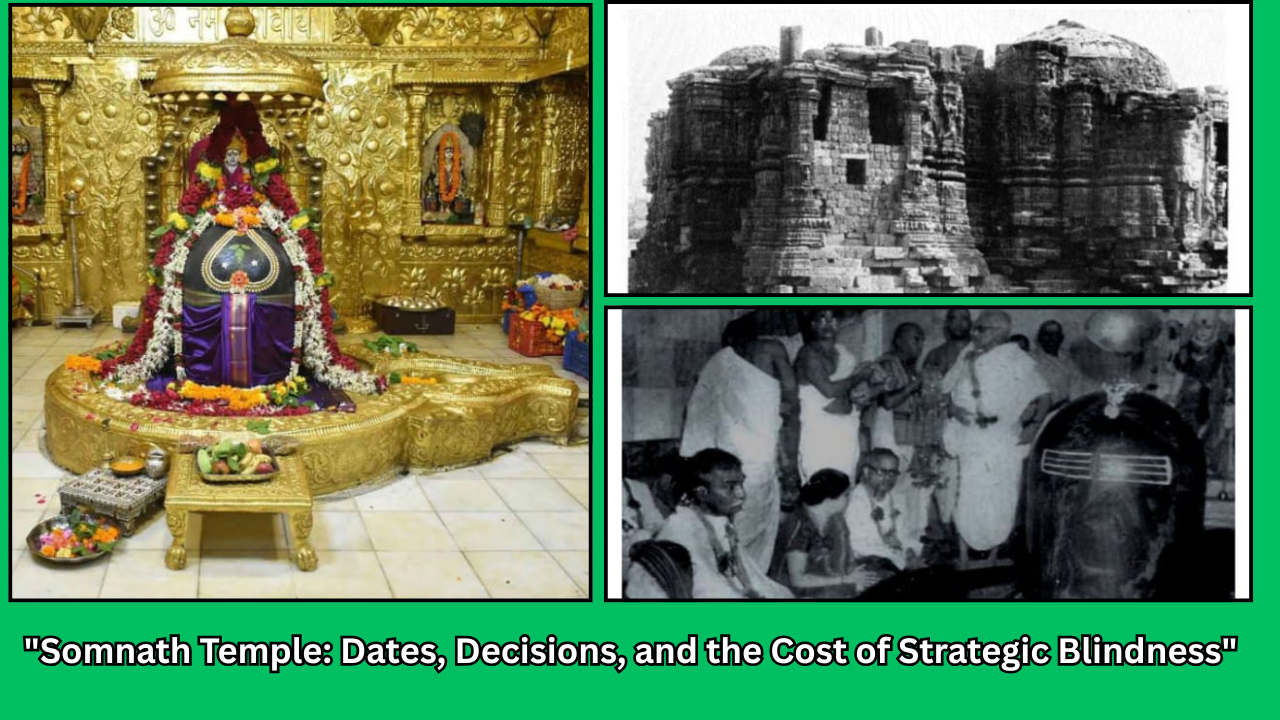
Somnath Mandir stands today at Prabhas Patan in Gujarat, facing the Arabian Sea with quiet dignity. Its present structure, inaugurated on 11 May 1951, is often seen as a symbol of national resurgence. Yet for those trained to study history through the lens of security and strategy, Somnath Temple is also a reminder of how civilisations falter not suddenly, but through a series of avoidable omissions.
The essential question is not emotional, but analytical.
Could Somnath Temple have been saved when it was first attacked in 1025 AD?
To answer this, one must look beyond devotion and destruction, and examine decisions, dates, and doctrine.
A Civilisational Landmark: Somnath Before 1025 AD.
Historical records, both Indian and foreign, agree that Somnath Temple was among the most prominent temples of early medieval India. References to Somnath appear in ancient texts such as the Skanda Purana, while Arab chroniclers later described it as one of the wealthiest and most revered shrines of the subcontinent.
By the 9th – 10th century AD, Somnath was:
(i) A major pilgrimage centre
(ii) An economic hub linked to maritime trade routes
(iii) A powerful civilisational symbol visible to traders, travellers, and invaders alike.
Its fame was not accidental, and neither was the attention it attracted.
The Invasion of Mahmud of Ghazni: 1025 AD.
Mahmud of Ghazni (998 – 1030 AD) launched at least 17 recorded raids into the Indian subcontinent. Somnath was not his first target; it was his most symbolic. In 1025–26 AD, Mahmud marched across Multan and Sindh, reaching Somnath after an arduous campaign. Contemporary accounts, including Al-Utbi’s Tarikh-i-Yamini and later Al-Biruni, describe the destruction of the temple and the slaughter that followed. What is often overlooked is this: Mahmud’s intent and pattern were already well known by 1025 AD.

A Temple Without a Civilisational Shield.
Despite Somnath’s prominence, there was no unified defence plan for its protection. The temple lay within the territory of local rulers, yet it symbolised faith far beyond regional boundaries.
By the early 11th century, India had powerful kingdoms – the Chaulukyas (Solankis) in Gujarat, the Pratiharas in the north, and the Chandelas in central India. Yet there was no civilisational doctrine that treated an attack on Somnath as an attack on Bharat itself.
From a soldier’s standpoint, this absence of shared responsibility proved fatal. Strategic assets, whether forts or faith centres, demand collective defence. Somnath Temple was revered nationally but defended locally.
Fragmented Command: Kingdoms Before Civilisation
The political landscape of India in the 10th – 11th century AD was fragmented. Kings ruled efficiently within their domains, but coordination between them was minimal. No joint military council existed. No confederation of kings emerged to counter repeated incursions from the north-west. Each ruler viewed Mahmud’s raids as episodic threats rather than a sustained strategic campaign.
Military history is unambiguous on this point: fragmented commands invite defeat. Mahmud of Ghazni faced brave resistance in pockets, but never a unified front. Somnath fell not because Indians lacked warriors, but because they lacked a civilisation-wide command structure.
Absence of Strategic Depth and Intelligence Foresight.
By the time Mahmud attacked Somnath in 1025 AD, he had already raided Indian territories repeatedly – Mathura (1018 AD), Kannauj (1019 AD), Thanesar, and other centres.
Patterns were visible:
Fast-moving cavalry
Targeting of symbolic cities, withdrawal after plunder,
Repeated return,
Yet these lessons were never institutionalised.
There was no layered defence from the Khyber and Bolan passes, no intelligence network to track enemy movement, and no forward deployment to delay or degrade Mahmud’s forces before they reached Gujarat.
Defence began at Somnath itself, at the last line.
For any professional soldier, this represents a failure of strategic depth. Nations do not lose wars when the enemy arrives, they lose them when they allow him to arrive unopposed.
Ritual Without Readiness
Historical accounts suggest that Somnath had priests, devotees, and local guards, but no standing military force proportionate to its importance. The temple was protected spiritually, not militarily.
This was not unique to Somnath. Across much of early medieval India, sacred spaces were viewed as inviolable by convention, not by force. This assumption collapsed when confronted by an adversary who saw symbolism as a weapon.
History repeatedly shows that faith survives longest when defended by discipline. The absence of a permanent garrison at Somnath was not irreverence, it was strategic misjudgement.
Misreading the Enemy
Mahmud of Ghazni was not merely a raider. His actions were ideological, political, and psychological. Chroniclers record that he sought legitimacy in the Islamic world through high-profile victories over prominent Hindu shrines. Indian rulers, however, treated each raid as a discrete event, not recognising a long-term campaign.

A soldier is trained to study doctrine, not just damage. Somnath fell because Mahmud’s intent was misunderstood, he was countered tactically, not strategically.
After 1025 AD: Repeated Destruction and Reconstruction
Somnath was rebuilt and destroyed multiple times:
1299 AD – Attacked during Alauddin Khilji’s campaigns.
1375 AD – Temple again damaged.
1706 AD – Destroyed under Aurangzeb.
Each reconstruction demonstrated resilience. Each destruction revealed recurring vulnerabilities.
1951 AD: Reconstruction and Reflection.
After Independence, Sardar Vallabhbhai Patel championed Somnath’s reconstruction. When Dr Rajendra Prasad inaugurated the temple in 1951, he described it as a symbol of India’s eternal spirit.
Yet rebuilding stone is easier than rebuilding doctrine.
Lessons That Still Matter.
Had Somnath been defended with unity, intelligence foresight, and strategic depth, Indian history might have evolved differently. Deterrence might have replaced repetition. Confidence might have replaced caution.
Civilisations do not fall when temples fall.
They fall when they fail to learn in time.
A Contemporary Soldier’s Reflection.
Somnath today does not accuse history, it educates it. Its lesson is timeless. Faith inspires, but strategy preserves. Unity of command, accurate threat perception, and forward defence are not modern inventions, they are ancient necessities rediscovered too late. Somnath fell once because a civilisation failed to think and act as one. That failure must remain historical. Its lesson must remain alive.
Contemporary Strategic Reflection.
The remark attributed to National Security Advisor Mr Ajit Doval on the need to be capable of “avenging Somnath” must be understood in its correct strategic context. It is not a call for vengeance rooted in grievance, but a reminder that a civilisation which forgets its vulnerabilities invites their repetition. In professional security doctrine, such language underscores the necessity of preparedness, deterrence, and unitysue of command, precisely what Somnath lacked in 1025 AD.
To “avenge” Somnath today is therefore to ensure that India never again allows its sacred, strategic, or civilisational symbols to stand undefended or unanticipated. It is a call to convert historical loss into institutional strength, so that faith is protected by foresight, and history is not allowed to repeat itself through neglect.

Author’s Note.
The author is a former Army officer and curative historian who goes deep into detail to uncover facts. This article is written from the perspective of a professional soldier for whom history is not nostalgia, but instruction.
The intent is not to assign blame across centuries, but to examine how strategic failures shape civilisational outcomes. Somnath Temple is viewed here as a historical and strategic case study, not merely a religious episode, so that past errors may inform present and future thinking.
Promotional | North East Integration Rally