


An ancient Hindu Temple at the Heart of Two Nations’ Conflict
 Sangram Datta
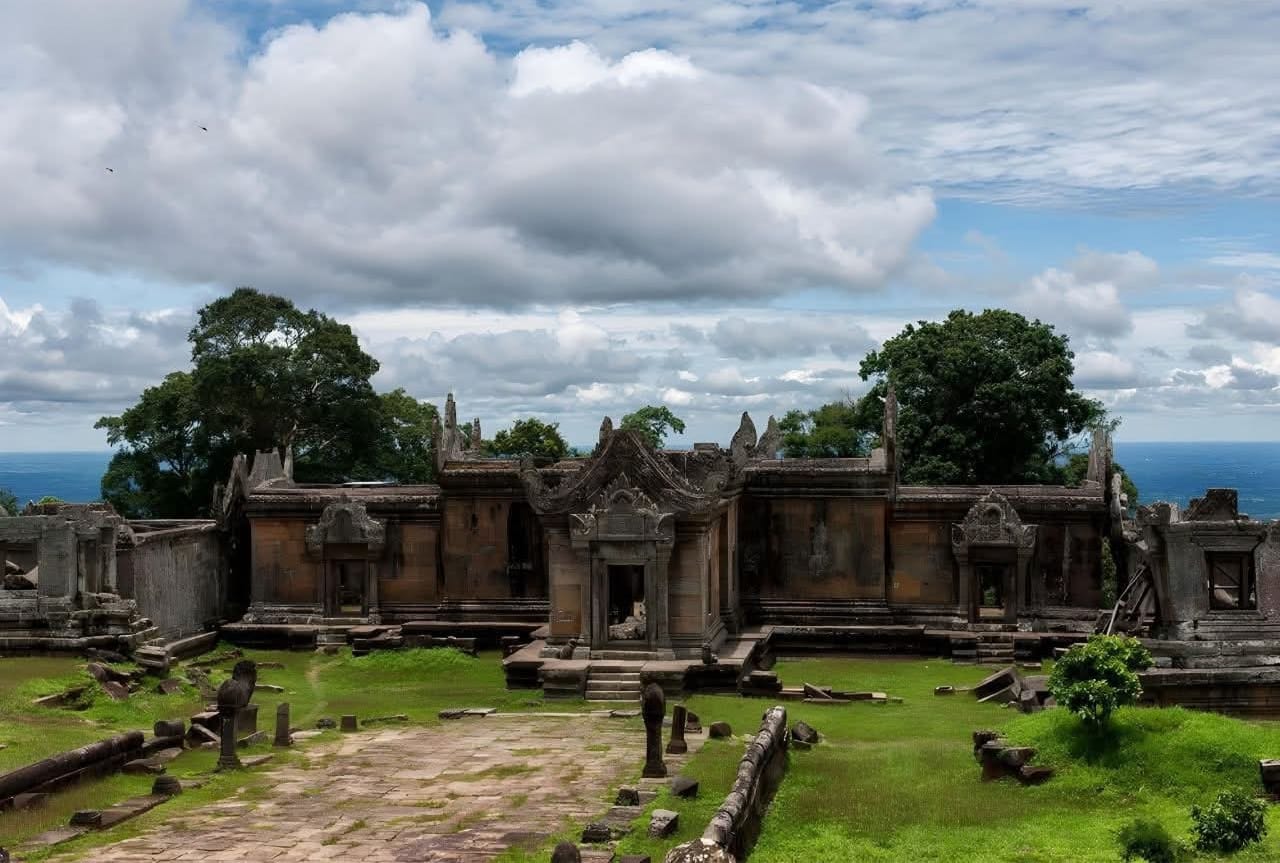
The centuries-old Preah Vihear Temple, perched atop the Dângrêk Mountains, has long been a symbol of spiritual reverence for Cambodians and Thais alike. However, this ancient Hindu temple became the center of a bitter territorial dispute between Cambodia and Thailand, leading to military clashes, political tension, and international legal battles.
The Preah Vihear Temple, a UNESCO World Heritage Site, was built during the reign of the Khmer Empire in the 9th to 12th centuries and is dedicated to the Hindu deity Lord Shiva. While the temple is geographically located within modern-day Cambodia, its proximity to Thailand and the ambiguity of colonial-era maps sowed seeds of contention.
This Hindu temple was built by the Khmer Empire. Construction began during the reign of King Yasovarman l in around 893–925 CE and was completed and expanded by later kings, notably King Suryavarman I and Suryavarman II in the 11th and 12th centuries.
It served both religious and political purposes, symbolising Khmer authority and devotion to Hinduism. Though it is now in Cambodia, Thailand has also historically claimed it due to its geographical location and historical influence.
In 1962, the International Court of Justice (ICJ) ruled that the temple belongs to Cambodia. Thailand reluctantly accepted the decision but continued to contest the 4.6-square-kilometer area surrounding the site, arguing that the ruling did not clearly address the adjacent land.
In 2008, Tensions reignited when Cambodia sought UNESCO recognition for the temple. Thailand saw this move as a threat to its claim over the surrounding land. This led to cross-border skirmishes in 2008, 2009, and particularly in 2011, where artillery exchanges resulted in casualties on both sides and the evacuation of civilians.
The temple and nearby territory became heavily militarized, and nationalist sentiments ran high in both countries. Political factions used the dispute to rally support, complicating diplomatic resolution efforts. In response to the clashes, ASEAN and the United Nations urged peaceful dialogue. Cambodia took the issue back to the ICJ, which in 2013 reaffirmed that the territory around the temple also belongs to Cambodia and called for Thai troop withdrawal from the area.
Since the ICJ’s clarification, tensions have eased. Joint border commissions were established to resolve demarcation peacefully. Both nations have made efforts to promote cross-border cooperation, tourism, and cultural preservation of the site.
The Preah Vihear conflict underscores how historical, cultural, and national pride can intersect with geopolitics. While both Cambodia and Thailand revere the temple, its legacy now includes a story of conflict and, ultimately, a move toward peaceful resolution.

Know More – Apply Here