


A story not just about a bird, but about all of us
 KRC TIMES Desk
Ashk Machhanvi
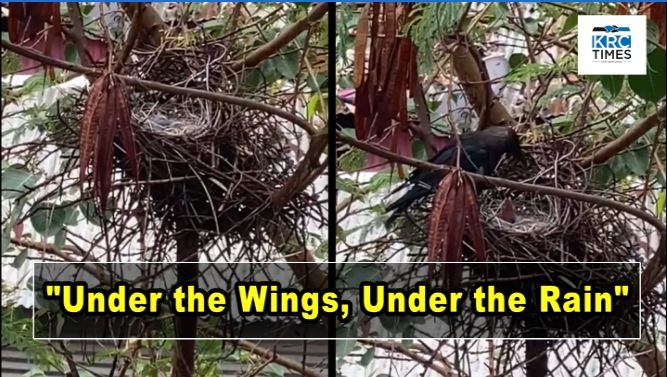
In a quiet corner of the world, during the blistering heat of early summer, a crow gave birth to new life. The nest built on a fragile tree branch outside a home’s tin-roofed backyard was hardly ideal. Constructed with twigs, strings, and hope, it rested in the open, vulnerable to the sun above and the world below. Yet the pair of crows who made it didn’t seek perfection. All they wanted was a space for love to grow.
As the egg hatched, the parents took turns caring for the newborn. In the scorching sun, the male crow fetched food, water, and shade while the female guarded the chick like a silent prayer. It was nature at its purest silent, selfless, and complete.
And then suddenly came the bursting rain too much windy and off the season. Then the nest was half way but was good enough to take care in the scorching heat of the sun.
Not the gentle kind, but a torrential storm. Winds howled, trees bowed, and the flimsy nest shook under the onslaught. At that moment, many birds fled. But not this pair. Because their child was in that nest and love, true love, does not flee.
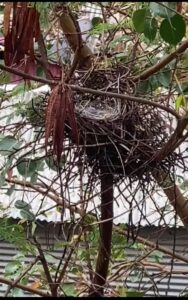
Through the night, the male crow became a roof. He spread his wings over the nest, absorbing every drop of rain, every cold wind, every tremor. The female remained within, shielding the tiny life with warmth and breath. By morning, the storm had passed. The nest had held. The chick had survived. But the father crow had not. He washed away with the stormy night but his body was still there to give shelter to his young baby chick.
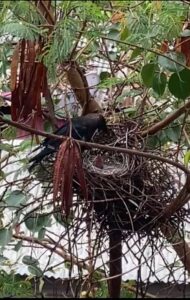
His wings, which once carried him across the skies, now hung limp. He had given everything he had including his life. This is not just a story of birds. It is a mirror for the new generation.
How many such fathers walk among us? Men who silently bear storms to raise their children. Mothers who wear thin torn sarees through winter so their children can wear wool. Parents who skip meals to pay school fees. They do not speak of sacrifice. They simply do what is needed for their children, with no expectation of reward but as a duty.
But what happens when they grow old?
We live in an age where comforts increase but so does distance. Our parents, once the shelters of our childhood, grow old in silent corners, watching us scroll through phones, busy with timelines, too tired for conversations. They ask for little. But what they deserve is everything. But do they get the same comforts from their children, do children spend the same time with their parents? Is a question mark for the new generation which is more digital than the conventional one.
In ancient Bharatiya tradition, such questions found answers not in textbooks but in sacred spaces, like the Sharada Sarvagya Peeth in Kashmir, where knowledge was not only about learning but about remembering one’s duties. It was believed that true wisdom lay in seva, service to parents, to teachers, and to all who once sheltered us. As guardians of eternal dharma, shrines like Sharada reminded generations that the home itself is the first temple, and parents its living deities.
The crow’s story must remind us especially our children that sacrifice of parents should never be forgotten. That those who stood between us and the storm deserve more than neglect love and affection at their last stage of life. Give them more than what they gave you not to get into any embarrassment of life. They deserve our time, our care, our presence to take care of them, give them the time at what they gave you.
Teach your children not just how to achieve success, not how to spend money but how to earn and last but not least but how to show gratitude. That to be educated and well-employed is good but to be loving and responsible is divine.
A closing thought for every home.
“When we were helpless, they stood above us like shields. Now that they are fragile, will we stand over them like trees?”
“Jo chhaya ban gaye dhoop mein, Jo chaadar ban gaye sardi mein, Un parindon ke par thak gaye hain ab, To kya tum chhata ban sakoge barish mein?”
(Those who became shade in the heat, Who became blankets in the cold, Their wings are tired now Can you become their shelter in the rain?)
Let this story be passed from one home to another not just as a tale of a bird but as a timeless message: that love is shelter, and shelter is sacred.
Promotional | Subscribe KRC TIMES e-copy