

Various Bengali social and political organisations attempt to form alliances before elections and speak of resistance, they rarely receive majority support
 KRC TIMES Desk
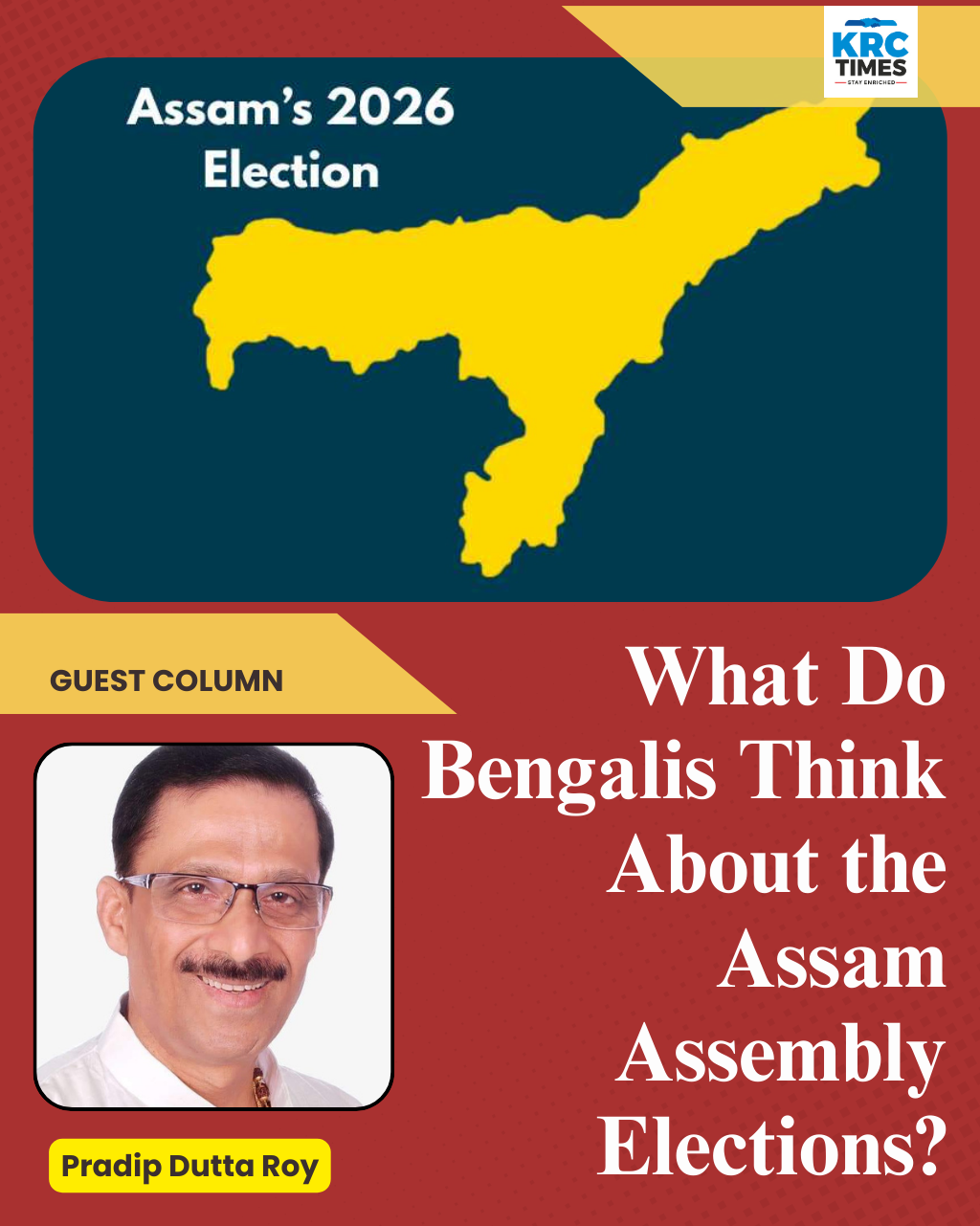
Pradip Dutta Roy
Regardless of which political party comes to power in Dispur, Bengalis in this state have long been treated as a vote bank. Instead of being given the democratic right to elect representatives from within their own community, they are discouraged through misleading arguments. Although various Bengali social and political organisations attempt to form alliances before elections and speak of resistance, they rarely receive majority support. As a result, such alliances fail and gradually fade away.
Assembly seats in Bengali-dominated areas are reduced. Even elected MLAs are often kept away from ministerial positions. Emotional narratives are created to divide different communities, muddying the waters for political advantage. The ruling party then benefits from this confusion. This pattern persisted during the Congress era and remains in place under the BJP government.
Often, nationalistic sentiment is used to sideline backward communities. Before elections, many people become confused about which direction to take. Those who fail to find clarity ultimately surrender to the prevailing political current and end up helping even candidates they dislike to win. In a democracy, independent politics has limited strength.
Even if an independent candidate wins, they often lack sufficient opportunity to serve their voters effectively. Therefore, most people feel compelled to vote for candidates from established political parties. Even when political rights are curtailed, circumstances do not always allow open protest. Those who speak up are silenced in the name of party discipline.
The Case of Barak Valley
Consider Barak Valley. It previously had 15 Assembly seats. Based on the population proportion, the number should have increased to 18. Instead, through political manoeuvring, the state government reduced it to 13 seats. When protests were raised, the Chief Minister stated that the two seats remain within the state, so there was no reason for outrage. However, the real issue is that in the areas where seats were added, Bengalis would not be able to secure representation. Effectively, this move curtailed Bengali political rights.

In regions where seats were increased, the population proportion is lower compared to the Barak Valley. The intention appears clear. To prevent strong leadership from emerging in Barak, seats were reduced, and candidate selection followed a specific bias. Supporters of the ruling party may understand this but remain silent due to circumstances.
Opposition leaders who raised the issue are also not in a strong position. Only individuals outside party structures continue to protest, though the ruling party has ignored them. Blinded by the desire to retain power, they may only realise the consequences when they fear losing it. Despite recognising the injustice done to Barak, people seem helpless and resigned.
Language Movement and Historical Grievances
The history of discrimination against Barak Valley is long-standing. Repeated attempts were made to impose the Assamese language. In 1961, people of Barak rose in protest against the 1960 language circular. Many sacrificed their lives to protect their linguistic rights. However, the state government has still not officially recognized them as language martyrs.
The Mehrotra Commission, formed to investigate the police firing at Silchar Railway Station in 1961, has never had its report published. Instead, during a legislative session, a state minister stated that official records describe those killed as “miscreants.” This reflects the government’s attitude. Refusing to recognize innocent victims of state violence as martyrs is deeply unfortunate.
Although the report on the Nellie massacre was published in the Assembly, the 1961 commission report remains undisclosed. Offering floral tributes at the Shahid Minar on Language Martyrs’ Day does not constitute true recognition. Renaming Silchar Railway Station in honor of the language martyrs is a demand tied to the emotions of millions—not just Bengalis, but all communities of Barak Valley who participated selflessly in the movement.
Post-Independence Discrimination
Since Independence, discriminatory treatment toward Bengali speakers in Assam has continued in changing forms. Dividing people into “sons of the soil” and “outsiders” remains an active political strategy.
After Partition, Sylhet was pushed into Pakistan through a referendum. Hindu residents migrated to other parts of Assam for safety. Various conspiracies attempted to deny them linguistic and educational rights, though strong resistance prevented success.

Recently, Bengali Muslims have been labelled “Miya” and branded as Bangladeshis. However, documented evidence of large-scale Muslim migration after 1971 is scarce.
Many individuals declared foreigners by tribunals have later been recognised as Indian citizens by High Courts or the Supreme Court. Despite this, harassment continues—allegedly to consolidate Hindu votes. Religious division weakens the broader Bengali identity, yet many fail to recognise this.
Unemployment in Barak Valley
The youth of Barak Valley are in a state of uncertainty. There are approximately 500,000 registered unemployed individuals in the region. Local candidates often do not receive priority even for third and fourth-grade government jobs, with candidates brought from the Brahmaputra Valley instead.
Although Barak has engineering colleges, a medical college, and a central university, many students prefer to pursue higher education in Kolkata, Delhi, Chennai, Hyderabad, Mumbai, or Bengaluru. The reason is that employment opportunities are better in those cities. There is no assurance of employment if they remain in Barak. Some campus placements do occur, but mostly outside the state.
In a state of about 25 million people, 4.5 million reside in the Barak Valley. Yet adequate government opportunities are lacking. Even Master’s degree holders apply for low-level positions. Many young people are forced to engage in manual labour, auto-rickshaw driving, or small roadside businesses to support their families.
Political Scenario
The Congress party is attempting to strengthen its organisation across the state to challenge the ruling BJP. However, internal resignations highlight organisational weaknesses. The AIUDF, led by Badruddin Ajmal, also faces instability. Consolidating minority votes against the ruling party is a challenging task. Bengalis are often divided along religious lines, making electoral outcomes uncertain.
Although Bengali organisations attempt to pressure political parties to ensure fair representation, it remains doubtful how effective these efforts will be. There is concern that their strong rhetoric may ultimately yield little practical result.