


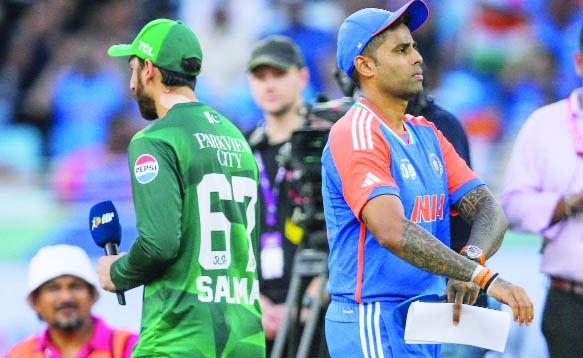
Indian batsman Captain dedicated India’s victory to the victims of the recent Pahalgam terror attack
 KRC TIMES Desk
Ashok Ogra
The recent incident in Dubai, where the Indian cricket captain Surya Kumar Yadav did not shake hands with Pakistan’s Salman Ali in what turned out to be a one-sided match, has sparked controversy – particularly in the neighbouring country.
Cricket fans are asking: Was it a breach of sportsmanship? A silent protest? Or both? Was it personal, political, or a mix of the two?
Handshakes, simple as they seem, have often carried far more meaning than a greeting. They can be gestures of respect, solidarity, or even quiet defiance. And sometimes, not shaking hands can make a statement louder than words.
In 2020, at the height of the COVID-19 pandemic, Dutch Prime Minister Mark Rutte made headlines when he announced a national “no-handshake” policy. But moments later, in a natural reflex, he extended his hand, realized his mistake, laughed, and apologized: “Oh, sorry! We can’t do that anymore. Sorry, sorry.” The incident was light-hearted and funny.
The Dubai situation was different. There was no laughter. The silence between the players reflected real tension. Adding to the moment, Indian batsman Captain dedicated India’s victory to the victims of the recent Pahalgam terror attack. Many saw this as a heartfelt gesture of solidarity.
Pakistan, however, objected sharply. This raises a question: If a country had no role in Pahalgam terror attack, why would it feel provoked by honouring its victims?
This is not the first time a handshake-or the lack of it-has captured the world’s attention. Sports history is filled with such moments.
In cricket, the rivalry witnessed between England and Australia during the Ashes series is legendary. Remember the1932-33 BODYLINE series- watched by millions of Indians when first telecast on Doordarshanduring the 1980s. England’s captain, Douglas Jardine, used short-pitched bowling aimed at the bodies of Australian batsmen- particularly Donald Bradman.
At the time, no helmets or other upper-body protective gear was worn. It was technically legal, but many considered it dangerous and unsportsmanlike. The anger it generated went beyond cricket. It touched national pride and politics. The bowling tactic became symbolic of a country asserting its dominance over another, showing how sports and politics can intertwine.
Thanks to a powerful documentary aired on the Discovery Channel in the late 1990s-during my time working there-I got a firsthand glimpse into the incredible story of Jesse Owens, the legendary African-American athlete. He left the world in awe at the 1936 Berlin Olympics by winning four gold medals- thus shattering Hitler’s so-called Aryan supremacy myth.
Hitler’s absence during the medal ceremony made headlines worldwide- though there is debate over whether Hitler deliberately ignored Owens. Needless, this incident was enough to carry profound political and social symbolism. During the Cold War, the 1972 World Chess Championship between American Bobby Fischer and Soviet Boris Spassky turned out to be not just about chess.
The Soviets had dominated the World Chess Championship since 1948. To them, it wasn’t just a game- it was proof of their intellectual superiority.Fischer’s refusal to engage normally with Spassky mirrored the ideological standoff between the United States and the USSR. Every move on the board, and even their interactions outside it, reflected larger political tensions.
Fischer won the tournament and rewrote the story of chess, transforming it from a quiet intellectual pursuit into a global spectacle laced with Cold War drama.
Tennis too has seen its share of symbolic gestures.In 1974, the Indian Davis Cup team, led by Vijay Amritraj, refused to play the final against apartheid-era South Africa. It was a lost opportunity for India to make history in the Davis Cup, but a significant victory for the movement against apartheid.”

In 2023, top Ukrainian tennis player Elina Svitolina refused to shake hands with Russian Aryna Sabalenka, silently protesting the war in Ukraine.
At the 2016 Rio Olympics, Egyptian Judo player Islam El Shehaby refused to bow or shake hands with Israeli Or Sasson. The boos from the crowd echoedshowing that even a simple gesture can become an international talking point.
Imagine, the football superstar Lionel Messi once ignored a handshake from Real Madrid’s Álvaro Arbeloa during a tense match against FC Barcelona in 2010.
In 1980, Pakistan along with the United States along with many western countries boycotted the Moscow Olympics to protest the Soviet invasion of Afghanistan. Four years later, the Soviets retaliated by boycotting the Los Angeles Olympics. Sports were no longer limited to just games-they were platforms for political expression.
For whatever reasons, all forms of sport and politics in this region are inseparable. The games often carry a symbolic weight far beyond the playing field. Is it the legacy of Partition, or the many provocations since, including state-sponsored terror attacks on Indian soil, that make every match so charged?These questions are complex, and no single answer captures the full picture.
Take Hockey that has its own history of gestures laden with meaning in South Asia. At the 2014 Hockey Championships Trophy match against India played in Bhubaneshwar, two Pakistani hockey players were banned after making provocative gestures towards the crowd.
After the 2016 Uri terror attack, the Indian hockey team initially refused to shake hands with Pakistani players at the Asian Champions Trophy in Malaysia.
The point is clear: a handshake-or its absence-is never just a gesture. It can convey respect, protest, resentment, or political defiance. The context makes it significant, especially in situations where historical tensions run deep.
This brings us back to India vs Pakistan cricket matches that often evoke raw emotions and nationalist fervour. Every encounter between the two nations is more than a game. The backdrop of wars, terror incidents, and a shared but painful history makes every boundary, wicket, and gesture symbolic.

Yet the quiet grace of sportsmanship-in how players behave during victories, losses, or tense encounters-remainworth defending.
It is worth recalling sportsmanship as displayed by England cricket captain Andrew Flintoff during the second Test of the 2005 Ashes against Australia. England won the match by just two runs. While players and fans celebrated, England captain Andrew Flintoff showed great sportsmanship by consoling Australia’s Brett Lee, who remained not out at 43 – saying something like, “Bad luck mate… see you inside for a beer after.”
This beautiful gesture on the part of Andrew Flintoff reminds us that SPORTSMANSHIP is a quality worth sticking up for. But then England does not sponsor terror against Australia.
Also, cricket just isn’t what it used to be in England. A hundred years ago, it was a national passion-now, the spark feels faded. Instead, it has become far more sub-continental game…. a cultural ritual, and close to two billion-strong spectacle.The noted political psychologist and social theorist Ashis Nandy once said: “Cricket is an Indian game accidentally discovered by the British.”
Meanwhile, expect more intense celebrations and stronger controversies – at least till borders remain tense. However, the tournaments will carry on so will the drama…