

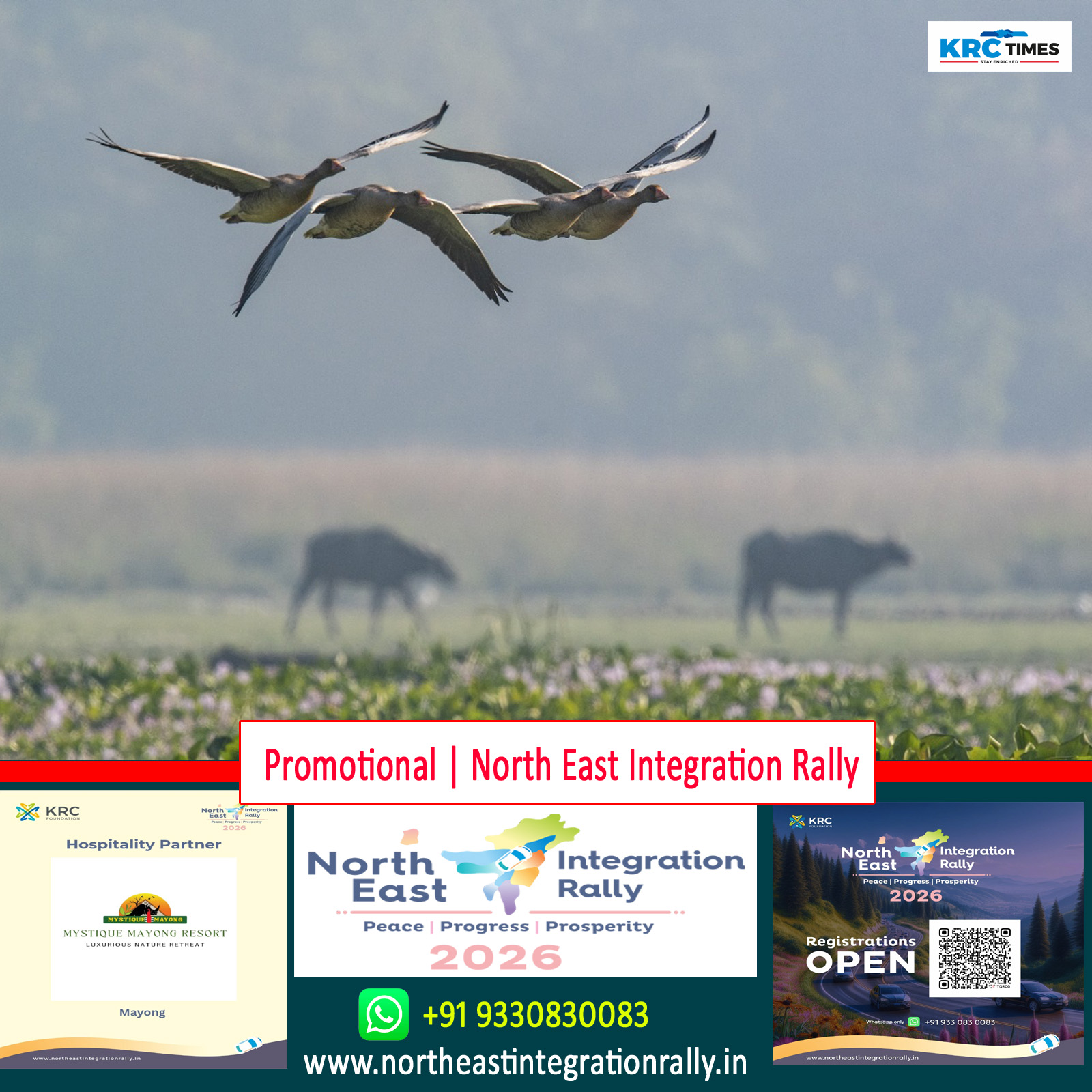
The NEIR-2026 events will begin with the rally flagging off at Manas National Park on January 11, and continue the next day with activities scheduled at Pobitora National Park on January 12
 North East Integration Rally
The national park (Pobitora) sits barely an hour from Guwahati, yet it feels like you’ve crossed into a world that doesn’t operate on the city’s clock.
It’s small, almost deceptively so, especially when you compare it with giant names like Manas or Kaziranga. But size isn’t the measure here. What matters is density, rhythm, and the sheer audacity with which this tiny forest sustains more wildlife than anyone expects.
Set in the outskirts of Guwahati, this landscape is often cited as a conservation success, especially for the protection of the one horned rhino. The sanctuary covers the Rajamayong Reserve Forest and the Pobitora Reserve Forest. The Rajamayong hills support a wide range of wildlife including leopard, capped langur, porcupine, and pangolin.

Pobitora’s grasslands are known for regular sightings of the greater one horned rhinoceros, wild water buffalo, monitor lizard, and wild boar. More than 375 bird species have been recorded here, which makes it a strong draw for birdwatchers.
Pobitora also serves as a source population for the Indian Rhinoceros Vision 2020 initiative. Eight rhinos were moved from here to Manas National Park as part of the effort to rebuild rhino numbers in the region.
On paper, that makes it look like an afterthought in Assam’s chain of protected areas. But the moment you enter, that perception disappears. The grasslands stretch out in clean, open lines. The wetlands shimmer. Birds circle lazily in the sky. And everywhere you look, the landscape feels elastic, like it’s holding far more life than its boundaries suggest.
The truth is straightforward: Pobitora has one of the highest concentrations of one-horned rhinoceroses on the planet. Dozens of them live here, which means your chances of spotting one aren’t just good—they’re almost guaranteed.
This is the park’s signature. It doesn’t make you wait, it doesn’t test your luck, it simply delivers.
Pobitora is rhino place. At dawn, you see them grazing in the tall elephant grass, their silhouettes emerging through the mist like ancient creatures moving at their own pace. Some stand knee-deep in the marshes. Others walk with slow confidence down mud tracks.
You feel their weight before you hear them. The park’s small size means rhinos are never too far. You don’t need to chase them across vast distances. They live, breathe, graze, and wallow in tight proximity, and that intimacy changes how you experience them. These aren’t glimpses. These are encounters.
And because the park has worked hard to protect them—through village cooperation, anti-poaching units, and controlled grazing—Pobitora has become one of Assam’s most successful conservation stories. Pobitora isn’t just grassland. It’s a mosaic. Wetlands curve into reed beds.
Open fields rise into wooded patches. Marshes hold entire microhabitats of birds and amphibians. The water gives everything life. Migratory ducks crowd the lakes. Storks and herons stand still as sculptures. Raptors circle overhead in patient arcs.
If you spend even half an hour near one of the wetlands, you sense how important water is to this ecosystem. The park’s rhythm follows the level of the marshes. When water rises, life concentrates. When water drops, the landscape opens up.
No matter the season, the wetland is the park’s spine. Pobitora is a paradise for birdwatchers, but even if you don’t know the names, the experience stays with you. You hear the calls before you see the wings. The wetlands are full of movement—teal, pintails, herons, egrets, and dozens of smaller species flicking between the reeds.
The park draws migratory birds from Central Asia and Siberia every winter. They arrive in loose, scattered formations that settle over the marshes like living brushstrokes. For many visitors, the rhinos get the spotlight, but the birds reveal the park’s subtler layers.
They show you how differently life expresses itself when space is shared rather than claimed.
Pobitora doesn’t exist in isolation. Villages wrap around the park like a human boundary—Muduki, Gendamari, Gerimari, and a handful of others. Their fields extend to the forest edges. Their cattle graze near the park. Their daily lives overlap with wildlife in ways people from cities rarely experience.
Conflicts happen, especially when rhinos stray into farmland or elephants wander too close at night. But communities here have learned to coexist because they understand how much the park supports their economy. Homestays, guiding jobs, jeep safaris, small eateries—all of these depend on tourists who come for the rhinos.

The connection isn’t romantic. It’s practical. And that practicality has helped Pobitora survive. Pobitora’s revival didn’t happen because of one big decision. It happened through steady, long-term work. Local youth trained as wildlife guards. NGOs built awareness programs. Forest staff patrolled relentlessly. Community groups discouraged poaching and provided early warnings when animals strayed out.
This shared ownership changed the park’s future. Today, Pobitora stands as an example of how conservation works best when villages are part of the solution, not outsiders to the process.A safari here feels different from larger parks. The tracks are narrower. The grass towers above the jeep in certain stretches.
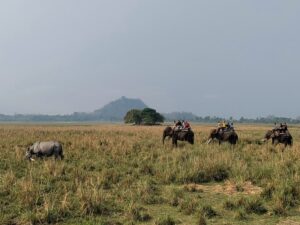
The sightings come faster, but never feel rushed. You move slowly because the landscape asks for patience, not speed. Sometimes you turn a corner and find a rhino standing still on the road, unbothered by your presence. Sometimes a herd of wild buffalo grazes in open grassland with quiet authority.
Sometimes you see a mongoose dart across the path or a hog deer lift its head and freeze for just a moment before disappearing into the green. The encounters feel closer, more intimate, almost conversational.
One of Pobitora’s quiet strengths is how easily it lets you step out of Guwahati’s noise. You leave the city’s rush, cross the Brahmaputra’s floodplains, pass through villages and farmland, and suddenly you’re in a different world.

It’s close enough for a day trip. But it’s deep enough to make you forget the city exists. Pobitora doesn’t try to impress you with scale or drama. It simply shows you what it is—beautiful, compact, bustling with life, and shaped by the cooperation between people and wilderness.
There’s an honesty to that. It’s not selling a grand adventure. It’s giving you a real one. Pobitora National Park proves that conservation doesn’t need endless land or extravagant infrastructure. It needs commitment, balance, and communities that believe the forest deserves to survive.
It’s a park where the rhino isn’t a symbol—it’s a neighbour. Where wetlands cradle more life than you expect. Where villagers, guards, and wildlife share a space that could have fractured long ago but didn’t. To understand Assam’s conservation spirit, start here. A small park with a big heartbeat, alive with creatures that thrive because people chose to protect them.
Spend a morning in Pobitora and you’ll see why this place matters—quietly, powerfully, and without needing to prove anything.