

Aizawl, where the hills shape life, memory
 North East Integration Rally
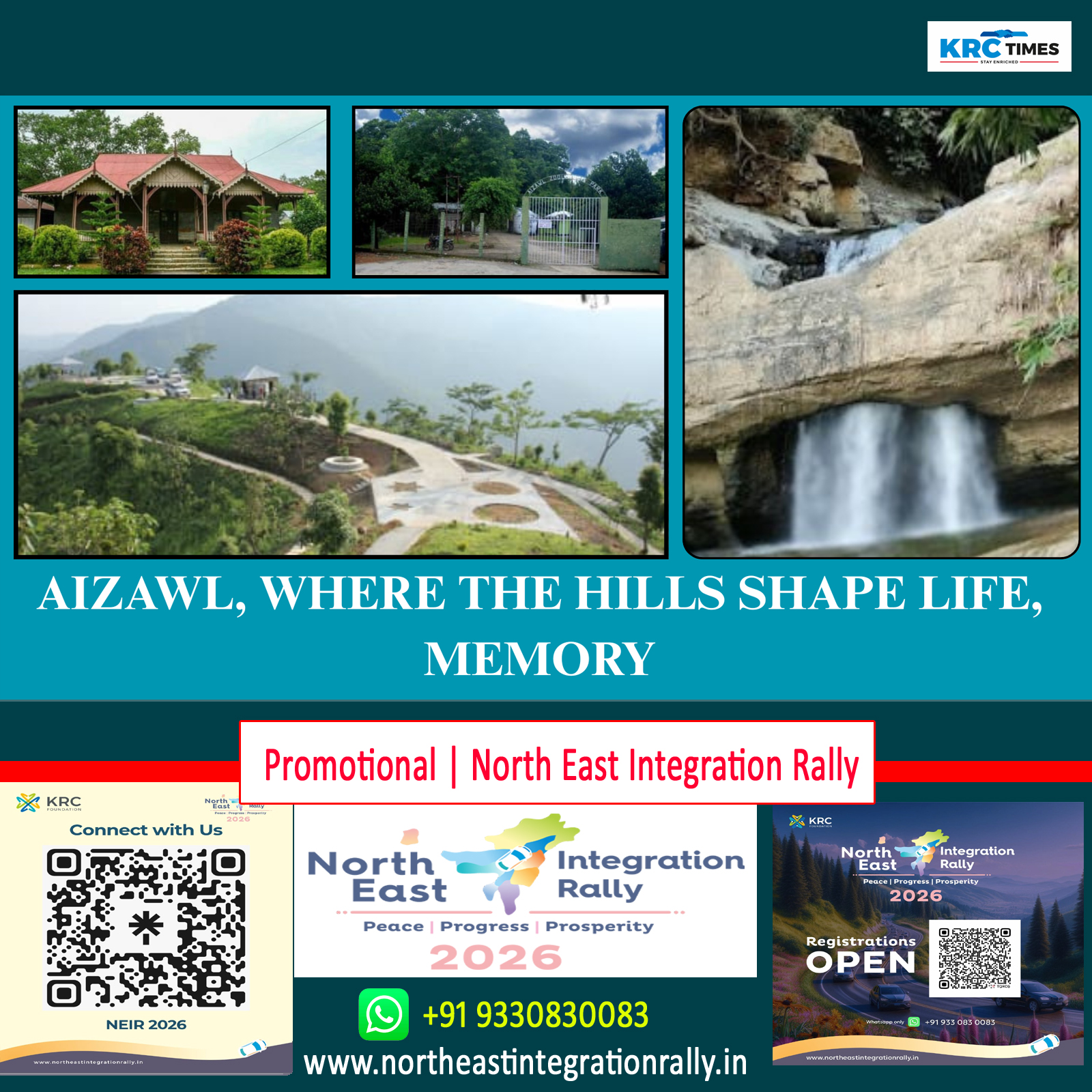
Aizawl rises from the hills like a city that learned early how to live with uncertainty. Roads curve instead of running straight. Houses stack themselves along steep slopes, tin roofs catching light at odd angles. From a distance it looks fragile, almost improvised. Up close, it feels deliberate. This is a place shaped by terrain, memory, and a quiet insistence on order.

The capital of Mizoram sits at around 1,100 metres above sea level, stretched along a ridge that refuses symmetry. Nothing about Aizawl is flat, including its history. The city grew out of colonial outposts, missionary settlements, insurgency years, and a long negotiation between tradition and modern life. What you see today is not a planned metropolis but a lived-in one. Every lane tells you that people adjusted, adapted, and stayed.
Church bells define the rhythm of Aizawl more than traffic signals. On Sundays, the city slows almost to a halt. Shops pull down shutters. Streets empty. Congregations walk uphill and downhill, Bibles in hand, dressed neatly but without display. Christianity here is not ornamental. It is structural. It shapes time, behaviour, and community life. Even for outsiders, the discipline is striking. Noise drops. The city breathes differently.

Music fills the silence once the service ends. Aizawl has one of the strongest musical cultures in the Northeast. Gospel harmonies spill from churches, while rock, blues, and folk drift out of homes and cafés.
Almost every household seems to own a guitar. Music is not treated as a career gamble here. It is a language. Many of India’s finest independent musicians trace their roots to these hills, carrying Aizawl’s restraint and emotional clarity into their work.
The streets tell another story. Aizawl is clean in a way that feels collective rather than enforced. There is no visible obsession with surveillance or fines. People simply do not litter. Community organisations, local councils, and churches play a role, but the deeper reason is social accountability. In a city where everyone knows someone who knows you, public behaviour matters.

Food in Aizawl reflects both geography and history. Smoked pork, bamboo shoot, fermented soybeans, and simple rice meals dominate kitchens. There is little excess spice. Flavours are clean, sharp, and honest.
Meals are functional but comforting. Street food culture is growing, especially among younger residents, but even here the emphasis is on freshness rather than spectacle. Cafés now line parts of the city, serving coffee that competes with any urban centre, yet the mood remains unhurried.
Aizawl’s relationship with the rest of India has always been complex. For decades, it felt distant, misunderstood, and politically tense. The insurgency years left scars, but also a strong sense of internal cohesion.

The peace accord changed the trajectory, allowing the city to turn inward and rebuild rather than constantly defend itself. Today, there is cautious optimism. Infrastructure is improving. Connectivity is better. But the city remains wary of losing its character in the rush to catch up.
That caution shows in how development is discussed. There is interest in growth, not obsession. Locals talk about roads, healthcare, education, and jobs, but rarely in the language of grand ambition. The fear is not stagnation. It is erosion. Aizawl does not want to become a generic hill city with glass buildings and cultural amnesia. There is pride in being small, orderly, and distinct.
The youth of Aizawl live at an intersection. They are globally aware, digitally fluent, and culturally rooted. Social media connects them outward, while family and church pull them inward. Many leave for studies or work, but a significant number return. The city may not offer endless opportunities, but it offers something harder to replace: belonging without suffocation.

Women are visible everywhere in Aizawl’s public life. They work in offices, run shops, manage households, and lead community initiatives. While traditional structures remain, the everyday reality is one of participation rather than confinement. The city feels safe, not because crime does not exist, but because public spaces are shared and watched over by the community itself.
From certain viewpoints, especially at dawn or dusk, Aizawl feels almost suspended. Mist moves between houses. Church spires cut through low clouds. The city looks temporary, as if it could be folded away. Yet it has endured earthquakes, political upheaval, and cultural shifts. Its strength lies not in permanence but in flexibility.
Aizawl does not sell itself loudly. It does not chase tourists with curated experiences. Visitors who arrive expecting spectacle may miss its appeal. This is a city that rewards patience. Walk its stairways. Sit in a quiet café. Listen to conversations that drift between Mizo and English. Watch how people wait for each other on narrow roads, how drivers yield without drama, how neighbours share space.
What Aizawl offers is not excitement but clarity. Life here is stripped of unnecessary noise. Faith, community, music, and routine hold things together. In a country racing toward scale and speed, Aizawl stands slightly apart, asking a different question. Not how big a city can become, but how intact it can remain.
That question defines Aizawl’s present and will shape its future.