


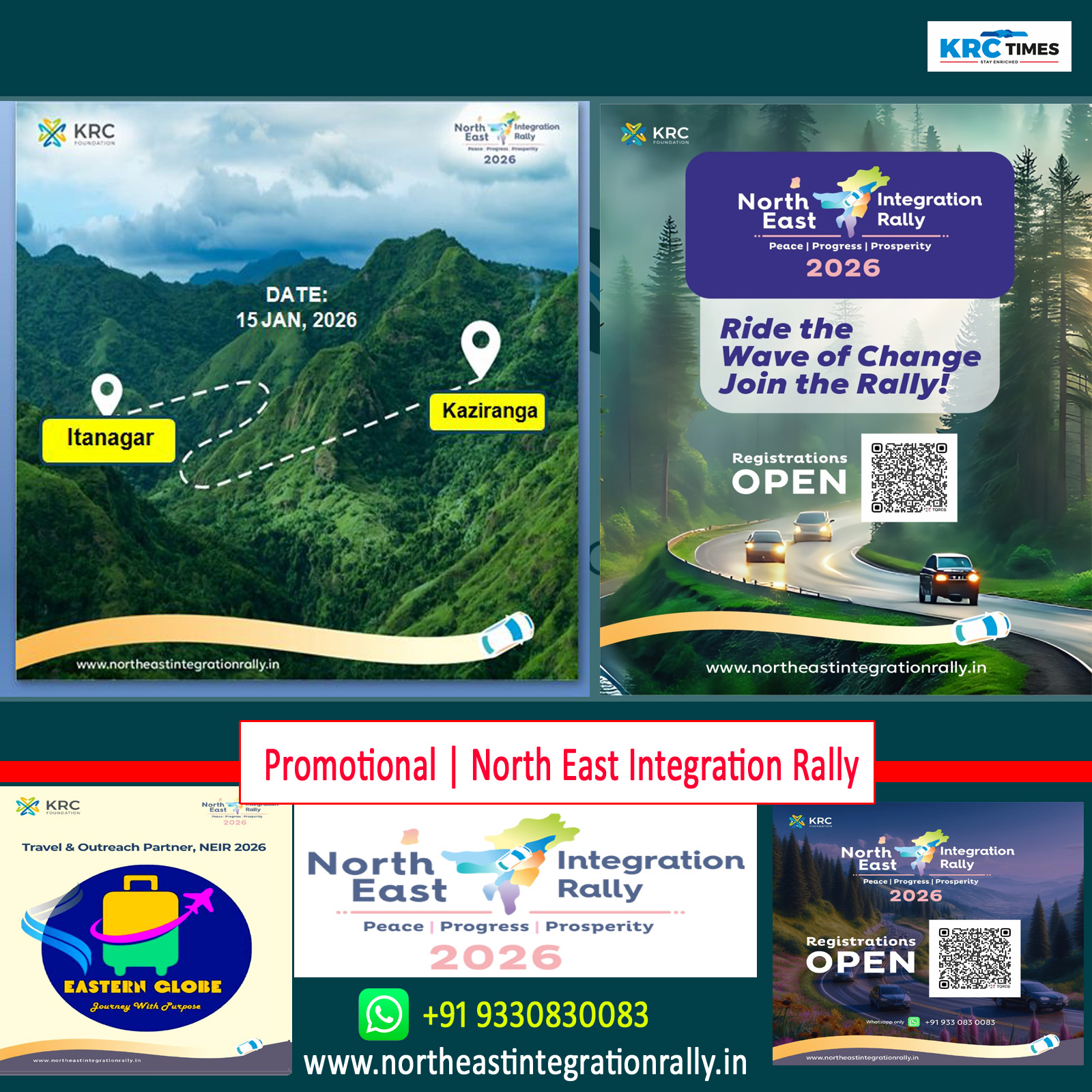
The NEIR 2026 will reach Kaziranga on January 15, when the winter chill sets in, and carry out its activities the next day, January 16
 North East Integration Rally
Kaziranga has a kind of presence that doesn’t rely on drama. You don’t need soaring mountains or postcard lakes to feel its force.
The park works on a different scale. Wide floodplains. Tall elephant grass. Forest patches that look ordinary until something massive moves inside them. The quiet is never really empty. It’s a pause before something reveals itself.
Kaziranga’s story begins long before it became a national park. At the turn of the twentieth century, when rhinos were disappearing fast, conservationists and administrators pushed for protection of this landscape.

What started as a small reserve eventually grew into one of India’s most successful wildlife sanctuaries. Today, Kaziranga isn’t just an ecological asset. It’s a symbol of how a place can fight back from the edge when people commit to protecting it.
The first thing that strikes you is scale. Kaziranga stretches along the Brahmaputra, its terrain shaped by the river’s moods. The park isn’t a single consistent ecosystem. It shifts constantly between wetlands, grasslands, and semi-evergreen forests.
During the monsoon, parts of it drown under floodwater. When the water retreats, animals return to feed on the fresh growth. This cycle of destruction and renewal is so deeply woven into the park’s rhythm that you can’t understand Kaziranga without understanding the river.

And then there are the rhinos. This is their kingdom. You see them grazing alone or in small groups, their bodies heavy but their movement almost casual. They don’t seem to hurry. They’ve learned to trust the land again.
Kaziranga holds two-thirds of the world’s remaining one-horned rhinoceroses, and watching one at close range is a reminder of what conservation actually means: not documents or declarations, but a living, breathing animal that almost vanished a century ago.
But the rhino is only one part of the story. The park supports a dense population of tigers, and though you rarely see them, you feel their authority. Their tracks in the mud, the alarm calls of deer, the sudden stillness in a patch of grass—everything hints at power moving through the park’s hidden layers.
Kaziranga has one of the highest tiger densities in India. The fact that you may not see one doesn’t diminish the experience. If anything, it sharpens your sense of being in a functioning, healthy ecosystem.
The elephants offer a different kind of drama. Entire herds cross the grasslands with a level of coordination that feels choreographed. Young ones stay tucked between adults, protected from stray vehicles or curious tourists. Their presence alone can shift the energy of a safari. You learn quickly that in Kaziranga, you aren’t the center of the story. You’re a guest on someone else’s land.
Kaziranga is divided into zones—Kohora, Bagori, Agaratoli, and Burapahar. Each has its own character. Kohora is the familiar starting point, accessible and well-organized. Bagori gives you sweeping views of the floodplains and some of the most reliable rhino sightings.
Agaratoli, on the eastern edge, feels quieter and more forested. Burapahar tests your patience a little more but rewards you with a deeper sense of wilderness. You can visit all four and still feel you’ve barely scratched the surface.
The landscape never stays still. Morning safaris begin with mist rising off the grass, softening every outline. Birds start calls that sound like a dozen different clocks going off at once. As the sun rises, the light transforms the wetlands into sheets of silver.

By afternoon, the brightness sharpens into a harsher tone, and the animals retreat to shade. Evening brings cooler air and a rush of movement—herds feeding more openly, birds returning to roost, and predators preparing for night.
Birdlife is one of Kaziranga’s overlooked joys. You’ll spot adjutant storks, bar-headed geese, crested serpent eagles, Bengal floricans, hornbills, and dozens more if you pay attention. The park sits along a major migratory route, so the variety changes through the year. Even someone with a casual interest in birds ends up scanning treetops more than expected.
Kaziranga’s beauty lies in its simplicity. Grasslands dominate the terrain. Yet those grasses are the basis of the entire food chain. They feed rhinos, deer, buffaloes, and elephants. They hide predators. They even determine where water collects, shaping the wetlands that sustain countless species. Conservation here isn’t about one animal alone. It’s about maintaining an entire system built around cycles of grazing, growth, flooding, and migration.
There’s a human story too. The villages surrounding the park live with wildlife in ways that are difficult for outsiders to fully grasp. Crop raids happen. Elephants wander into fields. Villagers sometimes lose livestock to predators.

Floods push animals out of the park and into human settlements. Yet communities continue to adapt. Some families work in tourism. Others in forest protection. Many simply coexist because this land has shaped their lives for generations.
The relationship isn’t perfect. Conflicts occur. But the region has shown that with consistent management, strong protection, and community involvement, conservation can succeed without pushing people entirely out of the picture.
Kaziranga’s guards, often working in tough conditions, deserve credit for the park’s stability. They patrol on foot, on elephant back, and in boats during floods. Their efforts rarely make headlines, but without them, the rhinos would not be here.
Now let’s talk about the floods. To an outsider, yearly flooding looks like a disaster. And it can be, especially when animals drown or roads cut off villages. But ecologically, the floods keep the park alive. They wash away old vegetation, deposit nutrients, and prevent the grasslands from turning into forests.
Without this annual renewal, Kaziranga would lose the character that supports its wildlife. The challenge is to manage the floods, not prevent them entirely.

Climate change, however, alters the equation. Heavier rainfall, more unpredictable river behaviour, and increased erosion threaten both animals and people. The park’s future depends on how well Assam adapts to these new patterns. Conservation can’t remain static when the environment refuses to stay predictable.
And then there is tourism. Done responsibly, it brings income, awareness, and incentive to protect the park. But unmanaged tourism can crowd sensitive zones. Kaziranga, for the most part, has found a workable balance. Safaris follow strict routes. Tourist numbers remain controlled. But as interest grows, the pressure will increase. The success story needs constant maintenance.
Kaziranga isn’t just a national park. It’s a living argument for why conservation matters. It proves that species can bounce back, ecosystems can recover, and humans and wildlife can share space if the boundaries are respected.
The park doesn’t rely on spectacle to impress you. Its charm lies in how naturally everything fits together. You leave with a sense of how rare that balance is, and how much effort goes into keeping it intact.
Spend a day in Kaziranga and you carry the memory. Spend a few more and you begin to understand that the place isn’t defined by rhinos alone. It’s defined by resilience, by the pulse of a river that shapes life, and by the quiet, steady work of people who’ve protected the land long enough for the animals to reclaim it. That’s what stays with you long after you’ve left the grasslands behind.