

Refineries, Transport Services Hit Amid Protest Over Labour Codes
 KRC TIMES Assam Bureau
Guwahati : The nationwide strike called by a joint platform of central trade unions on Thursday made its impact felt across Assam, with oil refineries, public transport services and key commercial areas witnessing significant disruption.
The “Bharat Bandh”, backed by 10 central trade unions and supported by several farmer organisations, saw protests erupt from early morning in parts of the State. Organisers claimed that nearly 30 crore workers across the country participated in the strike against the four labour codes enacted by the Centre in 2020.
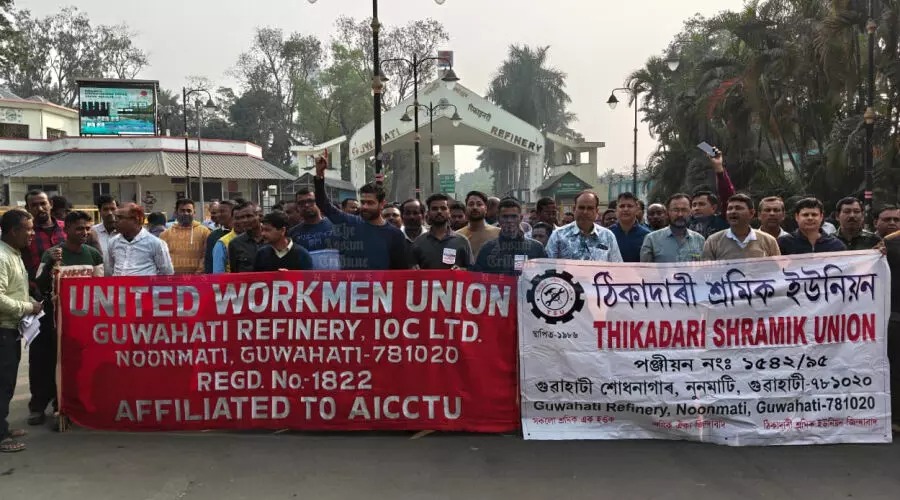
In Guwahati, the entrance to the Guwahati Refinery at Noonmati turned into a protest venue as members of the United Workmen Union and the Thikadari Shramik Union staged demonstrations demanding the withdrawal of the labour codes. Workers assembled outside the refinery gates, raising slogans and voicing concerns over what they described as threats to job security and labour rights.
“We want the Central government to scrap the labour codes. If these codes are implemented, workers will lose job security and be deprived of their rights,” said Girish Kalita, General Secretary of the United Workmen Union, while addressing the gathering.
The strike had a cascading effect on daily life in the city. Public transport services were severely curtailed, with only a limited number of electric buses operating on select routes. Many commuters were left stranded at bus stops as regular services remained off the roads.

At Mathgharia, residents expressed frustration over the disruption. “We didn’t realise the bandh would affect transport services like this. I have to drop my child at school, and now there is no public transport available. The schools should have remained closed today,” said a mother waiting for a bus.
Commercial activity in several parts of the city was subdued, with fewer vehicles plying and some establishments keeping shutters down as a precautionary measure.
In Upper Assam, a similar scene unfolded in Digboi, where hundreds of workers from the Digboi Refinery gathered outside the refinery premises to join the protest. Demonstrators warned that the agitation could intensify if their demands were not addressed by the Centre.
“This protest is to make it clear that we will not remain silent. The labour codes the government wants to implement will deprive workers of their rights. Today, workers have stopped their work to show their support,” said Nagen Chutia, General Secretary of the Petroleum and Gas Workers Federation of India in Digboi.
Chutia added that further agitation was likely if the government did not reconsider the reforms. “The government is trying to turn industries into private enterprises and has consistently ignored the concerns of common people,” he alleged.
The strike call has been backed by major trade unions, including the Indian National Trade Union Congress (INTUC), All India Trade Union Congress (AITUC), Hind Mazdoor Sabha (HMS), Centre of Indian Trade Unions (CITU), All India United Trade Union Centre (AIUTUC), Trade Union Coordination Centre (TUCC), Self-Employed Women’s Association (SEWA), All India Central Council of Trade Unions (AICCTU), Labour Progressive Federation (LPF) and United Trade Union Congress (UTUC).

The Samyukta Kisan Morcha (SKM) has also extended support to the bandh, with several farmer bodies expressing solidarity with the workers’ demands.
The protest has been organised against the four labour codes – on wages, industrial relations, social security and occupational safety – which subsumed 29 existing central labour laws into a consolidated framework. Trade unions argue that the new codes dilute long-standing safeguards relating to job security, social protection and collective bargaining rights.
Among the key demands raised during the bandh are the withdrawal of the four labour codes, restoration of the Mahatma Gandhi National Rural Employment Guarantee Act (MGNREGA) provisions as originally envisaged, and a rollback of policies that unions claim undermine civil services and public sector institutions.
While there were no immediate reports of major law-and-order incidents in Assam, the strike underscored the continuing tensions between organised labour groups and the Centre over labour reforms. With union leaders warning of intensified agitation, the coming days may see further mobilisation if talks between stakeholders fail to yield a breakthrough.