

“His life was a lesson in patriotism and nation-building. – It is our duty to carry forward that lesson,”
 KRC TIMES Barak Valley Bureau
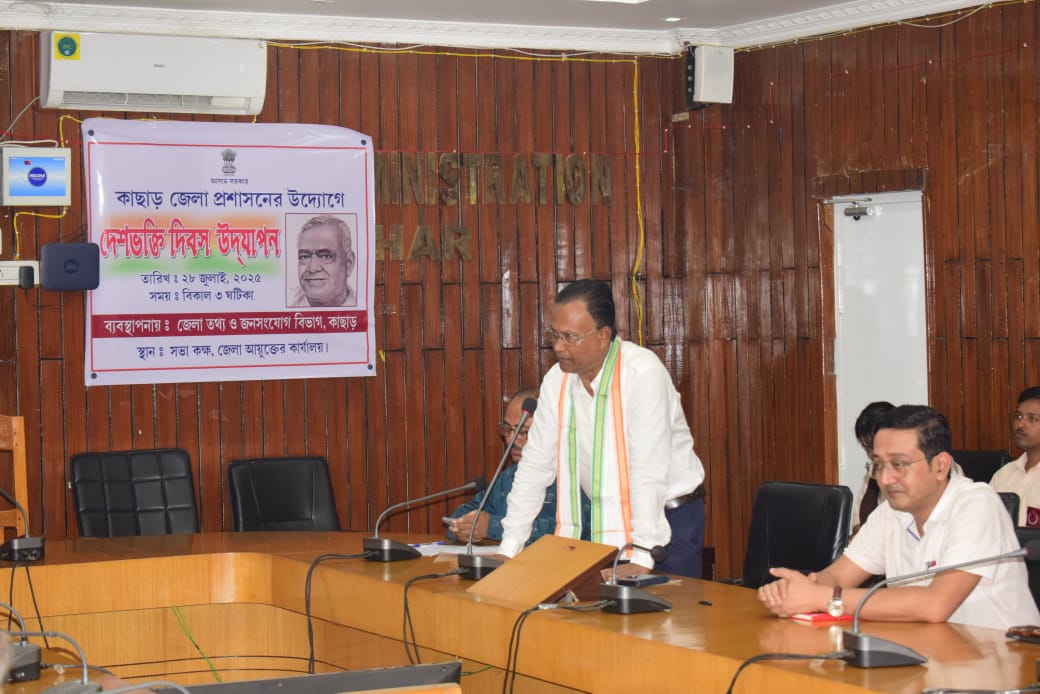
Silchar: The Cachar District Administration, in association with the Regional Office of Information and Public Relations, Barak Valley Zone, Silchar, observed Deshbhakta Tarun Ram Phukan Divas on Monday with profound solemnity and patriotic spirit, commemorating the 86th death anniversary of one of Assam’s foremost freedom fighters and intellectuals.
The day began with a floral tribute at the office of the District Commissioner, where DC Mridul Yadav, along with senior officials, paid homage to Tarun Ram Phukan’s portrait. The gathering of officers and staff observed a moment of silence, creating an atmosphere of reflection and national pride.
Addressing the gathering, DC Yadav described Tarun Ram Phukan as “a symbol of truth, sacrifice, and fearless leadership,” and urged the youth to draw inspiration from his life dedicated to India’s freedom and social reform.
A district-level programme followed at the DC’s Conference Hall, jointly organised by the Deputy Director of Information and Public Relations (DDIPR), Barak Valley Zone. Additional Deputy Commissioner Hemanga Nobis, welcomed the dignitaries and highlighted Phukan’s enduring impact on Assam’s sociopolitical and cultural landscape. “His legacy is a guiding light for generations to come,” Nobis remarked.
Assistant Commissioner and In-Charge of DDIPR, Deepa Das, spoke on the importance of commemorating such historical figures. “Deshbhakta Divas is a moment to reconnect with our roots and uphold the ideals of service and patriotism that Tarun Ram Phukan stood for,” she said.
The keynote address was delivered by Dr. Ashraf Hussain, Head of Assamese Literature at G.C. College, who presented a nuanced portrayal of Phukan’s multifaceted persona—as a political leader, spiritual poet, and cultural reformist. He emphasised Phukan’s literary contributions, especially his devotional verses penned during imprisonment, which he described as “a poetic embodiment of resistance and inner strength.”
Dr. Hussain also noted Phukan’s pivotal role in the 1926 Indian National Congress Session held in Pandu, Guwahati, marking Assam’s prominent entry into the national freedom movement discourse.
Adding further historical and emotional resonance, renowned writer and columnist Dipankar Ghosh spoke passionately about Phukan’s time in Silchar Jail in 1921, during which he composed devotional poems later compiled in Stutimala. Ghosh proposed installing a memorial bust of Phukan outside the Silchar Central Jail to honour both his incarceration and his literary contributions. “Such a gesture would keep alive the memory of a man who turned captivity into creativity,” he stated.
Senior advocate and Bar Association member Panchami Nath offered a legal lens on Phukan’s life, hailing him as “a jurist of integrity and moral vision.” She reflected on his career—from the Chief Court in Shillong to the Assam Legislative Council—and called upon legal professionals and public servants to follow his principles of justice and service. “He used the law not as a weapon of privilege, but as a means to uplift the oppressed,” she said.
Speaking on behalf of the educational community, Suparna Sinha, Principal of Tarun Ram Phukan H.S. School, emphasised the importance of transmitting Phukan’s ideals to the next generation. “His life was a lesson in patriotism and nation-building. It is our duty to carry forward that lesson,” she noted with heartfelt gratitude to the organisers.
Among other notable attendees were Assistant Commissioner and DSWO Anjali Kumari, Dr. Apratim Nag, Principal of Cachar College; Dr. Santanu Das, Vice Principal of Women’s College, Silchar; and Dr. Bidhan Barman, Assistant Professor of Political Science, Radhamadhab College. The gathering concluded with a reflective discussion on Phukan’s relevance in contemporary times.
The event, seamlessly coordinated by the District Administration and the DDIPR Barak Valley Zone, was not just a commemoration but a reaffirmation of the commitment to honour and uphold the legacy of visionary leaders like Tarun Ram Phukan—whose words, values, and vision continue to resonate across generations.

Know More – Apply Here