


The protesters have sought the intervention of the Dima Hasao district administration and police authorities to ensure immediate settlement of compensation claims
 KRC TIMES Dima Hasao Bureau
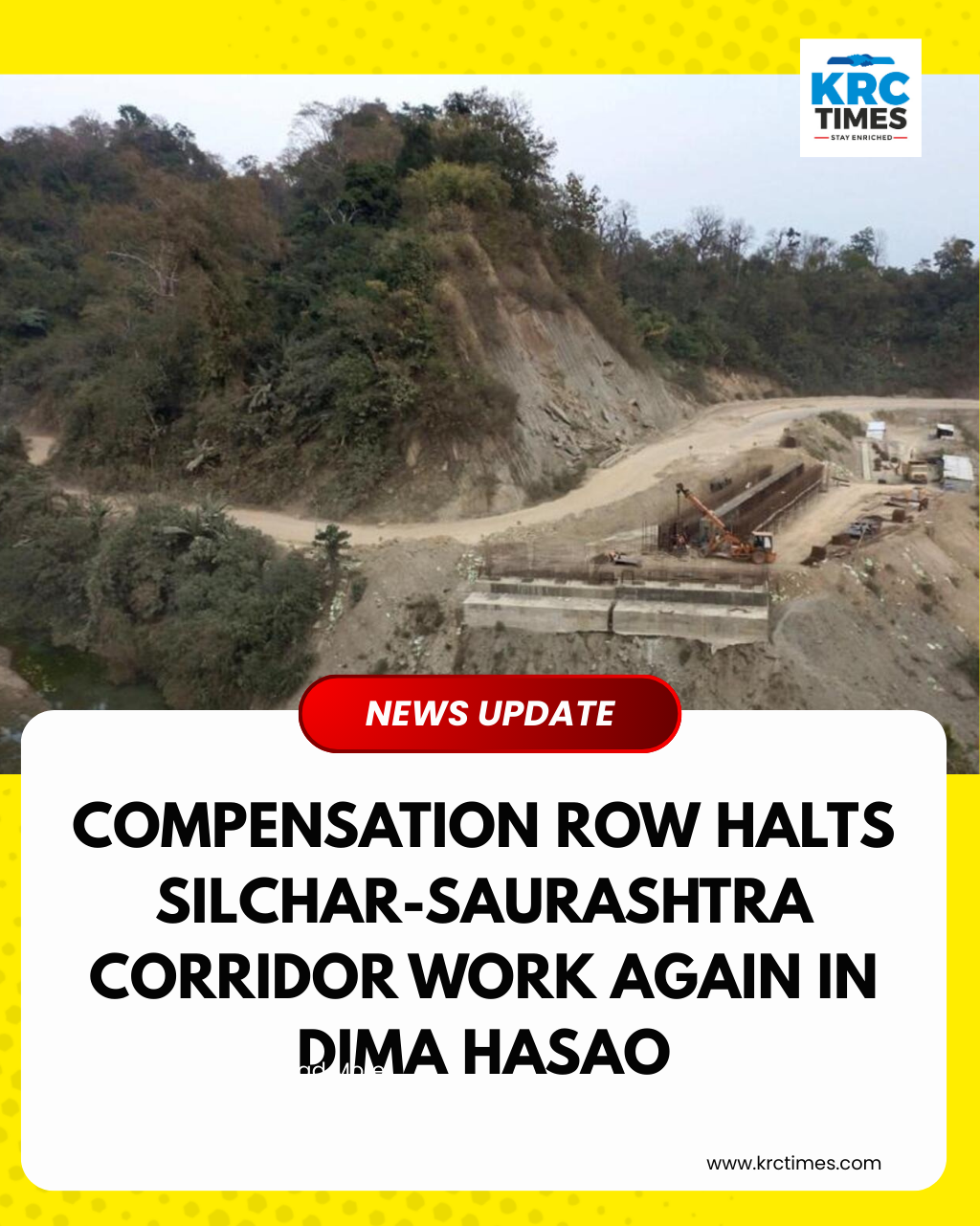
Haflong : Construction of the long-delayed Silchar-Saurashtra East-West Corridor has once again ground to a halt after residents of Dolai Chunga village in Assam’s Dima Hasao district stopped work on the four-lane National Highway, alleging non-payment of compensation for land and property losses.
The fresh disruption comes days after a major structural setback along the project. On the night of February 22, an under-construction flyover collapsed at Dolai Chunga on the Harangajao-Jatinga stretch, further compounding delays in a highway project that has struggled to stay on schedule since it was first taken up in 2004.
The Silchar-Saurashtra four-lane highway is part of the larger East-West Corridor initiative aimed at strengthening road connectivity between the Northeast and western India. Despite its strategic importance, the project has remained incomplete for over two decades, hampered by technical challenges, difficult terrain, administrative bottlenecks and periodic local opposition.

With Assembly elections drawing near in Assam, construction activity along key stretches had recently gathered pace following the intervention of Chief Minister Himanta Biswa Sarma, who pushed for expediting the work and opening crucial segments ahead of the polls.
However, from Wednesday, aggrieved residents of Dolai Chunga brought all construction activity in their area to a standstill, insisting that no further work would be allowed until compensation dues are cleared.
According to villagers, a joint survey was conducted on November 26, 2025, to assess damage to homes, landholdings and plantations belonging to 50 affected families. Officials from the National Highways Authority of India (NHAI), the Dima Hasao Land Revenue Department, the Public Works Department under the North Cachar Hills Autonomous Council, and representatives of the Agriculture and Forest Departments were part of the assessment exercise.
Following the survey, compensation bills were reportedly prepared and forwarded to the Silchar Project Implementation Unit (PIU) of NHAI. However, residents allege that no payments have been disbursed so far.
An affected villager said additional land was acquired for widening the highway, leading to the demolition of several houses and the destruction of betel nut plantations and fruit orchards. For many families, these plantations were the sole source of livelihood.
Villagers further claimed that State Ministers Kaushik Rai and Nandita Garlosa, during a visit to the site on January 31 ahead of a proposed inauguration of the highway stretch, had urged residents not to obstruct the project and assured them that compensation would be released at the earliest. They were also reportedly asked to vacate three houses to facilitate completion of the stretch.
Despite these assurances, the affected families allege that their files remain pending at the NHAI office in Silchar and that no financial relief has reached them. Some villagers contend that with elections approaching, the issue was handled with political expediency rather than administrative urgency.
“We will not allow construction to resume until our compensation is released,” protesting residents said, maintaining that there would be no compromise on the matter.
The economic fallout has been severe, villagers said. The loss of betel nut groves and fruit orchards has cut off regular income, pushing several households into financial distress.
The protesters have sought the intervention of the Dima Hasao district administration and police authorities to ensure immediate settlement of compensation claims. They urged the authorities to resolve the impasse at the earliest to restore public confidence in the implementation of the long-pending highway project.