


More than 200 involved floods and landslides,” Prof. Oinam
 Biswadeep Gupta
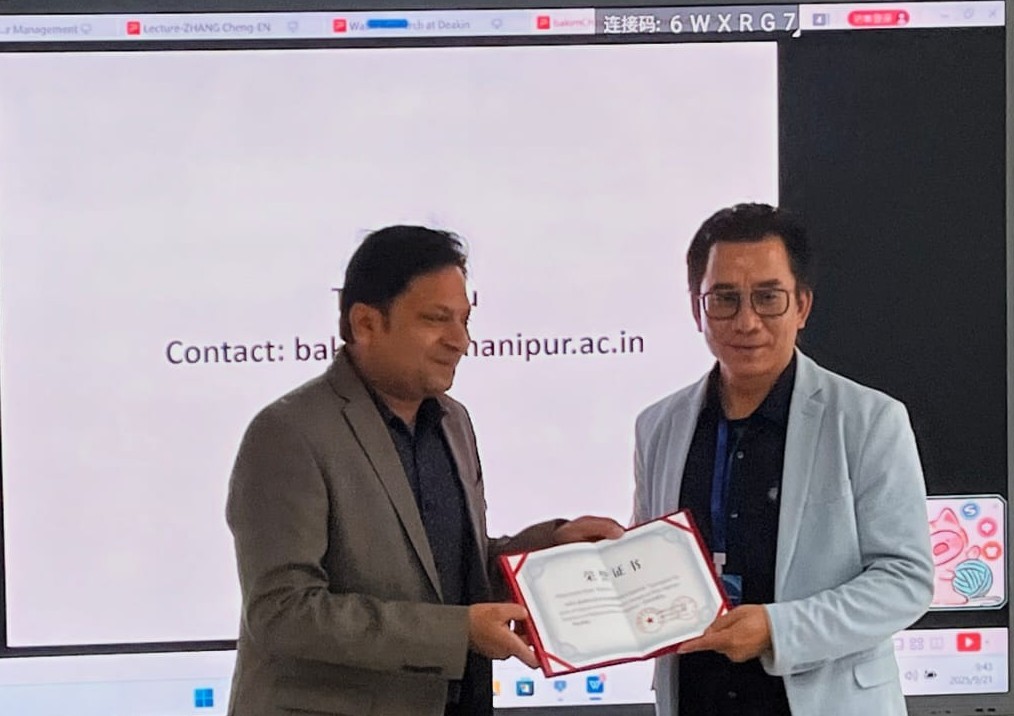
Imphal : At the Eighth Conference on Urban Water Security and Management held in NUIST, Nanjing, China on 19-21 September 2025, experts emphasized the mounting challenges posed by natural and anthropogenic changes on global flow regimes.
Prof. (Dr.-Ing.) Bakimchandra Oinam from the Department of Civil Engineering, National Institute of Technology (NIT) Manipur, delivered a session titled “Synergistic Impacts of Natural and Anthropogenic Changes on Flow Regimes: Emphasis on Floods and Their Mitigation.” He highlighted how India’s flood vulnerability is shaped by the southwest monsoon, glacial lake outburst floods (GLOFs), rapid land use change, and inadequate urban drainage.

“India recorded 314 extreme weather days in 2022, of which more than 200 involved floods and landslides,” Prof. Oinam noted. “The Imphal Valley and Brahmaputra basin remain particularly at risk, with increasing flood frequency and intensity under projected climate scenarios.”
The study presented by Prof. Oinam, based on CMIP6 climate models, indicated a 31–37% rise in streamflow by the 2050s and 2090sin north-eastern catchments such as Loktak Lake. This trend, he cautioned, could overwhelm water systems, trigger landslides, and endanger wetland ecosystems.
The session also discussed existing frameworks like the National Disaster Management Authority’s guidelines, AMRUT, and Water Sensitive Urban Design (WSUDP). While these provide a policy backbone, Prof. Oinam stressed the need for “effective implementation, robust monitoring, and community participation” to build climate resilience.
The conference brought together global experts to deliberate on securing water systems in a rapidly urbanizing and warming world.