

These announcements follow those made in May 2024 by Spain, Ireland and Norway, three of the other European signatories
 KRC TIMES Desk
TELAVIV : A new vision for Middle East peace emerged this week which proposes the withdrawal of Israel from Gaza and the West Bank, the disarming and disbanding of Hamas and the creation of a unified Palestinian state.
The plan emerged from a “high-level conference” in New York on July 29, which assembled representatives of 17 states, the European Union and the Arab League. The resulting proposal is “a comprehensive and actionable framework for the implementation of the two-state solution and the achievement of peace and security for all.”
Signatories include Turkey and the Middle Eastern states of Saudi Arabia, Qatar, Egypt and Jordan. Europe was represented by France, Ireland, Italy, Norway, Spain and the UK. Indonesia was there for Asia, Senegal for Africa, and Brazil, Canada and Mexico for the Americas. Neither the US nor Israel were present.
Significantly, it is the first time the Arab states have called for Hamas to disarm and disband. But, while condemning Hamas’s attack on Israel of October 7, 2023, and recalling that the taking of hostages is a violation of international law, the document is unsparing in its connection between a state of Palestine and an end to Israel’s assault on Gaza’s civilians.
It says: “Absent decisive measures toward the two-state solution and robust international guarantees, the conflict will deepen and regional peace will remain elusive.”
A plan for the reconstruction of Gaza will be developed by the Arab states and the Organisation of Islamic Cooperation – a Jeddah-based group which aims to be the collective voice of the Muslim world – supported by an international fund. The details will be hammered out at a Gaza Reconstruction and Recovery Conference, to be held in Cairo.
It is a bold initiative. In theory, it could end the Israeli mass killing in Gaza, remove Hamas from power and begin the implementation of a process for a state of Palestine. The question is whether it has any chance of success.
First, there appears to be growing momentum to press ahead with recognition of the state of Palestine as part of a comprehensive peace plan leading to a two-state solution. France, the UK and, most recently, Canada have announced they would take that step at the UN general assembly in September. The UK stated that it would do so unless Israel agreed to a ceasefire and the commencement of a substantive peace process.
These announcements follow those made in May 2024 by Spain, Ireland and Norway, three of the other European signatories. By the end of September at least 150 of the UN’s 193 members will recognise Palestinian statehood. Recognition is largely symbolic without a ceasefire and Israeli withdrawal from both Gaza and the West Bank. But it is essential symbolism.
For years, many European countries, Canada, Australia and the US have said that recognition could not be declared if there was the prospect of Israel-Palestine negotiations. Now the sequence is reversed: recognition is necessary as pressure for a ceasefire and the necessary talks to ensure the security of both Israelis and Palestinians.
Israel accelerated that reversal at the start of March, when it rejected the scheduled move to phase two of the six-week ceasefire negotiated with the help of the US, and imposed a blockade on aid coming into the Strip.
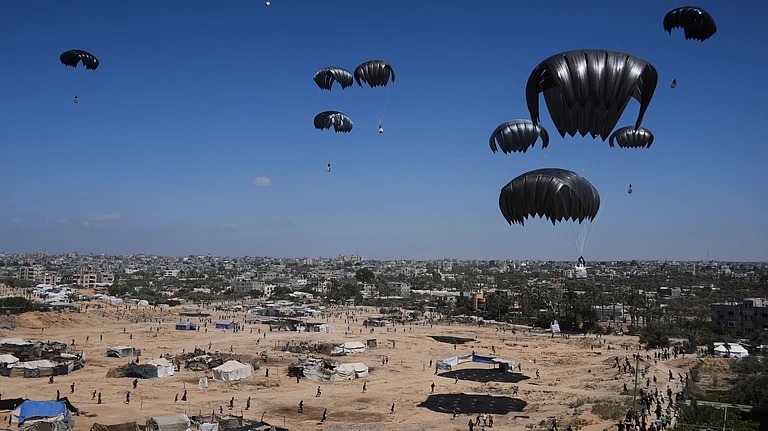
The Netanyahu government continues to hold out against the ceasefire. But its loud blame of Hamas is becoming harder to accept. The images of the starvation in Gaza and warnings by doctors, humanitarian organisations and the UN of an effective famine with the deaths of thousands can no longer be denied.
Saudi Arabia and Qatar, behind the scenes and through their embassies, have been encouraging European countries to make the jump to recognition. Their efforts at the UN conference in New York this week are another front of that campaign.
But in the short term, there is little prospect of the Netanyahu government giving way with its mass killing, let alone entering talks for two states. Notably, neither Israel nor the US took part in the conference.
Promotional | Subscribe KRC TIMES e-copy