

According to the prosecution, Haokip faces charges under Section 13 of the UAPA for alleged unlawful activities
 KRC TIMES Manipur Bureau
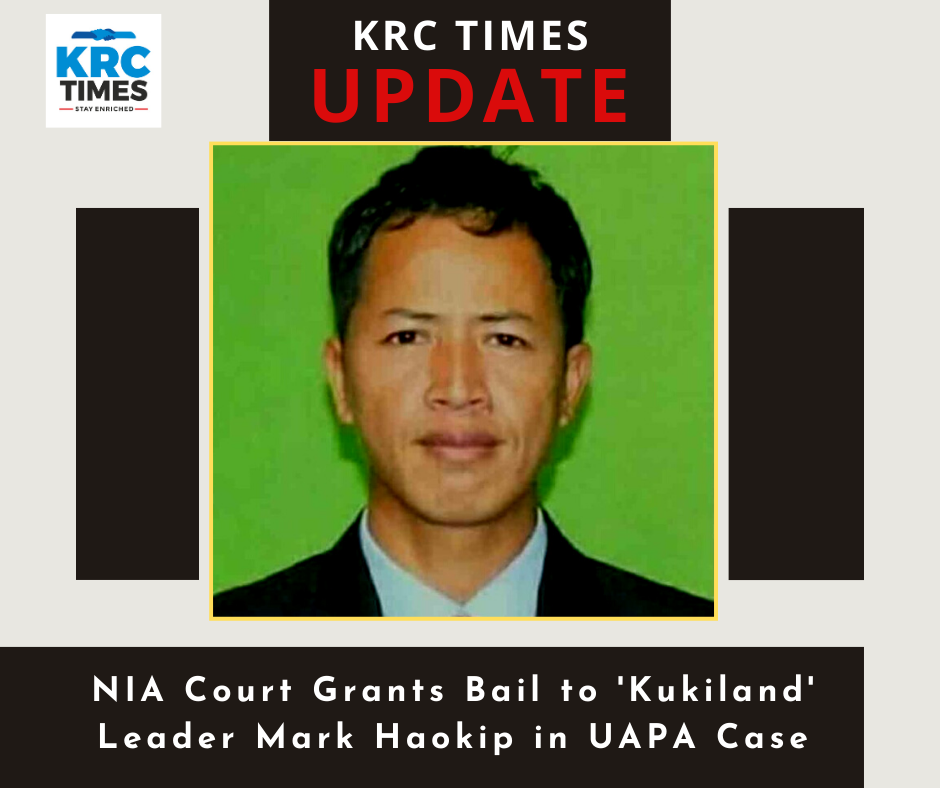
Imphal : The Special Court of the National Investigation Agency (NIA) in Manipur’s Imphal West district has granted bail to Mark Thangmang Haokip, the president of the self-proclaimed “Government of People’s Democratic Republic of Kukiland,” in a case registered under the Unlawful Activities (Prevention) Act (UAPA) along with several sections of the Indian Penal Code.
The order was issued by the Special Judge of the NIA court in Imphal West on February 27, 2026. Haokip was released on bail after furnishing two sureties of Rs 3,00,000 each along with a personal bond of Rs 3,00,000. The court has directed him to appear through video conferencing on March 10, 2026 for further proceedings in the case.
The court’s decision came after charges were formally framed against Haokip on February 2, 2026. The 40-year-old, a resident of Molnom village in Churachandpur district and son of Limkhosei Haokip, has been accused of involvement in activities linked to a conspiracy aimed at secession from India and attempts to wage war against the Union government.
According to the prosecution, Haokip faces charges under Section 13 of the UAPA for alleged unlawful activities. Investigators claim that he played a key role in spreading propaganda and mobilising support for a separate political entity referred to as the “Democratic Republic of Kukiland.”
Haokip was arrested on May 30, 2022, in Kishangarh, New Delhi. Authorities alleged that he had been actively using social media platforms to disseminate propaganda that could fuel instability and incite communal tensions in Manipur. The charge sheet submitted in the case states that his online activities allegedly promoted communal animosity and attempted to aggravate tensions between the Meitei and Kuki communities in the state.

Investigators also claimed that a diary recovered from Haokip during the investigation contained references to plans for establishing a sovereign entity called “Kukiland.” According to the charge sheet, the proposed territory was said to include certain areas spanning across India, Myanmar (formerly Burma), and Bangladesh.
The NIA further alleged that Haokip had formed a group that maintained an online platform – www.kukigovt.com – to promote the idea of the proposed republic and to propagate views considered hostile to the sovereignty and integrity of India.
Authorities argued that such activities were part of a broader conspiracy against the Union government. The prosecution maintained that the accused’s actions contributed to escalating communal tensions at a sensitive time in Manipur’s already fragile ethnic landscape.
Meanwhile, media platforms associated with the Kukiland movement presented a contrasting narrative. According to reports circulated by Kukiland Media, Haokip has long advocated for justice and political recognition for the Kuki community. His supporters contend that he had raised concerns regarding the rights and security of the Kuki population well before the outbreak of large-scale ethnic unrest in Manipur.
They also alleged that Haokip was unfairly targeted and that his prolonged incarceration since 2022 amounted to an unjust detention. Supporters argue that his activism was aimed at addressing perceived grievances of the Kuki community rather than promoting violence or secession.
The granting of bail has triggered mixed reactions across the region. While some groups have welcomed the court’s decision as a step toward justice and due process, others have expressed concern over the implications of releasing an individual accused of promoting separatist ideas.
The case continues to draw attention amid the broader context of ethnic tensions in Manipur, where relations between the Meitei and Kuki communities have remained strained in recent years. Observers note that developments in the trial may have wider political and social implications for the state.
Haokip’s next appearance in the NIA court is scheduled for March 10, when he will join the proceedings through video conferencing as directed by the court. The trial in the case is expected to continue as the prosecution and defence present their arguments.