

A Feast of Love and Lineage
 KRC TIMES Manipur Bureau
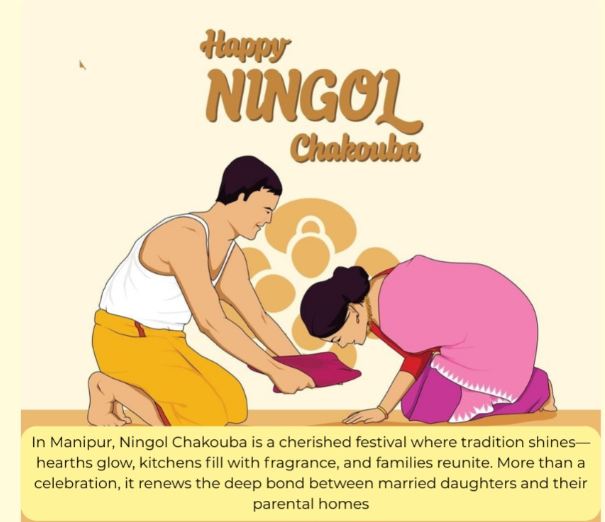
IMPHAL : In the heart of Manipur, where tradition still holds sway over modern haste, there comes each year a day when hearths glow brighter, kitchens brim with fragrance, and laughter fills the courtyards—the day of Ningol Chakouba.
It is more than a festival; it is the very soul of Meitei familial life, a celebration of kinship that binds married daughters and sisters to their parental homes with warmth deeper than words.
Observed on the second day of the Manipuri lunar month of Hiyangei (October–November), Ningol Chakouba transforms every Meitei household into a place of reunion and remembrance. The word “Ningol” means a woman, while “Chakouba” refers to a grand feast.
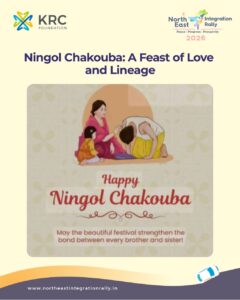
On this day, fathers and brothers invite their married daughters and sisters back home for a sumptuous meal—a symbolic gesture that reaffirms their belonging, even after marriage.
From early morning, homes come alive with cheerful bustle. The male members of the family together prepare an array of traditional delicacies— a variety of fish dishes, vegetable items, scented black rice items, singju or vegetable salads prepared with fermented fish as a core ingredient and of course iromba, the Meitei delicacy.
The menu is more than food; it is affection made edible, a father’s and brother’s quiet way of saying what hearts cannot. The ‘guests’ arrive in their finest phaneks and innaphis, carrying gifts of fruits and sweets. But it is the hosts—the fathers and brothers—who take delight in presenting them with tokens of love: shawls, clothes, or even simple household items. In return the ‘guests’ shower them with blessings.
Though rooted in Meitei culture, Ningol Chakouba transcends religion and ethnicity in today’s Manipur. In Imphal, government departments, schools, and clubs organize community feasts inviting women from different communities, echoing the larger spirit of unity and familial harmony. It is this inclusiveness that lends the festival a timeless appeal, transforming what began as a domestic ritual into a social statement about togetherness.
The festival’s charm lies not in pomp, but in sentiment. In an age where migration and modernity scatter families across distances, Ningol Chakouba becomes a bridge back to one’s roots—a reminder that kinship is not bound by geography. For many, it is a day of tender nostalgia: of returning to one’s childhood home, sitting again at the familiar hearth, and being a daughter once more.
As twilight descends and the guests depart, the courtyards fall silent, yet hearts remain full. Ningol Chakouba endures not merely as a festival, but as a reaffirmation of love, lineage, and the enduring sanctity of family—the living thread that continues to weave the cultural fabric of the Meiteis of Manipur.
Promotional | North East Integration Rally