

10,860-Crore Annual Strain on Assam’s Finances: State Finance Commission
 KRC TIMES Assam Bureau
GUWAHATI : The Seventh Assam State Finance Commission has cautioned that two flagship welfare initiatives of the state government – Orunodoi and the National Food Security Act (NFSA) – could exert significant pressure on Assam’s finances, particularly amid a declining share of Central tax devolution.
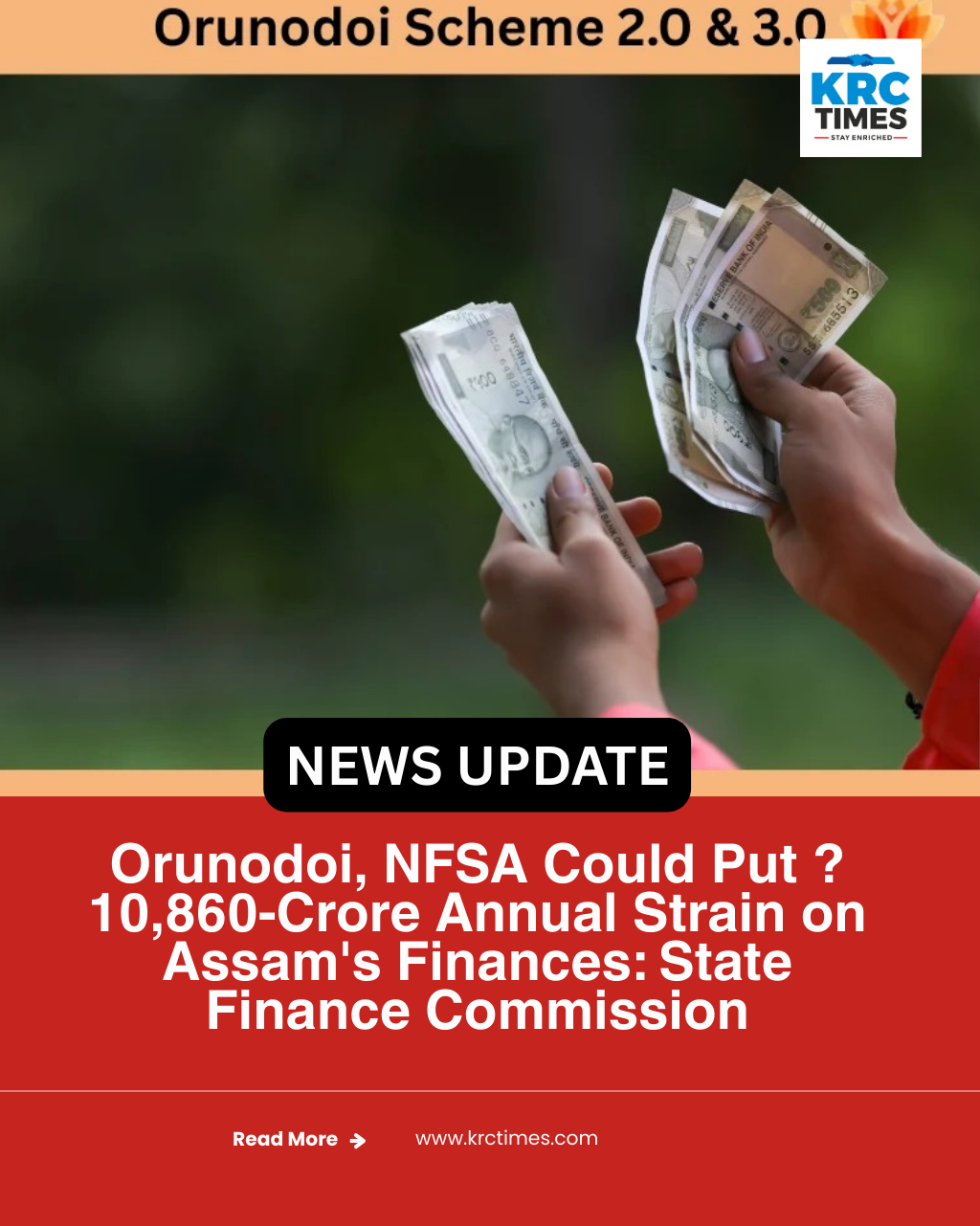
In its latest report, the Commission warned that the combined annual financial burden of the two schemes could reach ?10,860 crore, raising concerns about long-term fiscal sustainability.
The third edition of the Orunodoi scheme is expected to cover 37.2 lakh beneficiaries, with each receiving ?1,250 per month. According to the Commission’s assessment, this translates into an annual outgo of ?5,580 crore.
While acknowledging that the schemes are “laudable” and designed to support vulnerable sections, the panel expressed concern over funding modalities. “The schemes are no doubt laudable, albeit they touch a small segment of the needy population. More importantly, such a huge outgo annually will have disastrous effect on State finances since Government of Assam is silent about the modalities of funding it,” the report noted.

Under the NFSA, the Government of Assam proposes to issue ration cards to 19,92,167 beneficiaries, entitling them to free food grains every month. These cardholders would also be eligible for free treatment under the Ayushman Bharat scheme.
The Commission pegged the annual financial implication of the NFSA initiative at ?5,280 crore – approximately ?440 crore per month. It further observed that the state plans to integrate the Orunodoi scheme with the ration card programme, taking the combined annual financial impact to a substantial ?10,860 crore.
The report also highlighted a structural issue affecting Assam’s fiscal position – the gradual decline in its percentage share of the divisible pool of Central taxes as recommended by successive Central Finance Commissions.
Assam’s share has fallen from 4.12 per cent in the first report of the IX Finance Commission to 3.128 per cent in the second report of the XV Finance Commission. The Commission said this steady reduction has adversely affected the flow of funds from the Centre.
“For instance, a drop of mere 0.1 per cent in the percentage share entails revenue sacrifice of about ?758 crore,” the report stated, underlining the magnitude of the impact. The Commission’s observations come at a time when the state government continues to expand welfare coverage while also committing resources to infrastructure and development projects.
The report suggests that without clearly articulated funding mechanisms and prudent fiscal management, the cumulative burden of large-scale welfare schemes – combined with shrinking Central transfers – could strain Assam’s financial stability in the coming years.