

The Governor said Sanskrit carries wisdom, humanity and the idea of liberation
 KRC TIMES Assam Bureau
Guwahati: Assam Governor Lakshman Prasad Acharya on Monday said Sanskrit is not just a language of the past but a language meant for the future. He stressed the need to link Sanskrit with modern subjects and interdisciplinary studies so that it stays alive in today’s academic world.
Speaking at the Acharya Jogiraj Basu Memorial Lecture at Gauhati University, the Governor said Sanskrit carries wisdom, humanity and the idea of liberation. He said it should not remain limited to textbooks or traditional classrooms. He urged students and scholars to see Sanskrit as a living knowledge system that can guide present-day thinking, ethics and research.
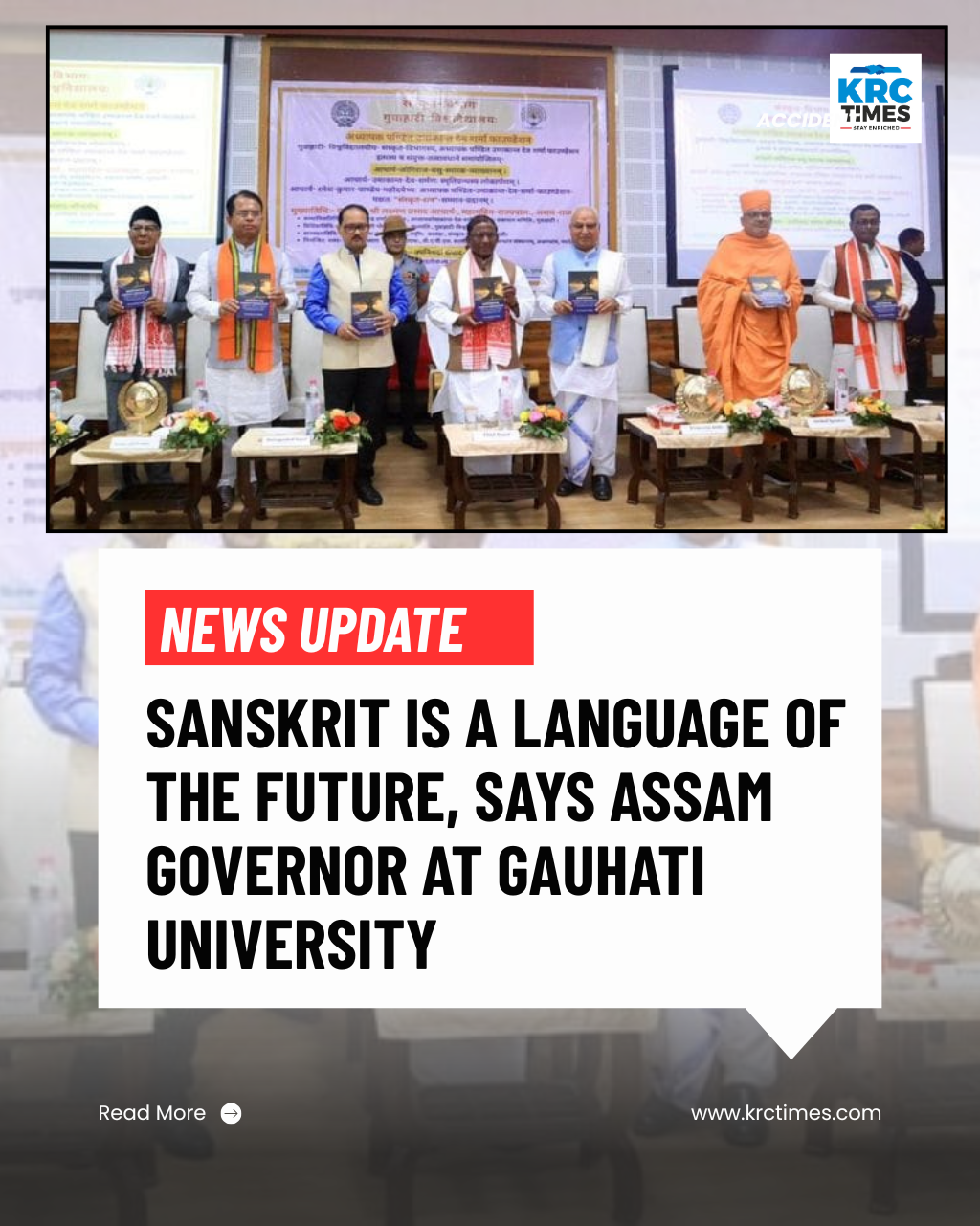
The programme was organised by the Department of Sanskrit, Gauhati University, along with the Professor Umakanta Deva Sharma Foundation. It was held at the Phanidhar Datta Seminar Hall. The Governor attended as the Chief Guest, while Vice Chancellor Prof. Nani Gopal Mahanta was present as a Distinguished Guest.

Addressing the gathering, Prof. Mahanta spoke on key Upanishadic ideas such as Brahman, Maya and Jiva. He explained how these concepts explore the gap between the self and ultimate reality. He also spoke about the traditional learning process of shravana, manana and nididhyasana, calling it a clear path from doubt to understanding. He said these methods are still useful in modern education.
The memorial lecture was delivered by Mahamahopadhyaya Bhadreshdas Swami of the BAPS Swaminarayan Research Institute, New Delhi. He spoke on “The Aesthetic Beauty of Upanishadic Dialogue.”
On the occasion, Prof. Ramesh Kumar Pandey, National President of Sanskrit Bharati, was honoured with the “Sanskrit Ratna” award for his contribution to the promotion of Sanskrit. Prof. Kameshwar Shukla, Head of the Department of Sanskrit, spoke on Prof. Pandey’s work and delivered the vote of thanks.
The event also marked the release of the Acharya Umakanta Deva Sharma Commemoration Volume, edited by Prof. Kameshwar Shukla. Scholars, teachers, researchers and students attended the programme, which highlighted the lasting value of Upanishadic thought in today’s education system.