The sessions were also audited by research scholars, who highlighted key takeaways for the youth
 Biswadeep Gupta
Imphal : On July 10-11, 2025, the U.S. Consulate General Kolkata, in partnership with the Observer Research Foundation (ORF), hosted a virtual Manipur Chapter of the ongoing U.S. government-funded grant project, the “U.S. Strategic Framework for the Indo-Pacific: Northeastern Dialogue.”
This dialogue part of an 18-month project aims to build understanding of the U.S. Indo-Pacific strategy and explore avenues for advancing trade, connectivity, and economic growth through the U.S.-India partnership under President Trump’s administration. Previous chapters were held in Meghalaya, Assam, and Sikkim.
The project aims to discuss policies and advance the U.S. Strategic Framework for the Indo-Pacific in India’s Northeast, and underscore its role in developing trade, connectivity, and economic prosperity in the region through U.S.-India cooperation.
The Manipur Chapter convened 37 stakeholders from across the Northeast and India. They hailed from different sectors, including government, businesses, civil society, NGOs, media, academia, and policy research. The inaugural session was attended by several dignitaries.
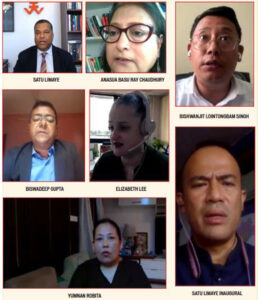
In his welcome address, Nilanjan Ghosh, Vice President, Development Studies, and Director of ORF Kolkata, and Project Director USSFIP Northeastern Dialogue, highlighted, “This Dialogue is part of a larger effort to better understand and unlock the role of the Northeast in India’s Indo-Pacific vision.
At a time when the world is looking eastward for economic partnerships and strategic convergence, this region is not a peripheral space. It is central to India’s connectivity aspirations, to cross-border trade, and to regional cooperation.”
Underscoring the United States’ enduring commitment to a free and open Indo-Pacific, Elizabeth Lee, Public Affairs Officer of the U.S. Consulate General Kolkata and Director of the American Center, emphasised the importance of infrastructure development, trade, and people-to-people ties.
She said, “Manipur is uniquely positioned for rapid development, and that’s the basis of growth, for a free and open Indo-Pacific. Building strong, sustainable infrastructure is going to be key to unlocking the Indo-Pacific’s full economic potential, and the economic potential here is significant.”
In her special address, Yumnam Robita, Director of Trade, Commerce & Industries, Government of Manipur, underscored the strategic geographical position of Manipur in India’s trade, specifically with Southeast Asian countries, and drew attention to upcoming transnational highways and enhanced connectivity via the Kaladan Multi-Modal Transit Transport Project, once it is functional. Manipur is vital for India’s Act East policy, she said.
Dr. Satu Limaye, Vice President of the East-West Center and Director of the East-West Center, USA, delivered the keynote address and reinforced the U.S. recognition of India as a like-minded partner and a leader in South Asia and the Indian Ocean region. “A driving force of the Quad and other regional forums, Northeast India will play a vital role in promoting connectivity with the wider Southeast Asia region,” he mentioned.
Subsequently, Anasua Basu Ray Chaudhury, Senior Fellow, ORF and Project In-Charge USSFIP Northeastern Dialogue, introduced the project to the delegates and audience. She underlined the importance of enhanced connectivity in Northeast India while noting that the security-development conundrum often hampers progress. She mentioned the importance of a robust and well-connected connectivity network to unlock the region’s potential and set the tone for the following panel discussions.
The two-day event was divided into six panel discussions on trade, physical connectivity infrastructure, digital connectivity, the economic prosperity of Manipur, the importance of small-scale industries in the Northeast, and the geopolitical importance of this region within the Indo-Pacific gamut. The discussions featured several experts from various policy fields. The sessions were also audited by research scholars, who highlighted key takeaways for the youth.
Promotional | Subscribe KRC TIMES e-copy