


Planting Assam’s Bamboo, conceived by KVIC in 2021
 Biswadeep Gupta
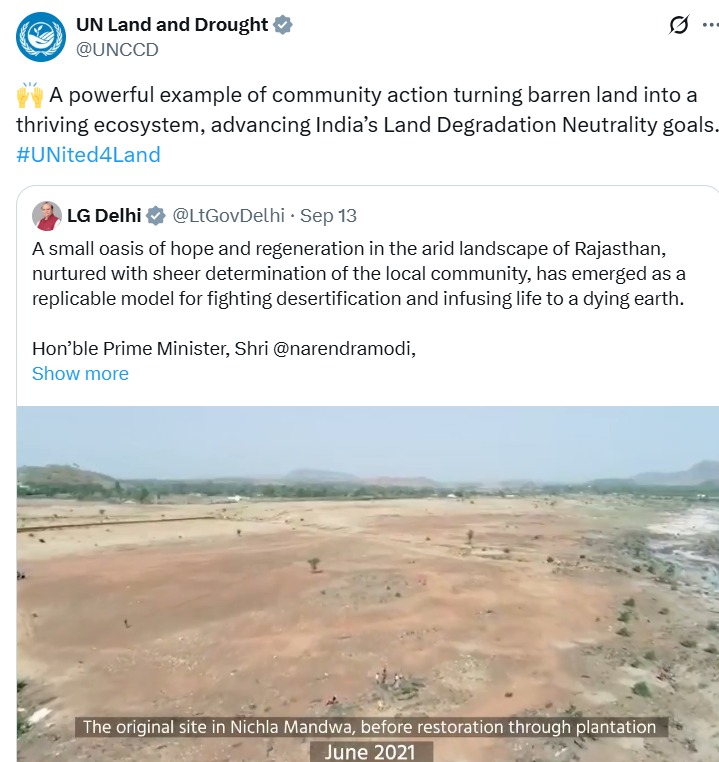
Imphal : Last month, we covered a story of the transformation of arid land in Rajasthan, planting bamboo from Assam. The initiative began in 2021 under the leadership of V K Saxena, Lieutenant Governor, Delhi, who was then the Chairman, Khadi & Village Industries Commission (KVIC), and Prof (Dr) Sukamal Deb was then his Dy. CEO, KVIC, In-charge of the North East Region.
In the age of climate change and global warming, the importance of this innovative work acquire a wider recognition when the United Nations Convention to Combat Desertification (UNCCD) appreciated it in a post on X, terming it “a powerful example of community action turning barren land into a thriving ecosystem, advancing India’s Land Degradation Neutrality goals”, (@UNCCD) on X, https://x.com/UNCCD/status/1970067035905531950?s=08.
The UNCCD is a United Nations convention aimed at addressing desertification and droughts. It is a legally binding convention linking development and environment to sustainable land management that addresses particularly the arid, semi-arid & dry sub-humid areas, called drylands, where some of the most vulnerable ecosystems and peoples are found.

This project fits well to achieve these objectives, as Nichla Mandwa village in the Udaipur district of Rajasthan is afflicted with one of the most vulnerable ecosystems and is inhabited by people coping with adverse climatic conditions, where villagers offered 25 acres of Gram Sabha land for rejuvenation. This is a classic example of community mobilisation for a cause.
The Convention obliges national governments to take measures to tackle the issue of desertification. The convention’s 2018 – 2030 Strategic Framework is a comprehensive international commitment to attain Land Degradation Neutrality (LDN), focusing on having a bottom-up approach to achieve its goals by involving the local communities. The tweet exemplifies the relevance of the work by terming it as a powerful example of community action.
India ratified the Convention to Combat Desertification, with the nodal ministry for the convention in India being the Ministry of Environment, Forest, and Climate Change, working on the theme, Restore Land, Sustain Future. India is a part of the international effort to bring 350 million hectares of the world’s degraded and deforested land into restoration by 2030.
Saxena, whose brainchild is the project and was executed under his leadership, expresses his immense happiness for the recognition by a United Nations body, saying the credit goes to the committed team, who worked passionately over the phone with Prof. Sukamal Deb on October 2.
The tall and large bamboos flourishing on land, which for decades were considered arid, rekindle hope for humanity to live in an age of sustainable development, as Saxena’s leadership is creating a living example (https://x.com/ltgovdelhi/status/1966822726011961726?s=48).
Promotional | North East Integration Rally