

A Movement of Unity, Cultural Pride, and Rediscovery of Northeast’s Living Heritage
 North East Integration Rally
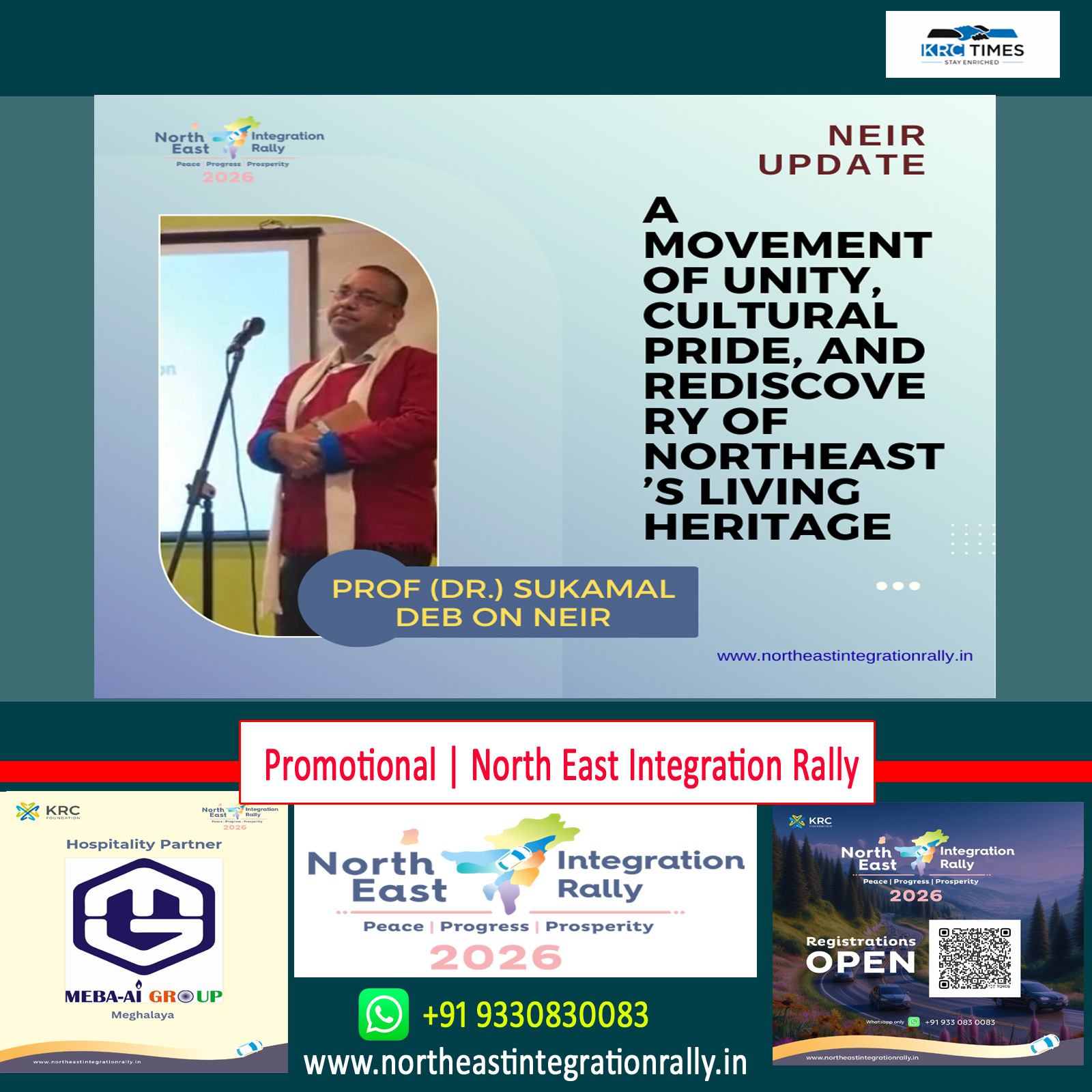
Shillong: At the foothills of Meghalaya, in the quiet greens of Ri-Bhoi district, something remarkable unfolded on October 17. The pre-launch of the North East Integration Rally (NEIR) was not a routine event. It was the first spark of a movement — one that seeks to connect eight states through their shared soul.
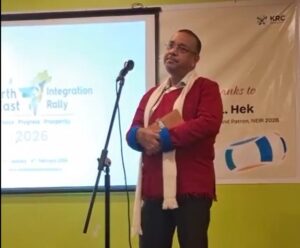
While delivering the keynote speech at the ceremony, Prof. (Dr.) Sukamal Deb, Adviser to the NEIR and Lead of the Project of 40 Languishing Crafts of the Northeast under the KRC Foundation, spoke not as an administrator or academic, but as a believer in the region’s collective destiny.
“The NEIR is not a showpiece,” he said, his words calm yet charged with conviction. “It’s a living movement — a journey to rediscover who we are as people, as communities, and as a civilisation that has thrived in diversity for centuries.”
He is a dedicated advocate for inclusive development, having worked with the government for over three decades on initiatives for the North East Region. Currently, he is affiliated with several universities and serves as the nominee of the Lieutenant Governor of Delhi at the Delhi Skill and Entrepreneurship University, New Delhi.
A Movement Born of Vision
The North East Integration Rally 2026, conceptualised by Biswadeep Gupta, Founder of the KRC Foundation, is envisioned as one of the most ambitious cultural journeys in the region’s history. Over a month, it will travel across all eight Northeastern states — Assam, Arunachal Pradesh, Manipur, Meghalaya, Mizoram, Nagaland, Tripura, and Sikkim — showcasing not only their art and music but the living stories of their people.
For Prof Deb, the NEIR represents more than logistics or performance. “This is not merely a parade of diversity,” he explained. “It’s a reminder that our differences are our strength, and our shared identity is our foundation.”
He credited Biswadeep Gupta for conceiving an initiative that moves beyond token celebration. “Biswadeep’s vision has turned culture into a mission,” Deb said. “He understands that culture is not ornamental — it’s essential. If we ignore it, we lose the root of progress itself.”
The Symbolism of a New Beginning
The NEIR is set to begin in January 2026, deliberately timed with the dawn of a new year. For Prof Deb, that choice carries deep meaning. “Every new year brings hope, but this one should bring confidence,” he said. “Starting the rally at that moment signals a new chapter — one of solidarity, self-belief, and cultural pride.”
Throughout its journey, the rally will host performances, exhibitions, and interactions designed to capture the Northeast’s full range of cultural expression. Yet, as Deb emphasised, it is not spectacle but substance that defines NEIR’s intent.
“The Northeast is too often seen in fragments — each state boxed in, each identity simplified. The NEIR aims to tell the whole story,” he said. “It’s about resilience, coexistence, and the creativity that binds our people together.”
Rediscovering the Forgotten Hands
At the heart of the NEIR lies one of its most compelling undertakings — the Project of 40 Languishing Crafts of the Northeast. Led by Prof Deb himself under the KRC Foundation, the project seeks to identify, document, and revive traditional crafts teetering on the brink of extinction.
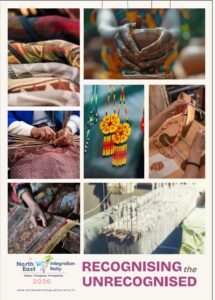
“These crafts are not museum pieces,” he said firmly. “They are living traditions that carry our collective memory. When we revive them, we are not only saving art; we are restoring dignity and livelihood.”
Across villages and valleys, from Nagaland’s bamboo weavers to Tripura’s handloom artists, thousands of artisans continue their work in silence, often unseen by policy or market. Many of their crafts have no digital record, no institutional recognition. NEIR seeks to change that — not with token awards, but with tangible visibility, training, and economic linkage.
The project includes:
- Identifying and documenting artisans across all eight states.
- Honouring master craftsmen with citations, medals, and certificates of excellence.
- Creating visual archives — short films, photography, and written documentation.
- Showcasing crafts during the rally’s journey and in the grand closing ceremony.
- Connecting artisans with designers, researchers, and potential markets.
“It’s not just about preserving something old,” Prof Deb said. “It’s about building something sustainable. If people can earn from their craft, tradition becomes a source of life, not nostalgia.”
Heritage as Livelihood
India’s craft sector employs more than 11 million artisans, second only to agriculture. In the Northeast, it holds unmatched potential for sustainable development, especially among rural women.
Prof Deb sees the NEIR as a platform that unites culture and economy — where preservation meets production. The KRC Foundation also plans to work with the World Crafts Council (WCC-AISBL) to secure World Craft City status for one Northeastern capital, bringing it on par with Srinagar, Jaipur, Mamallapuram, and Mysuru.
“This recognition isn’t just a badge,” he explained. “It’s a way to place the Northeast on the global craft map, where it has always belonged.”
At the end of the rally, the Award of Excellence Ceremony will honour outstanding artisans whose craftsmanship embodies the spirit of the region — innovation grounded in authenticity.
Why the Northeast Matters — and Must Be Heard
Stretching across 4,500 kilometres of international borders and home to over 160 Scheduled Tribes and 220 ethnic groups, the Northeast is both India’s frontier and its cultural reservoir. Yet, as Deb reminded the audience, isolation began long before modern politics — when British trade routes with Bhutan, Myanmar, and China were severed, cutting the region off from its historical lifelines.
Today, the Northeast connects to mainland India through the narrow Siliguri Corridor, just 22 kilometres wide. Despite its immense biodiversity and cultural wealth, the region remains economically fragile. Agriculture is constrained by terrain and inputs; industrialisation is slow; and most states depend heavily on central grants.
“The way forward,” Deb argued, “isn’t only through infrastructure or policy. It’s through people — through culture and community-based institutions that can rebuild from within.”
A Lifelong Mission
Prof Deb’s words carry weight because they are backed by decades of ground experience. He has worked in nearly 3,000 villages across the Northeast’s 44,544 settlements, helping artisans, youth, and local communities build self-reliant systems of livelihood.
“Peace cannot be built on speeches,” he said. “It grows from work, income, and dignity.”
Globally, 650 million people live in extreme poverty, including 7% of India’s population. For Deb, empowerment means giving people the tools to create — not wait for help. His approach blends sustainability with participation: community-based development rooted in cultural awareness.
“The NEIR embodies everything I believe in,” he said. “Work that uplifts. Culture that connects. Identity that unites.”
From Movement to Mindset
As preparations gather pace, anticipation is rising across the Northeast. Cultural bodies, universities, and local institutions are aligning with the rally’s goals. Artists, musicians, and craft cooperatives are preparing to join the month-long journey.
But for Prof Deb, the true success of NEIR will not be in numbers or media coverage. “If one young person sees the Northeast differently — as whole, proud, and creative — then the movement has already begun,” he said.
In his closing words, he called the NEIR “a call to move — not just across borders, but across minds and hearts.”
“The Northeast’s greatest strength has always been its unity in diversity,” he added. “This rally will make that truth visible, mile after mile.”
The Road Ahead
The North East Integration Rally 2026 is not simply a cultural expedition. It’s a statement of intent — that the Northeast will define its future through its own voice, its own crafts, and its own people.
In doing so, it aims to revive what has always set the region apart: its ability to weave diversity into harmony and heritage into hope.
As the rally’s motto says, “Reviving Heritage, Empowering Artisans, Reclaiming the Cultural Soul of the Northeast.”
If the movement succeeds, it won’t just connect eight states; it will reconnect a region with itself — and in that rediscovery, the Northeast may finally find the recognition it has long deserved.