

A Tale of Kamala Devi’s Unswerving Efforts
 North East Integration Rally
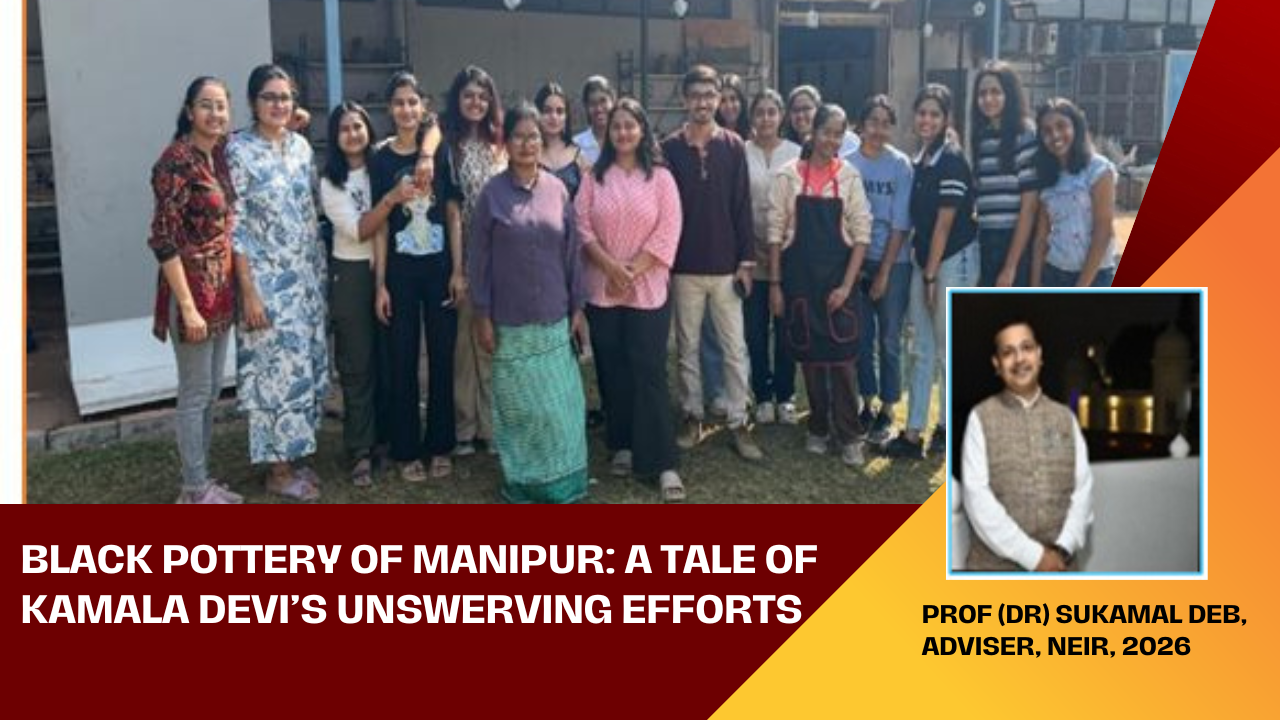
Prof (Dr) Sukamal Deb
Ms Shamjetshabam Kamala Devi is the first woman from the State of Manipur who did her M. Tech in Applied Geology from Dibrugarh University, Assam, in 2004. Instead of joining a government job, which she was offered, she chose to try clay, their heritage craft, applying her knowledge of applied geology to it. That inner call transformed her into an artisan, entrepreneur, and community leader who works silently for decades to keep the legacy of Black Pottery alive.
Kamala, once a little girl from Thongjao village, 57 km from Imphal, Kakchingdistrict,known as the Land of Pottery, fell in love with the Black Pottery. She never knew that she would dedicate her life to preserving and promoting her inherent craftand eventually become a leader of climate resilience through craft.
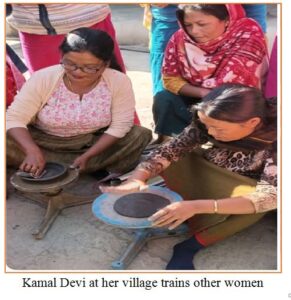
Kamala turns around the clay constantly, shaping it into a pot with her creative hands, making a brilliant piece of black pottery. She motivates other girls and women, trains them, and supports them to be creative artisans.
I visited her repeatedly, as my previous responsibilities as an official in the Government of India to develop micro-enterprises in the Northeast Region (2018 – 2022). I could hardly come across such an immaculate lady who sees the world through the lens of humanity.
The Terracotta Pottery of Thongjao, which Kamala works on, uses a mixture of red and black clay. This clay is kneaded and rolled into a wide slab. This slab is then given a cylindrical form and joined to a circular shape that forms the base.
A wet cloth and fingers shape the pot’s neck and rim. The outer layer is patted by a flat wooden beater (Asphuzei) with an engraved pattern is also used to pat the pots to achieve the same pattern on the surface. Continuous and clockwise movements of the expert hand and stroking are essential to the whole process.
After the structure is made, it is smoothed with a kanji/cactus seed, after which the pot is baked in an open traditional kiln made of bamboo layered with rice husk. The pot is covered with straw and exposed to fire for a few days in the trapped smoke.
In the kiln, some pots are placed inside other pots to prohibit the entry of air and, consequently, oxygen, which turns the clay black in colour. They also make brown-coloured pots, where the burning process is different.
In Manipur, there is another variety of Black Pottery, called Longpi Pottery or Black Serpentinite (a metamorphic rock) Pottery, a distinction of the Tangkhul Naga tribein Ukhrul district, Manipur, which they have practisedfor centuries. They discovered that local clay and weathered rock from the region could be mixed to make a unique, durable pottery with a black colour.
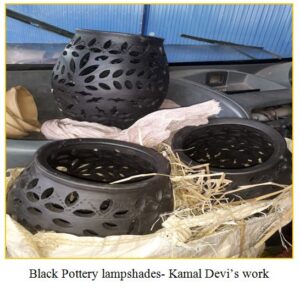
Over time, this became an important part of the cultural identity of the Tangkhul Naga community. Each of these products isfilled with cultural and spiritual significance. A mortar pestle is also used in the production.
Pointed metals engrave floral and geometrical patterns onto the pots before they are baked. Kamala,who belongs to the Meitei community,does not use serpentinite, the metamorphic rock; they use the special clay that is locally available and mix it with sand to make the products.
While baking, they use carbon (black colour), which they make by burning husk on the product to bring the black colour. The Tangkhul Naga Community uses Serpentinite to make Longpi Pottery, while Kamaladoes the terracotta work. This clearly distinguishes between the two varieties.
The Tangkhul Naga mostly make crookery items, smaller in size and more durable than thosemade by the Meitei community. The serpentine and clay pressure cooker is a unique symbol of the tribal craft of the Northeast made by the Tangkhul tribe. The Meitei community makes larger pots, a pitcher or a water jar, which is globally acclaimed.

These crafts contribute to the Circular Economy. By Circular Economy, we mean a systems solution framework that tackles global challenges like climate change, biodiversity loss, waste and pollution, circulates products and materials (at their highest value) and regenerates nature. This is an example of sustainable craft; it helps to support the local community and preserve traditional handicrafts.
Pottery is one of the heritage activities in India, an iconic element of Indian art. Around 65 Lakh families or 25 million people belong to the Potter Community (2011). The roots of Pottery can be traced back to the earliest times of civilisation. It has sustained for eons and is a massive employment creator in rural areas. The ancient pottery of a country speaks facts about its civilisation.
Pottery is one of those important media through which human have expressed their emotions. A piece of pottery has a visual message in its shape and colour. Pottery is the most sensual of all arts. A mass of clay touched by an artisan’s genius is said to becomea castle.
It holds significant value in understanding cultures where the script is either absent or undeciphered. Understanding the presence of fire, cooking, storage, sedentary or migratory populations, and social stratification can all be inferred through the study of pottery.Yet, the life of a Potter remained unrecognised and under-remunerated.

Pottery wares have played a significant role in the lives of men throughout the remote past. Archaeological sites worldwide have contributed to the knowledge of pottery through the material finds of the past.
Pottery was made during all three ages, the Stone, Bronze and Iron ages, yet pottery sherds are the commonest of all objects, which often provide clues to the Neolithic communities and are practically indestructible because once fired, pottery retains its form and colour for hundreds of years.
Pottery is tangible and is considered to be as old as civilisation itself. It is a great source of information for anthropologists and archaeologists. Either in sherds or as a whole, pottery reflects the way of life of a community. In the Northeast, Pottery has been attested from prehistoric sites, and it’s the livelihood for several communities to many of whomconsider pottery to be their way of life and mostly an exclusive job of females.

Indian Pottery, an odyssey of tradition, craftsmanship, and cultural legacy, as Kamala works on, isa rich tapestry of tradition, which is not just an art form; it’s a repository of heritage, echoing the whispers of centuries. But the potters have been navigating challenges.
The legacy Indian pottery stands at a crossroads, where preservation battles against the tide of modernity. Let’s unravel the challenges the craft faces and make an endeavour to safeguard India’s pottery heritage.The craft has not reduced its relevance in the present era of changes and will not be so in the future.
The artistic minds, the environmental consciousness, affordable prices, unique features of employing women, the use of local raw materials, the promotion of rural industrialisation, and the utility of the products keep the relevance of the pottery industry unshaken.
Male-dominated traditions in Manipur, in Thongjao village, have prevented women from becoming potters. Traditionally, women are not allowed to spin the potter’s wheel. Kamala Devi, however, overcame this traditional taboo most originally by replacing the potter’s wheel with herself – turning around the clay constantly, shaping it into a pot with her hands!

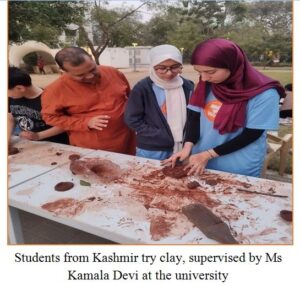
To bring her incredible story to the limelight and acquaint the students and others, Anant National University, Ahmedabad, where I work to document and develop India’s languishing craft, organised a 15-day Thongjao Black Pottery Workshop in Jan 2025.
Kamal stayed with us to conduct this enthusiastic workshop, bringing pride to Manipur and the Northeast.
She is the pride of ours, the pride of mine. At the sidelines of the workshop, Kamala also trained the students from Kashmir, who were on the university campus during the Winter School organised by the university.
I find a deeper meaning to this type of interaction, as it also promotes cultural integration between the two remote locations of India, Jammu & Kashmir and Manipur. It left behind an enduring happiness in me.

During ethnic strife in Manipur, I read an article published in the Economic Times, under the heading, “Amid conflict, women artisans eye e-commerce to preserve Manipur’s vanishing crafts”.This tells about the women’s power in Manipur.
Our women artisans have proven resilience; they are our hope in preserving our languishing crafts, creating livelihood, innovation and entrepreneurship at the bottom of the society. I attach my entire hopes on women like Kamala, who empower many.
The North East Integration Rally, 2026, opts for documentation of the crafts that may become extinct one day due to human indifference. Amid what is not in favour, let’s identify the languishing crafts of the Northeast, let’s celebrate, recognise and honour these amazing artisans, who have not given up hope, engaged in a silent struggle to preserve our identity, our culture