


What Manipur Reveals About Governance
 KRC TIMES Desk
Nil Konsam
A prolonged crisis is rarely a failure of capacity. It is a failure of sustained attention, coherence, and judgment at the highest levels. For nearly three years, Manipur has proven this truth with brutal clarity.
More than 58,000 citizens remain internally displaced. Over 217 lives have been lost. Livelihoods, education, healthcare, all stand fractured. Communities have hardened into ethnic segregation. This is no longer a transient disturbance; it is a prolonged condition of instability.
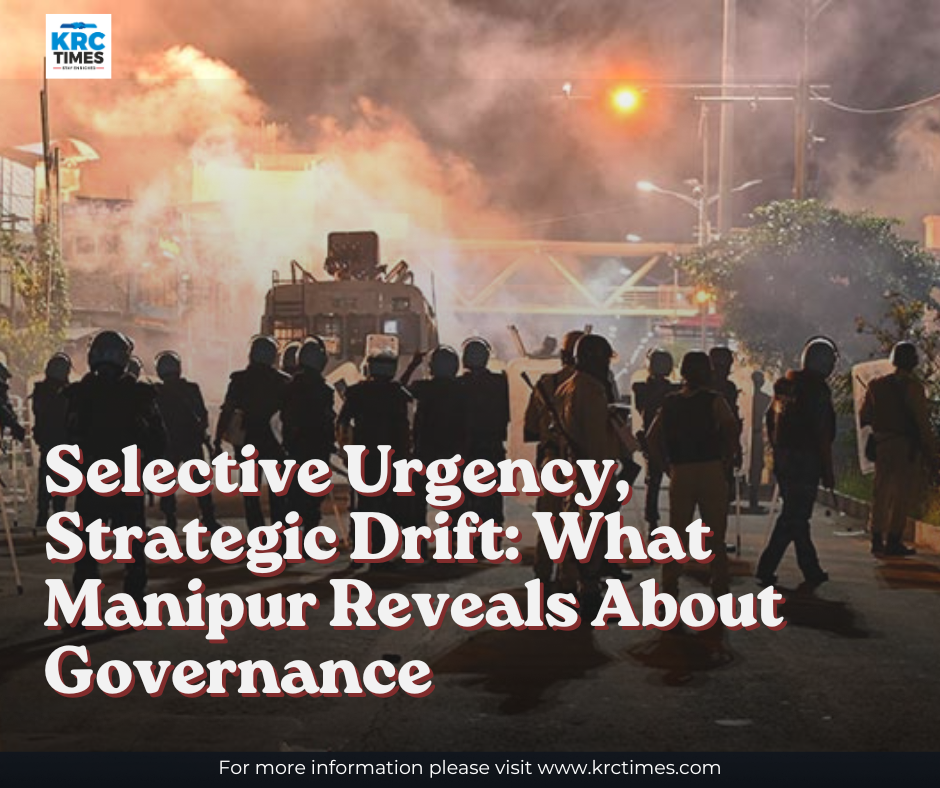
Recent incidents underscore how precarious the situation has become. An IED blast claimed two young lives. Days later, an ambush on a civilian convoy killed two more, including an ex-serviceman. Widespread agitations followed, crippling normalcy in a manner rarely witnessed. Movement and essential services remain under renewed strain. These are not isolated events—they are indicators of a deteriorating security environment where civilian vulnerability remains unacceptably high.
The Constitutional Core
The guarantees of life, liberty, and equal protection lose meaning when their enforcement becomes uneven or delayed. In Manipur, that gap has persisted for three years. Each passing month erodes institutional credibility further.
In the absence of consistent and visible state authority, civil society and community groups have stepped in. Their presence reflects resilience, but also signals a diffusion of authority. When governance becomes fragmented, resolution recedes.

More telling is the shift in public sentiment. Calls for extreme measures—once inconceivable—are now voiced openly. These signals are not the cause of instability; they are its consequence. They point to a deep and widening trust deficit.
Capacity Exists. It Is Selectively Deployed at Scale
What makes this situation difficult to defend is that the system, when it chooses, demonstrates overwhelming capacity.
Consider the 2026 electoral cycle in West Bengal. For a scheduled democratic exercise, approximately 2,400 companies of Central Armed Police Forces were deployed across phases, supported by extensive state police mobilisation and continuous high-level security oversight.
This was neither a counter-insurgency operation nor a national emergency. It was a planned election. Yet it demonstrated that where priority is assigned, the state can mobilise forces at significant scale, with speed, coordination, and sustained focus.
Elections are essential. But they are periodic. Governance is continuous. Its credibility rests on how it responds to prolonged distress, not merely to scheduled events.
The divergence, therefore, is not about capability. It is about calibration.
Why Manipur Is Different—And Why That Is Unacceptable
In Manipur, engagement has been episodic, reactive, and lacking a clearly articulated long-term strategy. Even operationally justified decisions have been undermined by inconsistent communication and limited visible leadership. In fragile environments, silence and distance are never neutral, they are interpreted.
The contrast is difficult to ignore: a system that can ensure extensive security for large-scale political mobilisation elsewhere has struggled, over three years, to guarantee safe and predictable civilian movement in parts of Manipur where ambushes and disruptions persist.
A constitutional order cannot afford selective intensity. The obligation to stabilise, protect, and reconcile must be steady, not situational.
What Authority Requires Now
What is needed is not incremental adjustment, but a fundamental shift in posture:
- Continuous highlevel engagement with accountable and visible leadership on the ground
- Transparent communication, including regular public reporting on security, relief, and rehabilitation
- Calibrated security deployment focused on intelligence, mobility, and civilian protection
- An inclusive, timebound political dialogue involving all affected communities
The Measure of the Nation
History does not judge capacity. It judges application. Prolonged crises reveal whether gaps are circumstantial or systemic.
Manipur today is not just a regional challenge. It is a measure of how seriously the nation applies its own principles when the test is prolonged, complex, and politically inconvenient.
In governance, priorities are rarely declared. They are revealed.

