


There should be no hesitation in acknowledging that foreign powers closely monitor internal unrest in other countries, seek to exploit it, and often attempt to benefit from it whenever possible
 KRC TIMES Desk
Dr. D.K. Giri
In India today, almost any political action-whether in a small town or on the streets of Delhi-if it concerns fundamental rights, politics, civil liberties, human rights, or causes major public disruption, can become global news within hours. This is both the privilege and the price of being the world’s largest democracy in an era of live television and viral social media.
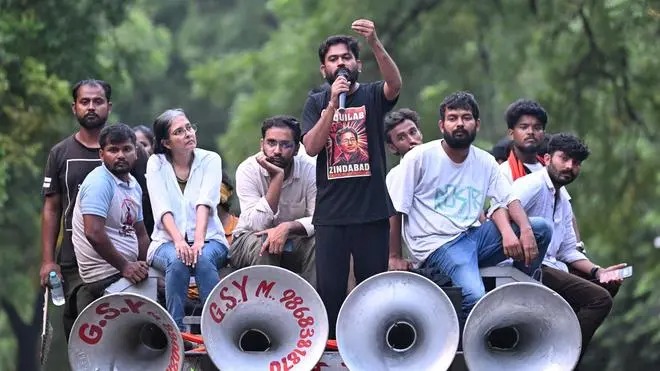
The recent protest against the Union Education Minister, described by some television channels as a movement by the “Cockroach Janata Party,” is the latest example of this new reality. What initially appears to be a domestic issue involving governance or public policy quickly transforms into a broader question of how India handles dissent and public protests.
Within days of the protests, a heated debate emerged over alleged foreign interference. Several prime-time television debates and digital news platforms claimed that the protesters had received “covert Chinese support.” The presence of some Left-wing leaders and student organizations at protest sites was presented as circumstantial evidence.
There should be no hesitation in acknowledging that foreign powers closely monitor internal unrest in other countries, seek to exploit it, and often attempt to benefit from it whenever possible. This is not unique to India but is a common feature of global geopolitics. Nearly every major democracy faces similar challenges.
However, in India’s case, the crucial question is evidence. Are there any concrete and verifiable proofs of direct involvement by a foreign power in this instance? So far, no publicly available evidence-whether financial records, digital forensic findings, or documented coordination-has emerged. At present, what is being presented in television debates appears to be correlation rather than proven causation.
Whenever the issue of a “foreign hand” is raised without solid evidence, it has two consequences. Domestically, it may be perceived as an attempt to delegitimize dissent. Internationally, however, it invites greater scrutiny. Foreign governments and think tanks begin asking whether New Delhi’s tendency to see foreign conspiracies behind every protest reflects deeper concerns about the state of democratic discourse in India.
In today’s media environment, images travel much faster than arguments. Mainstream television channels repeatedly broadcast scenes of stone-pelting, clashes with police, and damaged police vehicles, creating the impression that law and order had completely broken down.
At the same time, numerous social media accounts supportive of the protesters, along with international citizen journalists, continuously shared videos of baton charges, tear gas, and alleged police excesses. Their narrative sought to portray the government as suppressing democratic voices through force.
When Opposition leader Rahul Gandhi was removed from the road and taken into police custody, competing narratives emerged immediately. The police argued that the protesters had failed to obtain prior permission to demonstrate at the designated location, while the Opposition described the action as a suppression of the constitutional right to protest.

Send your resume:
biswa@jigyasu.co.in
krcfoundation@gmail.com
When Indian citizens themselves witness two completely different versions of India, the world inevitably sees the same. Foreign editors, diplomats, and investors often form opinions based not on lengthy reports but on 15-second video clips.
Today, credibility is among a nation’s greatest strategic assets. Prime Minister Narendra Modi may not be overly concerned that the Opposition or smaller political parties could pose an immediate electoral challenge, given his continuing popular support. However, he should certainly pay attention to how democratic nations perceive such events, because credibility has become a critical component of national power.
India is currently deepening political, economic, and technological partnerships with democratic countries such as the United States, the European Union, the United Kingdom, Japan, Australia, and Canada. These are not merely export markets; they are also India’s strategic partners in semiconductors, defence technology, clean energy, and artificial intelligence. In these countries, parliaments, media organizations, and civil society groups continuously examine democratic values and governance.
Against this backdrop, when a neutral country such as Switzerland publicly expresses concerns about human rights in India, New Delhi should take notice. The External Affairs Minister has effectively defended India’s democratic institutions in response to Swiss comments. Yet the very fact that Switzerland felt compelled to speak indicates that the global democratic community is monitoring not only India’s economic rise but also its democratic conduct.
Demonstrations in support of Sonam Wangchuk have already taken place in the United Kingdom, the Netherlands, Ireland, the United States, and Germany. These protests were organized by members of the Indian diaspora and received significant local media coverage.
This raises an important question: Had the government handled the movement within India through greater dialogue and a more balanced approach, could these international reactions have been avoided? It is an uncomfortable but legitimate question.
Undoubtedly, managing large and sometimes aggressive protests is never easy for any government. Violence committed by a few individuals cannot be allowed to undermine the peaceful protests of the majority. Yet a country’s international image is shaped not by a single incident but by a pattern of events.
Two recent developments have also influenced India’s global image.
The first concerns Sonam Wangchuk’s hunger strike. The climate activist and advocate for tribal rights adopted a Gandhian method of prolonged fasting. However, the administration’s silence allowed international non-governmental organizations to argue that India was “ignoring the voices of indigenous communities.”
The second concerns alleged irregularities in the NEET examination. For millions of Indian students and parents, the issue represented fairness and the future of their children. Internationally, however, it was interpreted as evidence of declining confidence among young people in public institutions.
Viewed individually, these are domestic issues. Collectively, however, they contribute to an international perception that prompts foreign media and legislatures to ask whether India’s democratic institutions are evolving at the same pace as its economic growth.
The fundamental principle of democracy is that protest and law and order are not opposing concepts but complementary ones.
In every democracy, peaceful protest is a fundamental right. A democratic government cannot simply prevent citizens from expressing dissent, nor should it attempt to crush such dissent through excessive force. History demonstrates that repression rarely eliminates discontent; instead, it often intensifies it over time.
At the same time, protests must remain peaceful. They should not descend into violence, vandalism, or destruction of public property. The state’s responsibility is to maintain law and order, ensure public safety, and protect public assets.
The true test of democratic governance lies in maintaining this balance. Peaceful protest must be given adequate space. When violence occurs, authorities should respond in accordance with the law and in a proportionate manner. Governments should clearly explain the rationale behind their actions, while Parliament should serve as the primary forum for debate rather than the last resort.
When this balance is lost, the costs extend beyond national borders. Friendly nations become more cautious in their official statements, investors begin factoring governance risks into economic assessments, and rival countries gain opportunities to launch propaganda campaigns against India.

Has India’s handling of protests and dissent at home damaged its democratic image abroad?
The answer is yes-but only to a limited extent.
India’s democratic traditions remain exceptionally strong. The world recognizes that India conducts massive, free, and fair elections. It would therefore be inaccurate to claim that India’s democratic credibility has suffered permanent or severe damage.
Nevertheless, there has been some impact. Countries competing with India have begun citing these incidents in their human rights reports. Friendly nations increasingly raise careful questions about democratic processes during bilateral meetings. International media, too, have begun giving greater prominence to images of confrontation and protests than to stories of development and reform.
This matters because, in the twenty-first century, a nation’s strength is measured not only by its military capabilities or economic performance but also by the trust it commands internationally.
Rapid economic growth and development are indispensable for India’s future. But they should not come at the expense of democratic values. Meaningful parliamentary debate, efforts to build political consensus, and sufficient democratic space for peaceful dissent are all essential pillars of India’s democratic identity.
If concerns about foreign interference in protests arise, the most effective response cannot be limited to government press releases. The strongest answer lies in demonstrating openness, fairness, and sensitivity toward India’s own citizens.
When the world sees Indian citizens expressing their views within constitutional limits, police enforcing the law with professionalism and humanity, and democratic institutions functioning transparently and effectively, India’s democratic image will grow even stronger.
In the years ahead, India should be recognized not only as one of the world’s fastest-growing economies but also as a mature democracy capable of accommodating differences, remaining resilient in the face of dissent, and resolving disputes through its democratic institutions.
That is the India the world needs most-one that advances the ideals of both development and democracy with equal commitment.

