


Bangladesh has experienced repeated outbreaks of violence following allegations that social media posts or perceived insults to Islam offended religious sentiment
 Sangram Datta
The treatment of religious minorities remains one of the clearest measures of Bangladesh’s democratic health. Founded on ideals of pluralism, equality and linguistic nationalism, the country has nevertheless struggled with recurring episodes of communal violence, allegations of land dispossession and persistent concerns that minority communities bear a disproportionate burden during periods of political instability.
The picture is neither simple nor one-sided. Reports by international organisations, the UK Home Office, domestic rights groups, civil society organisations and independent media describe a country where constitutional protections coexist with recurring incidents that continue to erode confidence among many minority citizens.
Bangladesh’s Constitution guarantees equality before the law, prohibits discrimination on religious grounds and protects freedom of worship, while also recognising Islam as the state religion. Successive governments have repeatedly affirmed their commitment to religious harmony, and security is routinely provided during major religious festivals, including Durga Puja, Christmas and Buddha Purnima.
Yet constitutional guarantees alone cannot determine whether citizens feel genuinely secure.
The UK Home Office’s Country Policy and Information Note published in June 2025 concludes that Bangladesh generally provides legal protection for religious minorities and that most are able to practise their faith freely. At the same time, it documents sporadic communal violence, notes that attacks increased during the political upheaval of 2024 and highlights concerns over laws criminalising alleged offences against religious sentiment.

The report further observes that while many incidents appeared to be linked to political conflict rather than purely religious animosity, minority communities nevertheless suffered deaths, injuries, destruction of homes and attacks on places of worship. For victims, the distinction between political and communal motives offers little consolation when faith or identity appears to increase vulnerability.
Civil society organisations paint a more troubling picture.
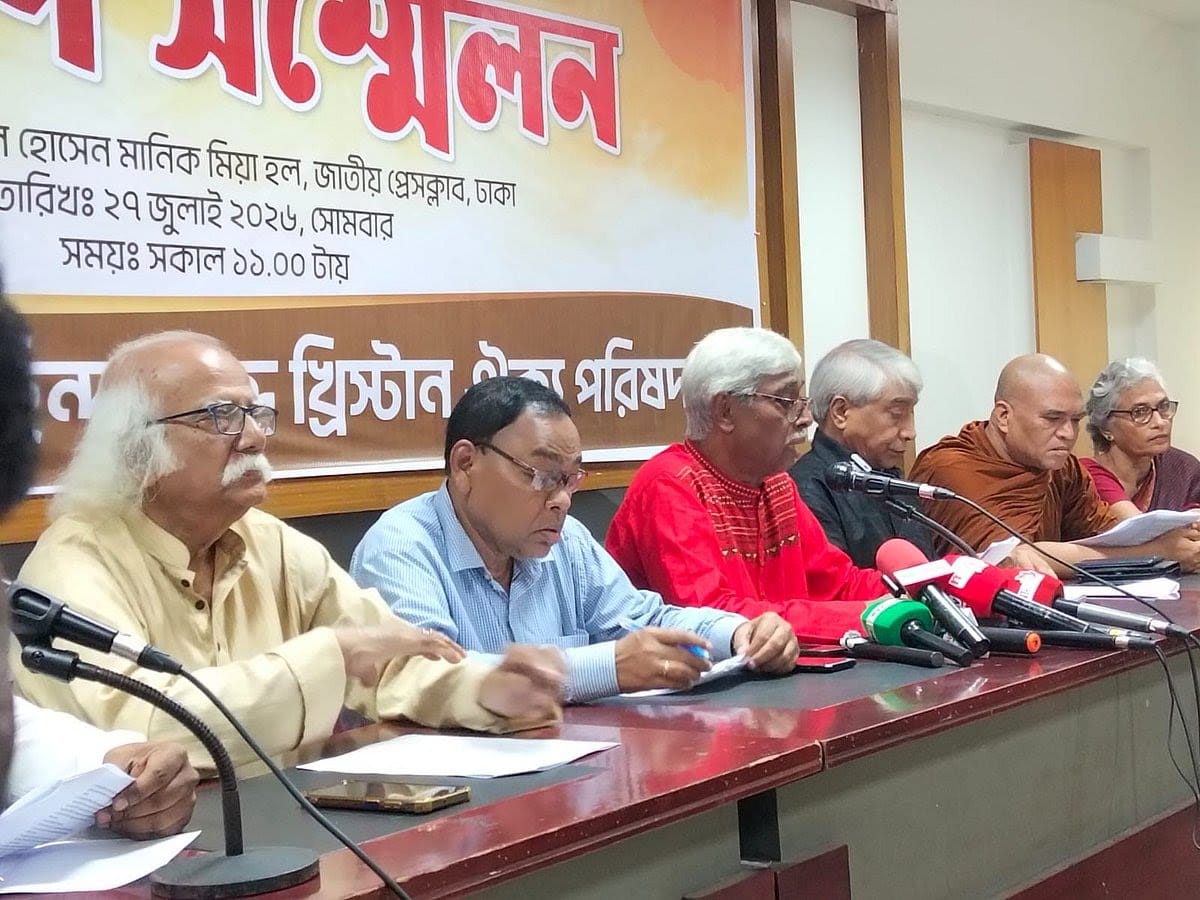
The Bangladesh Hindu Buddhist Christian Unity Council (BHBCUC) reported that between January and June 2026 it documented 257 incidents affecting minority communities, including 44 deaths across 40 incidents. The organisation also reported attacks on places of worship, allegations of land grabbing, assaults on women, extortion, arrests related to accusations of hurting religious sentiments and attacks on homes and businesses.
These figures represent the council’s own documentation rather than independently verified national statistics. Even so, they warrant careful attention because they reflect concerns that have been raised consistently over many years by domestic and international observers alike.
Prothom Alo’s English edition reported the council’s findings in July 2026, alongside its call for a policy of zero tolerance towards communal violence and institutional reforms, including a Minority Protection Act, a National Minority Commission and stronger legal safeguards.
International human rights organisations have echoed similar concerns.
Human Rights Watch has repeatedly warned that attacks against religious minorities remain a significant challenge and has urged the authorities to strengthen protections. International attention also focused on the killing of garment worker Dipu Chandra Das in December 2025 after BBC reporting highlighted the dangers posed by mob violence linked to allegations of blasphemy or religious insult.
These incidents form part of a broader pattern.
Bangladesh has experienced repeated outbreaks of violence following allegations that social media posts or perceived insults to Islam offended religious sentiment. During the Durga Puja violence of 2021, attacks spread across multiple districts after allegations originating in Comilla, leaving temples vandalised, homes destroyed and lives lost.
Such episodes expose a recurring institutional weakness: rumours spread rapidly, local tensions escalate quickly and minority communities often become the most vulnerable.
Land rights remain another enduring source of concern.
Minority organisations, researchers and international human rights bodies have long documented allegations that Hindu families have been disproportionately affected by land grabbing and property disputes. The former Vested Property framework has been widely criticised for facilitating decades of dispossession, although subsequent reforms sought to address some of its consequences.

Send your resume:
biswa@jigyasu.co.in
krcfoundation@gmail.com
Despite those reforms, allegations persist that influential individuals exploit legal complexity, administrative delays and unequal access to justice to obtain disputed property. Individual cases inevitably differ and should be assessed on their own facts, with allegations treated carefully unless supported by court judgments, official findings or other verifiable evidence.
The wider issue extends beyond individual disputes. For many minority families, land represents far more than economic value. It is closely tied to identity, security, inheritance and historical belonging. Where disputes remain unresolved for years, confidence in equal access to justice is inevitably weakened.
Bangladesh’s authorities reject claims that communal violence is widespread or systematically directed against minorities. Official investigations into violence following the political unrest of August 2024 concluded that many reported incidents were politically motivated rather than religiously driven. Government representatives have also pointed to arrests, criminal investigations and enhanced security deployments as evidence of the state’s commitment to protecting vulnerable communities.
Those efforts deserve recognition. But the effectiveness of protection is measured less by constitutional guarantees or official statements than by outcomes: whether citizens feel safe in their homes, whether places of worship remain secure, whether property rights are protected and whether those responsible for communal violence are investigated and prosecuted impartially, regardless of political influence.
Bangladesh has made remarkable economic and social progress over the past two decades and continues to aspire to democratic stability and greater international influence. Preserving those gains requires ensuring that every citizen—Muslim, Hindu, Buddhist, Christian, Ahmadi or non-believer—enjoys equal protection under the law.
Pluralism cannot rest solely on constitutional language. It must be reflected in institutions capable of protecting vulnerable communities, resolving disputes fairly, enforcing the rule of law without discrimination and ensuring that no citizen fears violence because of faith, identity or perceived difference.
The strength of Bangladesh’s democracy will ultimately be judged not only by elections, economic growth or public order, but by whether equal citizenship is experienced in everyday life as well as guaranteed in law.