

Falling Funding and Enrolment
 KRC TIMES Desk
Dhurjati Mukherjee
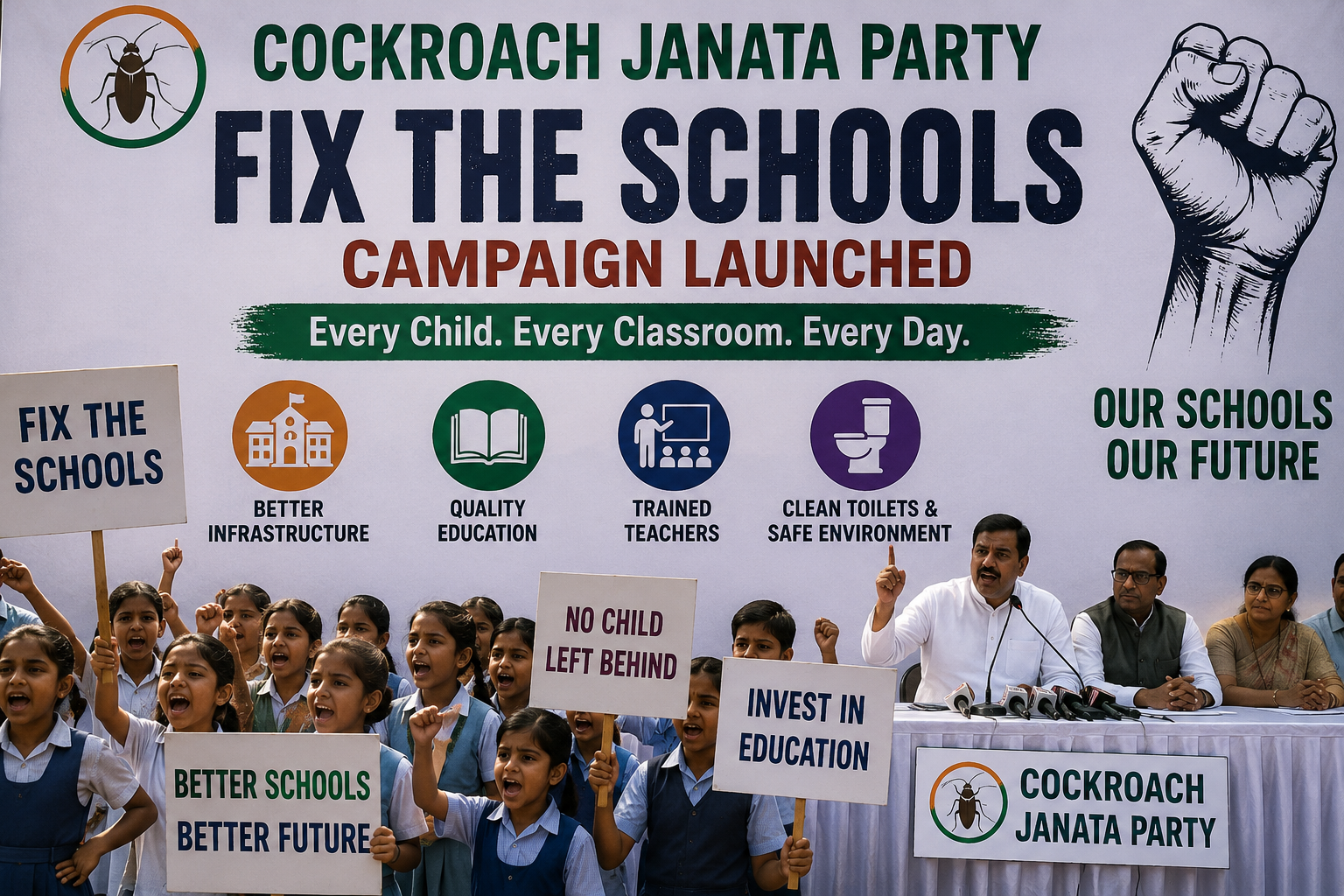
The “Fix the Schools” campaign launched by the Cockroach Janata Party to improve the condition of government schools in rural areas across the country is a welcome initiative. Just imagine where the state of education has reached today: over the past decade, education’s share in the Union Budget has fallen from 4.6 per cent to around 2.5 per cent. During the same period, the number of government primary schools across the country has declined by around 10,000, with Meghalaya, Telangana and Andhra Pradesh recording the sharpest falls.
The government has repeatedly claimed progress, but recent data suggest that school enrolment figures are far from encouraging despite population growth. Even after the much-publicised Right to Education Act came into force, there has been no significant change in containing the number of children dropping out of school. The impact is greatest on the poor, as a large section of them cannot afford the cost of higher education in private institutions.
According to the recently released Unified District Information System Plus (UDISE+) 2025-26 report, the number of students enrolled in government schools fell from 12.16 crore in 2024-25 to 11.89 crore in the last financial year. This came even as total enrolment in private and government-aided schools registered a marginal increase. During the same period, the number of government schools declined from 10.13 lakh to 10.05 lakh, a faster decline than the overall fall in the number of schools. While rationalisation of schools may be justified in certain circumstances, there is an urgent need to modernise schools and appoint an adequate number of teachers.

It is worrying that, according to government data presented in the Rajya Sabha, more than one lakh government, government-aided and private schools are being run with just one teacher each. This exposes serious shortcomings in teacher deployment, even though the overall pupil-teacher ratio in the country remains within national norms.
Moreover, the involvement of teachers in Special Intensive Revision (SIR) and census-related duties has also affected classroom teaching. Academics have criticised the deployment of teachers for non-academic work, arguing that it compromises their primary educational responsibilities. It is well known that most children studying in government schools come from poor families, and the majority of them cannot afford private tuition. It has been argued, quite rightly, that the existing system is increasingly depriving the poor of access to quality education.
Some facts need closer attention. According to the NITI Aayog report, The School Education System in India: Analysis and Policy Framework for Quality Improvement, nearly one lakh government schools were closed between 2014 and 2024, contributing significantly to a decline of 2.26 crore in school enrolment during the decade. The report states that 26.95 crore children were enrolled in schools in 2014-15, but the figure fell to 24.69 crore in 2024-25.
During the same period, the number of government schools declined from 11.07 lakh to 10.13 lakh, while government-aided schools also recorded a similar decline. In contrast, the number of private schools increased from 2.88 lakh to 3.39 lakh during the decade.
The report points out that the decline in school enrolment is partly linked to demographic changes, particularly the declining fertility rate, which has reduced the number of school-age children. School mergers and the challenge of retaining students in higher classes are other contributing factors. School mergers have another dimension as well: they can themselves lead to lower enrolment. Nearly 40,000 schools were merged in Uttar Pradesh and Madhya Pradesh. In addition, the dropout rate has been highest at the secondary level, particularly in Classes 9 and 10, where it has reached 11.5 per cent, although unofficial estimates suggest that the actual figure may not be less than 20 per cent.
Reports also indicate that difficulties in mathematics, particularly algebra and geometry, may be one reason why students leave school. Some activists argue that school mergers undermine the very objective of universal education, even as the government remains committed to universalising education under the Sustainable Development Goals (SDGs) for 2030. The policy of school mergers may be justified in some cases, but it can also become an obstacle to achieving the goal of expanding access to education.
Significantly, the report also highlights the shortage of laboratory facilities required for quality science education. In 2025-26, the proportion of schools equipped with such facilities fell to 54.6 per cent from 57.4 per cent in the previous financial year. According to the report, unless corrective measures are taken in time, this could increase the number of students dropping out at the secondary level.
On the positive side, however, government schools have recorded the fastest improvement in internet connectivity in recent years. Connectivity increased from 46.2 per cent in 2023-24 to 63.1 per cent in 2025-26, narrowing the gap between government schools and aided and private schools. Overall, 67.4 per cent of schools had internet facilities, up from 63.5 per cent in 2024-25.

Send your resume:
biswa@jigyasu.co.in
krcfoundation@gmail.com
Many experts regard Class 8 as a crucial turning point in a child’s academic life, after which the dropout rate tends to rise. This is particularly surprising because students are being provided with mid-day meals. However, it is possible that the economic compulsions of students’ families are a much stronger factor, particularly in the case of girls.
The question is: what will be the future of students from poor and disadvantaged sections, some of whom have immense potential to develop their talents if given adequate guidance? Education is on the Concurrent List, and it is the Centre’s responsibility to assist states in expanding educational opportunities, particularly in remote and backward districts.
Unfortunately, the Centre’s PM SHRI scheme has also failed to achieve its objective of opening schools in all districts of the country. At the very least, there should be an immediate effort to introduce Classes 9 to 12 in schools in backward districts. Higher education also needs attention, and curricula should be designed in such a way that students who do not wish to pursue further studies are still able to earn a dignified livelihood. It is imperative that an expert committee, after consulting educationists, prepare a policy paper on the issue at the earliest.
As far as higher education is concerned, undergraduate enrolment in educational institutions has declined for the first time. Experts attribute the decline to the government’s increasing emphasis on vocational education, growing disillusionment among young people regarding the value of higher education, and limited employment opportunities. According to the All India Survey on Higher Education (AISHE) reports for 2022-23 and 2023-24, undergraduate enrolment in 2023-24 declined by one lakh students compared with the previous year.
Former UGC chairman Prof. S. Thorat and other experts have attributed the decline to the increasing emphasis on skill education at the school level, the availability of multiple exit options at the undergraduate level, declining public funding for higher education institutions, and the discontinuation of several scholarship schemes at both school and college levels.
The above figures, together with the ground realities of rural schools, make it clear that the present situation offers little reason for optimism. Beyond the factors mentioned above, education is not receiving the priority it deserves as one of the fundamental foundations of life. The government must therefore urgently take note of the serious state of education and undertake concrete and corrective measures.