

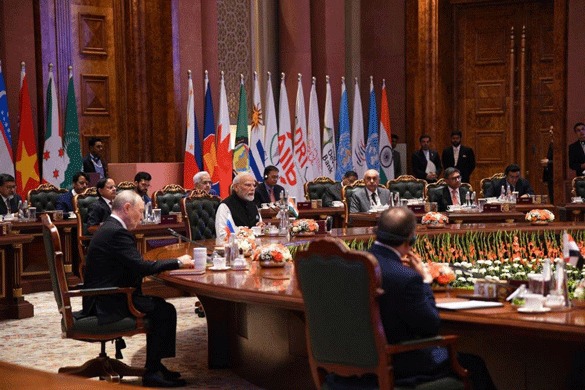
The visiting leaders discussed a host of global issues concerning various conflicts, trades, AI, cooperation and food securities in developing countries
 Nava Thakuria
As the largest democracy on Earth hosted the 18th BRICS Leaders’ Summit in New Delhi on 12-13 September 2026, under the theme ‘Building for Resilience, Innovation, Cooperation and Sustainability’, the world media covered the event with enthusiasm, where a series of discussions took place focusing an aim to resolve many pertinent global challenges.
The visiting leaders discussed a host of global issues concerning various conflicts, trades, AI, cooperation and food securities in developing countries. The participating heads of governments & states also unanimously adopted the New Delhi Declaration 2026. While reaffirming commitment to stronger multilateralism and deeper cooperation among BRICS countries, the declaration emphasized on avoiding while standing against anyone, but taking everyone onboard.
Initially began the journey in 2001 as a Global South powerhouse comprising only Brazil, Russia, India and China, the BRIC (later BRICS) expanded its territories with the inclusion of South Africa, Egypt, Ethiopia, Iran, UAE, Saudi Arabia and Indonesia (altogether 11 major emerging economies). The multilateral forum also has 10 partner nations including Thailand, Malaysia, Vietnam, Belarus, Bolivia, Cuba, Nigeria, Kazakhstan, Uganda and Uzbekistan.
The two-day Delhi summit, virtually presided over by Prime Minister Narendra Modi and attended by Russian President Vladimir Putin, Chinese President Xi Jinping, Iranian President Masoud Pezeshkian, South African President Cyril Ramaphosa, Indonesian President Prabowo Subianto, Egyptian President Abdel Fattah el-Sisi, Malaysian Premier Anwar Ibrahim, UAE crown prince Khaled bin Mohamed bin Zayed Al Nahyan with others expressed concern over growing tensions in West Asia and called for dialogue, diplomacy and conflict prevention so that the civilian casualties can be reduced.
One of the major outcomes included a consensus on comprehensive reforms in the United Nations precisely the UN Security Council with an aim to make the institution more democratic, representative, effective and efficient. Increasing the representation of developing countries in the UNSC membership so that it can adequately respond to prevailing global challenges and support the legitimate aspirations of emerging and developing countries from Africa, Asia and Latin America, was also insisted.In the presence of UNSC permanent members (China and Russia), the BRICS also agreed that both Brazil and India should play a greater role in the UN including its Security Council.
Ahead of the summit, Modi met with United Nations Secretary-General António Guterres in New Delhi, where both the visionary leaders discussed various issues covering global conflicts, sustainable development, human-centric technology, renewable energy, food security, etc. Guterres congratulated India for the BRICS chairship and admitted that the UNSC needs multilateral reform to reflect the contemporary realities on Earth. To mark two decades of the BRICS, two commemorative postage stamps were also released by the member country leaders.
The declaration expressed strong condemnation of any act of terrorism as criminal and unjustifiable, regardless of their motivation, whenever, wherever and by whomsoever committed. The brutal terrorist attack in Pahalgam of Jammu & Kashmir on 22 April 2025 (where 26 people were killed and many injured) also got space in the declaration. The leaders agreed that terrorism should not be associated with any religion, nationality, civilization or ethnic group, and all those involved in terrorist activities must be held accountable and brought to justice in accordance with relevant national and international laws.
The leaders reaffirmed support for Palestine’s full membership of the UN citing a two-state solution where sovereign Palestinian can have East Jerusalem as its capital. They opposed forced displacement of Palestinians and condemned violations of international humanitarian law, including attacks on civilians and civilian infrastructure.
Highlighting on universal health coverage, tuberculosis research, pandemic preparedness and early-warning systems, the participants endorsed initiatives on healthy lifestyles and mental wellbeing. On technology, they highlighted artificial intelligence (AI), digital public infrastructure, cybersecurity and cooperation on research and innovation. Describing AI as a significant potential tool for economic growth and sustainable development, the leaders stressed on safety, security, inclusiveness and reliability. Climate change also featured prominently, where they called for a stronger international action on climate finance, adaptation and sustainable development.
Expressing concern over the situation with illicit drug production, trafficking and abuse worldwide, the leaders identified it as a serious threat to public security, health safety and well-being of humankind that undermines the sustainable development of different countries. They also welcomed the Guwahati declaration issued by the BRICS heads of anti-drug agencies that facilitates operational and technical cooperation among those responsible agencies. The declaration also covered transport, tourism, anti-corruption efforts, digital connectivity and many other areas of BRICS cooperation.
The declaration also extended full support to Beijing for the 2027 BRICS chairship and 19th summit in China. Bangladesh, neither a member nor partner country, was invited to the BRICS summit as the current chair of BIMSTEC (Bay of Bengal Initiative for Multi-Sectoral Technical and Economic Cooperation), but Prime Minister Tarique Rahman preferred to reject the opportunity, reasons best known to Dhaka only.
Political observers believe it as a lost opportunity for Bangladesh in general and Rahman in particular, because his participation would have helped the poverty stricken county to highlight many relevant issues in the Global South forum that represents 50% of the world population, 40% of global GDP and over 30% of international trade. On the contrary, the current chair of SAARC (South Asian Association for Regional Cooperation) Nepal was not invited for the summit, but unlike Dhaka’s outburst, Kathmandu remains silent.