

The most consequential development for India was the BRICS condemnation of the Pahalgam terror attack and its reaffirmation of zero tolerance towards terrorism
 KRC TIMES Desk
R. S. Pathania
Long, long before the dogma of ‘nation-states’ came into being and states assumed boundaries, India had a civilisational, historiographical geography – Bharatvarsha-an idea extending, in the imagination of its people, from the Himalayas to the seas and through the great cultural corridors stretching towards Central Asia. It is not an argument for redrawing a modern map. It is an argument for remembering an ancient, traditional, ideological diplomatic instinct: India has historically sought engagement across civilisations rather than domination over them.
The philosophical roots of that instinct delve deep.
The Vedas spoke of the world as one family; the Upanishadic tradition celebrated the underlying unity of eternal existence. Vasudhaiva Kutumbakam-the world is one family-was not merely a slogan but a civilisational perspective and proposition. The idea of coexistence was complemented by the extraordinary Indian tradition of accepting plurality without pushing for uniformity.
Let is take cue from Ramayana. The powerful, propitious king, Lord Rama with ‘RamRajya’ as its essence and contribution never went for expansionism. His better half, was kidnapped by Ravana and he repeatedly vouched for truce before war.
Ashoka, exquisite mould of a ‘philosopher-king’ transformed this ‘idea of India’ into a viable statecraft. After Kalinga, the Mauryan emperor’s message was not revenge but restraint, not conquest but Dhamma. He advocated respect for different faiths and traditions, recognising that honouring another’s belief strengthened one’s own.
Centuries later, India’s saints, philosophers and Gurus carried the same instinct forward in different languages. India repeatedly demonstrated that disagreement need not become hostility and difference need not become division.
Then came Mahatma Gandhi, who converted Ahimsa from an ethical principle into a formidable instrument of direct political action. His India was an India in which “Ishwar Allah Tero Naam” could become a declaration of coexistence rather than a contradiction.
And before Gandhi, Swami Vivekananda gave this civilisational idea a global vocabulary. At Chicago, he spoke from a tradition that did not merely tolerate other faiths but embraced their legitimacy. The essential Indian proposition was beautifully simple: humanity may approach truth through different paths, and those paths need not destroy one another. All may be true.
This is the Bharat that has now expanded its footprints at the 18th BRICS Summit.
The New Delhi Declaration should therefore not be read merely as another diplomatic communiqué. It should be read in the backdrop of this civilisational background. India is not attempting to create another geopolitical bloc. It is attempting to create balance in a world-order that is becoming dangerously ruffled.
The most consequential development for India was the BRICS condemnation of the Pahalgam terror attack and its reaffirmation of zero tolerance towards terrorism. This gives new teeth and a pedestal to ‘India’s fight against terror For New Delhi, this is diplomatically significant: terrorism increasingly finds itself being addressed as a collective international challenge rather than merely an Indian security concern.

Equally important was the wider message against unilateralism-tariffs, coercive economic measures and sanctions being used as instruments of international pressure. The message was not anti-Western. It was essentially and fundamentally, anti-unilateralism. And that distinction is quintessentially Bharatiya.
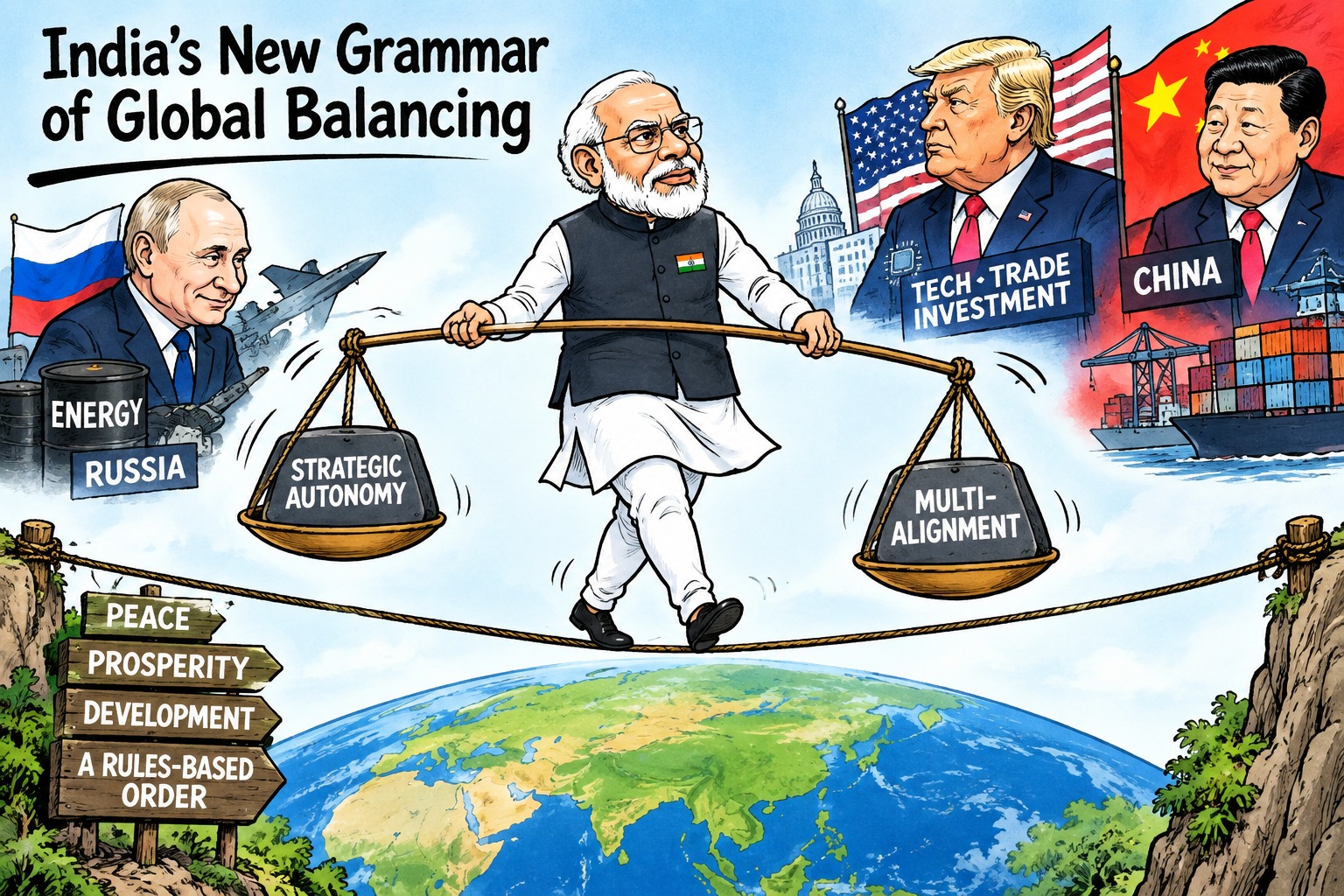
India does not want a world dominated by Washington, Beijing or Moscow. It wants a world in which power is balanced, institutions are representative and disagreements are negotiated through ‘dialogue and diplomacy’. ‘Today’s era is not an era of of war’, time and again, said by Indian PM, Narendra Modi.
That is why the economic dimension of BRICS matters enormously.
India-Russia trade is being targeted towards $100 billion by 2030. India-China trade, despite profound strategic differences, remains enormous and creates its own logic of economic engagement. The emerging architecture of local currencies, payment mechanisms, connectivity, energy and supply chains could gradually reduce the vulnerability of global trade to unilateral disruptions.
The diplomatic symbolism is equally striking.
Iran and the UAE-countries carrying their own complex regional equations-were part of the same conversation about the future of global trade and governance. If diplomacy means keeping difficult countries at the same table, Delhi demonstrated precisely that.
The demand for reform of the UN Security Council reflects another central Indian proposition: global governance cannot remain frozen in the geopolitical realities of 1945 while the economic and demographic realities of 2026 belong to another world and a new global order.
The same principle runs through BRICS’ position on Palestine, Lebanon and West Asia: respect for sovereignty, international law, humanitarian concerns and the legitimate aspirations of the Palestinian people. And perhaps most significantly, India and China are attempting to keep the door open for a peaceful resolution of their boundary differences.
That is not surrender. It is not appeasement. It is strategic maturity and rather a new diplomatic crest. Two countries can have unresolved disputes, compete economically and strategically, and yet recognise that permanent confrontation is in nobody’s interest.
This is where India’s BRICS moment becomes larger than BRICS. The expanded BRICS represents nearly half of world-population and around 40 per cent of global GDP. But India’s importance within this grouping comes not merely from its size. It comes from its ability to speak simultaneously to different worlds.
India speaks to Russia without becoming Russia’s camp. It speaks to America without becoming America’s ‘vassal-State’. It engages China without subserving to China’s. It works with Israel while retaining its historic commitment to Palestinian statehood.
It engages Iran and the Gulf simultaneously. This is not neutrality. It is strategic autonomy with a civilisational connect. India’s extraordinary economic momentum-around 7.8 per cent growth-gives that diplomacy additional weight. Economic strength, technological capability, demographic scale, military capacity and diplomatic credibility are beginning to converge.
And therefore, perhaps, the old phrase Vishwaguru needs to be understood differently. A Vishwaguru is not a country that lectures the world. Nor is it a country that seeks to command the world. It is a country capable of reminding a bitterly-divided world that coexistence is not weakness, dialogue is not surrender and diplomacy is not disorder.

That idea runs from the Vedas to the Upanishads, from Ashoka to the saints and gurus, from Vivekananda to Gandhi-and now, in a very modern form, from New Delhi to the negotiating tables of the world. India’s civilisational message has never been that there is only one way to truth.
It has been that there may be many ways-and humanity must learn to tread them, harmoniously, without trampling upon another. That may be India’s most important contribution to the emerging world order. Not the creation of another camp. Not the defeat of another power.
But the creation of space for dialogue between competing powers. From Bharatvarsha to modern India, the map may have changed. The diplomatic instinct has not. And at BRICS 2026, that instinct found perhaps its most consequential expression yet:
India is no longer merely seeking a place at the global table. It is increasingly helping decide how that table should be arranged. This is the real story and the globally-viral reel of September 2026.
(The columnist practices law at the J & K, High Court of Judicature. He is member of Legislative Assembly of J&K)