


The first and most important achievement was that India successfully steered the summit towards a consensus declaration
 KRC TIMES Desk
Dr D. K. Giri
When the national flags of the 21 participating countries were lowered at Bharat Mandapam following the conclusion of the 18th BRICS Summit last Sunday, it was time for the host country to assess its achievements and shortcomings – the successes it has secured and the challenges that lie ahead.
After any summit, all stakeholders undertake such an assessment. But BRICS is somewhat different. The grouping is widely seen as an alternative to Western-led institutions and groupings such as NATO, the Quad, the International Monetary Fund and the World Bank. That is why India’s presence and role within BRICS attract particular international attention.
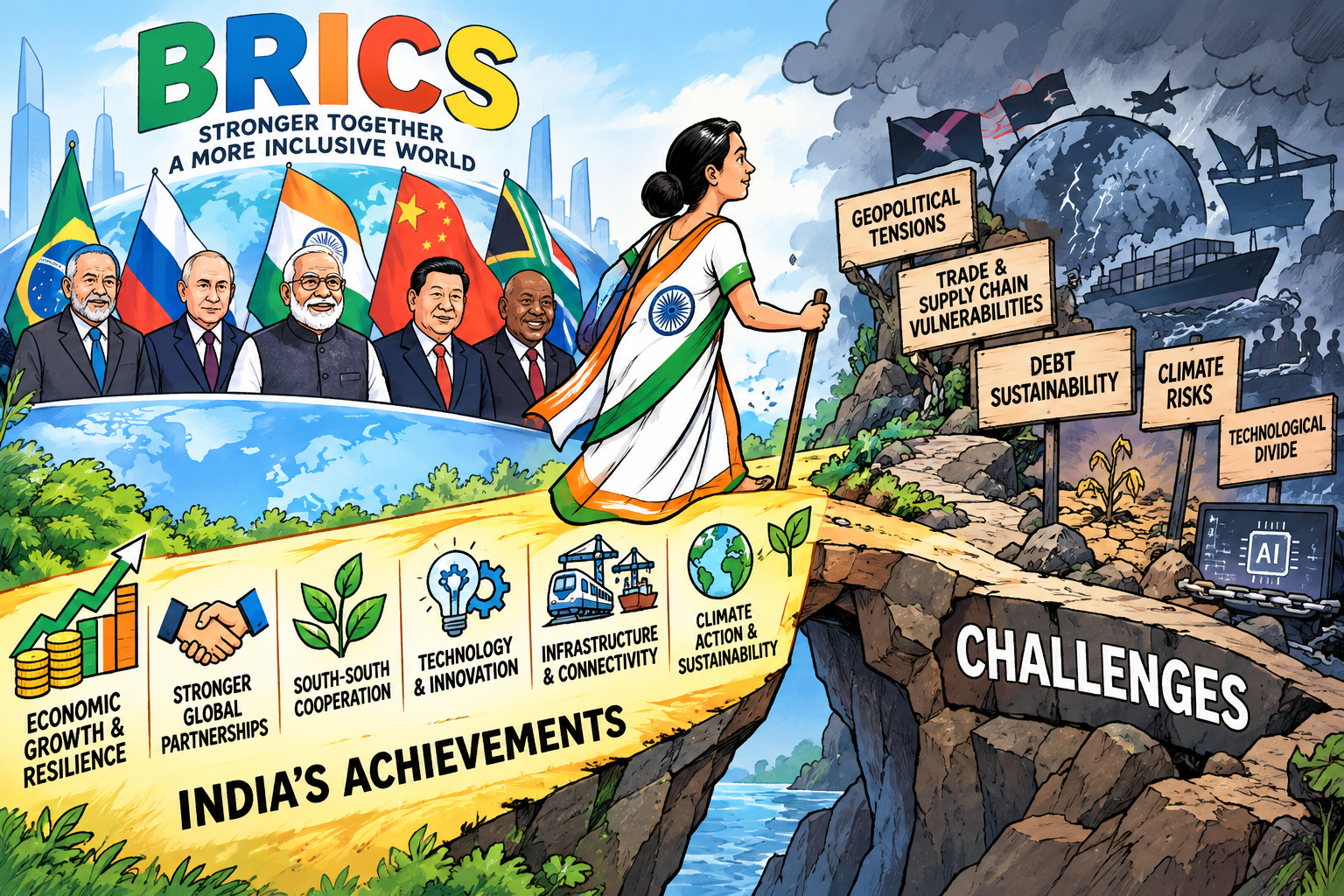
The first and most important achievement was that India successfully steered the summit towards a consensus declaration. There were neither sharp debates nor overt expressions of disagreement. At the same time, India ensured that the declaration did not explicitly adopt an anti-American or anti-Western position. The 45-page, 140-paragraph declaration covers a wide range of issues, but India gave priority to practical financial reforms. These include interoperable national payment systems and trade in local currencies. The idea of a common currency was kept separate from these initiatives.
This achievement deserves emphasis. The expanded BRICS has become far more diverse and heterogeneous than the original four-member grouping. Today, alongside India, China, Russia, Brazil and South Africa, the group includes Egypt, Ethiopia, Indonesia, Iran, Saudi Arabia and the United Arab Emirates. There are also 10 partner countries. Naturally, these countries have significantly different strategic priorities and national interests.
For instance, Iran is in confrontation with the United States and Israel. The United Arab Emirates has deep economic and security ties with Western countries. New Delhi continues to strengthen its strategic partnership with Washington. China remains America’s principal strategic rival, while Russia is facing unprecedented sanctions and is at war with Ukraine, which is backed by the West.
The second achievement was the emphasis at the summit on structural reforms in global institutions, particularly the United Nations Security Council, to give the Global South a more effective voice. For the first time, both Russia and China openly supported a larger role for Brazil and India in global institutions. This suggests that China may no longer block India’s entry into the UN Security Council. However, the question remains whether China would support granting India veto power, as enjoyed by the existing permanent members. If the structure is reformed, it is possible that the veto system itself could become irrelevant.
The third achievement was India’s role in restoring dialogue among member countries whose channels of communication had almost broken down. India used its diplomatic capacity to bridge differences and, particularly on the issue of regional stability, helped advance dialogue between Iran and the UAE. Only recently, in response to a US attack, Iran had targeted American bases located in the UAE.
Fourth, as always, India ensured that the BRICS position remained non-Western without allowing it to become anti-Western. This should send a clear message to the United States and Europe that New Delhi does not view BRICS as an alternative to its important relations with the West. For a large number of Indians, the security and counter-terrorism provisions in the declaration are also reassuring. India ensured an explicit condemnation of the Pahalgam terror attack and secured language calling for zero tolerance towards terrorism, full accountability for those responsible and a demand that terrorists not be provided safe havens. This language is stronger than what India received at the Shanghai Cooperation Organisation or the G20 – and this should be recognised as a diplomatic achievement.
The biggest strategic challenge is how to prevent BRICS from becoming an anti-Western platform. The New Delhi declaration clearly reflects the Global South’s dissatisfaction with the existing international financial system, which is dominated by Western institutions. Developing countries have been severely affected by unilateral sanctions, tariff barriers and the strategic use of supply chains. Even so, India’s strategic objectives differ considerably from those of several major BRICS members.
China wants to establish BRICS as an alternative to Western-dominated institutions and even sees it as a counterweight to NATO. Beijing openly criticises US policies and seeks to replace the United States with a China-centred global order. Russia largely views BRICS as a means of weakening Western sanctions. Iran, meanwhile, is seeking a way out of international isolation and wants a multipolar world order in which the United States cannot exert overwhelming pressure on any country.
India views BRICS from a very different perspective. For New Delhi, BRICS is another global network, much like the Quad, SCO, SAARC or BIMSTEC. New Delhi does not want to replace one hegemonic system with another, nor does it view BRICS as a mirror image of NATO.
The challenge for New Delhi is to counter the perception developing in the West that India has tilted towards a Beijing-Moscow-Tehran axis and that its participation signals a strategic realignment. If India fails to effectively address this perception, maintaining a balance between the two sides could become more difficult.

The author has long argued that India can engage, transact and cooperate strategically with any country on the basis of strategic autonomy and multi-alignment, but that in a polarised world it must make its position clear. New Delhi should remain aligned with the democratic world rather than authoritarian systems. Coincidentally, the democratic world has an advantage in two key elements that determine the balance of power – capital and technology.
Another challenge is dealing effectively with China while protecting national interests. Practical bilateral relations with China will determine India’s effectiveness within BRICS. The author has long warned about what he describes as China’s opaque and almost deceptive security policies, reflected in what he regards as false territorial claims and border confrontations dating back to 1962.
Immediately after the BRICS summit, China once again adopted what the author describes as a provocative position by confirming the reactivation of a joint boundary commission with Pakistan. New Delhi has rejected the move in strong terms. India maintains that there is no legitimate boundary between China and Pakistan and, therefore, that the commission is illegal and ineffective.
Finally, New Delhi will have to gradually reduce its trade dependence on China. A massive trade deficit of $112 billion in China’s favour is not in India’s national interest. New Delhi will have to make determined efforts to correct this imbalance or explore alternatives.
It is true that, following globalisation, trade and commerce have to some extent been separated from foreign and security policies. Beijing continues to favour this approach. It built its economy by benefiting from Western investment and relying on its low-cost labour force, while, according to the author, violations of human rights and suppression of citizens’ voices continued. At the height of Western investment in China, the world witnessed the use of tanks to suppress student protests in Tiananmen Square.
In its trade with India, China wants to keep border disputes, violence and territorial claims separate from trade and investment. This approach has traditionally not been acceptable in India’s international relations. In international politics, national interests are paramount, but shared values are equally important in global governance. Otherwise, the world could move towards anarchy. Therefore, maintaining a balance between national interests and international norms is essential for global peace, stability and solidarity.
New Delhi may not be able to change China’s thinking, but it must clearly articulate its position in negotiations so that the world also understands India’s stance.
As always, India’s BRICS outcome has been mixed. New Delhi should make full use of its achievements while also addressing both the perceptual and practical challenges before it.