


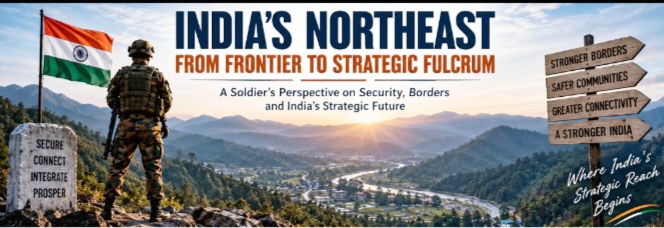
FROM FRONTIER TO STRATEGIC FULCRUM”
 KRC TIMES Desk
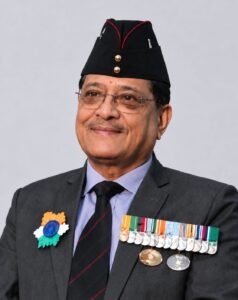
By Col (Dr.) Ashwani Kumar, MiD, VSM (Retd)
A Soldier’s Perspective on Security, Borders and India’s Strategic Future.
For a soldier, a border is never merely a line drawn on a map. It is a combination of terrain, weather, mountains, rivers, intelligence, logistics, local populations and, above all, the ability to anticipate a threat before it materialises. Nowhere is this reality more evident than in India’s Northeast, where geography, history, ethnic diversity and strategic competition converge to create one of the country’s most complex security environments.
For decades, India’s Northeast was viewed primarily through the lenses of insurgency, internal security and economic development. That approach is no longer sufficient. The region today occupies a pivotal position in India’s national security architecture. With China to the north, Myanmar to the east, Bangladesh to the southwest and Bhutan along its western approaches, the Northeast is both India’s eastern shield and its gateway to Southeast Asia.
Having served in difficult operational environments of the Northeast and other sensitive frontiers, I have learned that national security cannot be measured merely by the number of troops deployed or the weapons available. It depends equally on intelligence, infrastructure, logistical resilience, civil-military cooperation and the confidence of the people living along our borders.
India must therefore transform its Northeast from a region traditionally regarded as a remote frontier into a strategic fulcrum of national power.
The Geography of power: A Soldier’s Assessment.
The Northeast presents extraordinary operational challenges. Its mountains, dense forests, narrow valleys, fast flowing rivers and unpredictable weather create an environment in which conventional military planning must be adapted to local conditions.
A road that appears insignificant on a map may be the only means of reinforcing an isolated military post. A bridge may determine the speed of mobilisation. A mountain ridge may provide observation over an entire valley, while an unguarded jungle track may become an infiltration route.
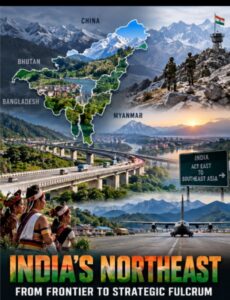
The soldier sees geography differently from the administrator. He assesses terrain in terms of observation, mobility, concealment, communications, defensive positions and the ability to sustain operations.
India’s Northeast must consequently be developed with both civilian and military requirements in mind. Roads, tunnels, bridges, advanced landing grounds and communication networks should be planned as dual-l use strategic assets.
Infrastructure that cannot withstand extreme weather or sustain military mobilisation during an emergency provides only limited strategic value.
China and the Himalayan frontier.
The Chinese frontier remains India’s principal conventional military concern in the Northeast. Arunachal Pradesh and Sikkim occupy particularly sensitive positions in the country’s defence architecture.
China’s infrastructure development in Tibet, its military modernisation and its territorial claims require sustained Indian attention. India’s response, however, must be based on professional military assessments rather than rhetoric.
The critical questions are operational. Can India detect unusual military movements sufficiently early? Can troops and equipment reach threatened sectors rapidly? Are adequate ammunition, fuel, medical facilities and reserves available? Can forward formations maintain secure communications and sustain operations during prolonged adverse weather?
The answers depend on preparedness long before a crisis develops.
India must continue strengthening its surveillance capabilities, all-weather infrastructure, air mobility and integrated intelligence systems while maintaining diplomatic mechanisms for managing border disagreements.
A credible military posture, supported by diplomacy, is essential to preventing localised incidents from escalating into wider confrontation.
Myanmar: The eastern Security Challenge.
The India-Myanmar border presents a fundamentally different but equally complex security environment. Its difficult terrain, longstanding ethnic connections and Myanmar’s continuing instability complicate conventional border management arrangements.
The consequences extend beyond insurgency. Weapons trafficking, narcotics, organised crime, irregular migration and the movement of armed groups create overlapping challenges for security forces and civil authorities.
For a soldier, the distinction between external and internal security becomes increasingly blurred in such an environment.
The Assam Rifles, Army, intelligence agencies, state police and civil administration must operate through effective coordination and clearly defined responsibilities.
However, security policy must also recognise the legitimate social and economic relationships of communities living along the international boundary. Border management should distinguish between civilians, legitimate cross-border activity and individuals involved in criminal or armed operations.
Military operations alone cannot resolve the consequences of political instability across an international border. India requires a combination of surveillance, intelligence sharing, diplomatic engagement, humanitarian coordination and effective law enforcement.
Bangladesh and The Changing Strategic Environment.
Bangladesh occupies an important position in India’s eastern security calculations. Its geography influences connectivity, border management, trade and the movement of people and goods between the Northeast and the rest of India.
The extensive India-Bangladesh border includes riverine stretches and densely populated areas where conventional fencing and surveillance can be difficult.
Smuggling, trafficking, irregular migration and transnational criminal activity require sustained cooperation between border forces and law-enforcement agencies.

At the same time, constructive relations with Bangladesh can strengthen regional connectivity and provide additional logistical options for the Northeast.
India’s strategic approach must therefore combine effective border management with diplomatic engagement and mutually beneficial infrastructure development.
The Siliguri Corridor: India’s Strategic Lifeline.
No assessment of Northeast security is complete without examining the Siliguri Corridor, popularly known as the Chicken’s Neck.
This narrow geographical passage connects the northeastern states with the rest of India. Its importance extends beyond civilian transport. It carries critical military, economic and logistical traffic.
A soldier assessing the corridor must consider the consequences of simultaneous disruptions to roads, railways, communications or essential infrastructure.
India needs sufficient logistical redundancy to sustain the Northeast during natural disasters, infrastructure failures or military emergencies.
Alternative transport routes, improved railway capacity, air connectivity, inland waterways, secure communications and adequate forward logistical reserves can reduce dependence on any single transportation artery.
The strategic objective should be to ensure that the Northeast remains connected, supplied and operational under all foreseeable contingencies.
Intelligence: The First Line of Defence.
My experience in Military Intelligence has reinforced one fundamental principle, information obtained at the right time can prevent a tactical incident from becoming a strategic crisis.
Border security requires much more than physical deployment. Human intelligence, technical surveillance, satellite imagery, unmanned aerial systems and ground-based sensors must complement one another.
The challenge is not simply collecting information but converting it into timely and actionable intelligence.
An unusual movement across a frontier, the emergence of a new route, changes in local activity or suspicious logistical preparations may provide early indications of a developing threat.
Such information must reach the appropriate operational commander without unnecessary bureaucratic delay.
The Northeast requires an integrated intelligence architecture in which military formations, border forces, central intelligence agencies and state authorities exchange relevant information through secure and reliable mechanisms.

Technology can expand surveillance capabilities, but it cannot replace local knowledge, professional judgment and human intelligence.
The Border Population: An Essential Partner in National Security.
One of the most important lessons of soldiering in difficult terrain is that the confidence of the local population is indispensable.
Border communities possess knowledge of terrain, weather, traditional routes and local developments that cannot be replicated by technology alone.
However, cooperation must be built on trust.
Remote villages need dependable roads, healthcare, education, telecommunications, employment opportunities and access to markets. These services improve civilian life while strengthening the resilience of frontier communities.
A border village should never feel that it exists merely to serve as a military outpost.
The relationship between security forces and local residents must be based on mutual respect, lawful conduct and shared confidence in national institutions.
The integration of border communities into India’s economic and social development is therefore an important component of long-term national security.
From Act East to Strategic Reach.
India’s Act East Policy provides an opportunity to transform the Northeast into a major centre of economic and strategic connectivity.
Projects connecting the region with Myanmar and Southeast Asia have the potential to expand trade, improve transport networks and strengthen India’s regional engagement.
However, connectivity initiatives must be supported by realistic assessments of security conditions, project viability and the reliability of international partnerships.
From a defence perspective, infrastructure should create multiple options for civilian and military movement.
Improved connectivity can strengthen national resilience, but international transport corridors must not become substitutes for dependable domestic logistical networks.
India’s eastern strategy should integrate economic development, military preparedness and diplomacy rather than treating them as separate objectives.
From Border Guarding to Comprehensive Border Security.
Traditional border guarding remains necessary, but the Northeast’s evolving security environment demands a more comprehensive approach.
Modern threats include conventional military pressure, insurgency, organised crime, narcotics trafficking, cyberattacks, disinformation and the disruption of critical infrastructure.
These threats do not always respect the administrative boundaries separating military, police, intelligence and civilian responsibilities.
India needs coordinated planning, clearly defined institutional roles, secure intelligence-sharing arrangements and regular joint exercises.
At the same time, military forces must remain focused on their primary operational responsibilities. Civil administration and law-enforcement institutions must be capable of addressing problems that do not require military intervention.
A successful security architecture is one that prevents threats where possible, responds effectively when necessary and preserves normal civilian life.
A Soldier’s Perspective: Preparedness Before Crisis.
A soldier deployed in difficult terrain understands that the greatest operational advantage often belongs to the force that prepares before a crisis.
Military readiness is not demonstrated solely through major exercises or public announcements. It is reflected in the reliability of communications, the condition of roads, the availability of reserves, the quality of intelligence and the confidence of junior commanders.
A forward post must be capable of functioning when weather deteriorates. A formation must have alternatives when its principal supply route is disrupted. Commanders must receive accurate information early enough to make informed decisions.
These principles apply equally to the mountains of Arunachal Pradesh, the forests along the Myanmar frontier and the logistical networks supporting the entire Northeast.
Strategic preparedness also requires restraint. Military strength is most effective when it supports national objectives without allowing isolated incidents to dictate wider policy.
The Way Forward.
India needs to develop an integrated Northeast security doctrine that brings together the military, paramilitary forces, intelligence agencies, police, civil administration and border communities.
The priorities should be clear, better intelligence, stronger surveillance, faster mobilisation, resilient logistics, all-weather infrastructure, secure communications, improved air connectivity and deeper coordination between agencies. But the military dimension must remain only one part of the larger strategy.
Economic development, education, healthcare, employment and connectivity are equally important to creating a secure frontier.
The objective should be to make the Northeast not merely defensible, but resilient.
To conclude, the northeast As India’s Strategic Fulcrum.
India’s Northeast must no longer be regarded merely as a remote region requiring protection and development. Its geography places it at the intersection of India’s continental defence, eastern diplomacy, internal security and engagement with Southeast Asia.
China’s military posture, Myanmar’s instability, relations with Bangladesh, the resilience of the Siliguri Corridor and the aspirations of northeastern communities will continue to shape India’s strategic calculations.
The region requires sustained investment in military preparedness, intelligence, infrastructure, economic opportunity and effective governance.
Above all, India must recognise that the strength of its eastern frontier depends not only on the soldiers guarding it but also on the institutions supporting them and the citizens living alongside them.
For a soldier, the Northeast is not simply where India’s territory ends.
It is where India’s strategic reach begins.
The Northeast is India’s eastern shield, its gateway to Southeast Asia and a vital component of its future strategic power. Transforming it from a frontier into a strategic fulcrum must become an enduring national priority.
Certainly, Aks ji. I would make the Author’s Note a single flowing paragraph, slightly more authoritative and personal, while keeping the disclaimer concise. You can append these to the existing article:
Author’s Note.
This article is written from the perspective of a soldier who has had the opportunity to serve in challenging operational environments and sensitive border areas and to observe at close quarters the relationship between terrain, intelligence, logistics, local communities and national security. The Northeast is not merely a geographical frontier in my assessment, it is a region where the soldier’s experience of the ground must be connected with the larger strategic vision of the nation. The observations in this article draw upon my professional experience, understanding of border issues and study of India’s evolving security environment. The purpose is to stimulate informed public and strategic discussion on how the Northeast can be secured, strengthened and transformed into an important pillar of India’s national power and strategic outreach towards Southeast Asia.
Disclaimer:
The views expressed are the author’s personal views and do not represent the official position of the Indian Army, Government of India, or any organisation with which the author has been associated. The article is based on publicly available information, professional experience and the author’s independent assessment.