

The Court also recognised that the objective of ensuring the accuracy of electoral rolls and protecting free and fair elections constitutes a legitimate purpose
 KRC TIMES Desk
Lalit Gargg
The greatest strength of Indian democracy is its voter, and the most fundamental democratic identity of a voter is the right to vote. Therefore, an electoral roll is not merely an administrative document; it is the foundation of the democratic system. If an eligible citizen’s name is missing from the electoral roll, his or her democratic participation remains incomplete. Conversely, if the name of a person who is deceased, has shifted residence, or is registered at more than one place continues to remain on the roll, it raises questions about the credibility of the electoral process.
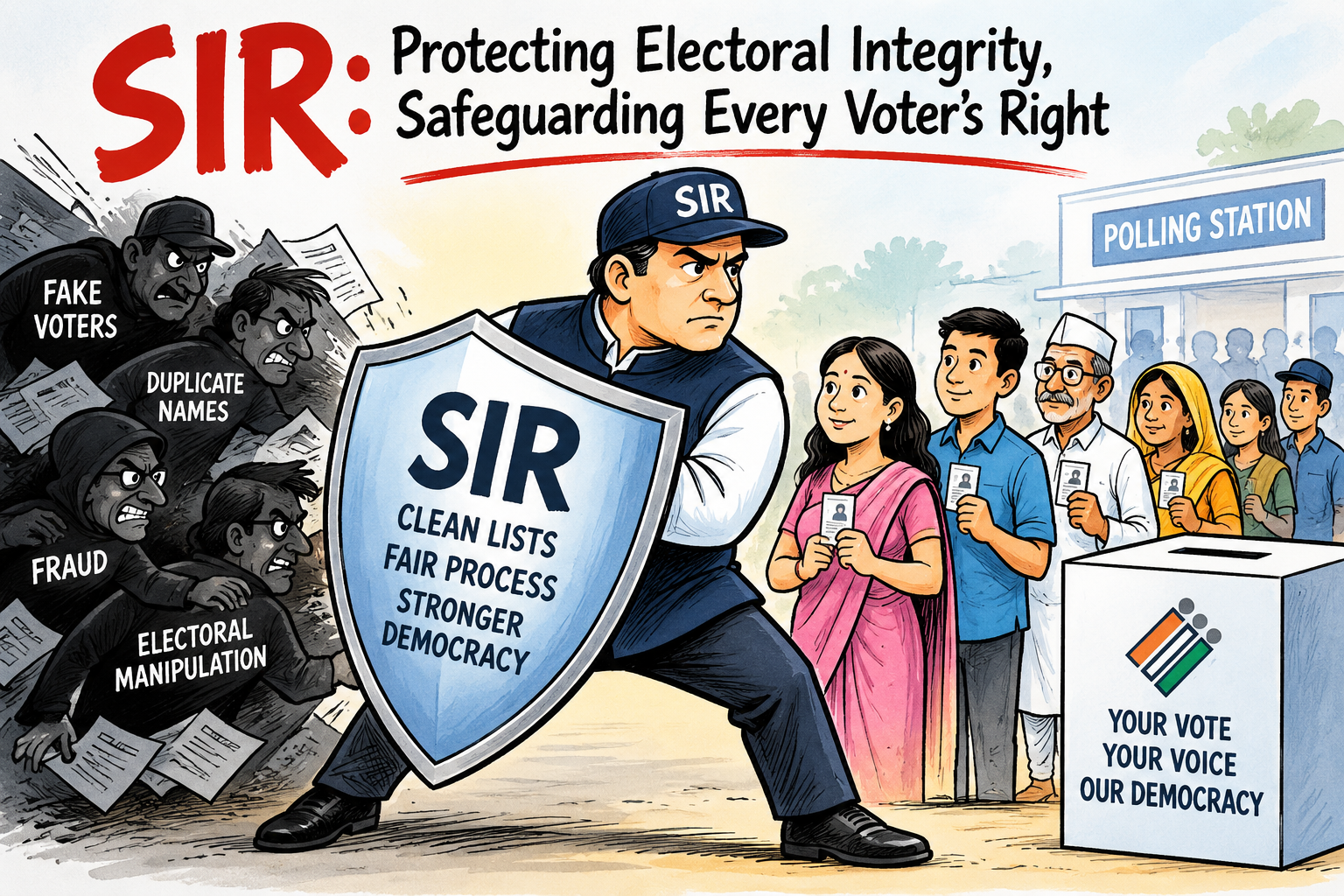
From this perspective, the Special Intensive Revision (SIR) of electoral rolls is an important administrative exercise. However, its success cannot be measured merely by the removal of incorrect or ineligible names. It must equally be judged by whether the names of all eligible citizens are protected and whether those who have been inadvertently left out are brought back into the electoral rolls.
In 2026, the Election Commission has extended the SIR exercise to several states and Union Territories. The Commission’s programme includes house-to-house verification, publication of draft electoral rolls, inviting claims and objections, and publication of the final electoral rolls.
It is also important to note that on May 27, 2026, the Supreme Court upheld the legal validity of the SIR conducted in Bihar and held that the Election Commission has the authority to undertake such an exercise under Article 324 of the Constitution and the relevant provisions of the Representation of the People Act. The Court also recognised that the objective of ensuring the accuracy of electoral rolls and protecting free and fair elections constitutes a legitimate purpose.

The large-scale deletion of names during the SIR has naturally generated political and social debate. However, it is unfortunate when unnecessary controversies are created around the Election Commission and the Chief Election Commissioner. According to the available data, the combined electoral rolls of nine states and three Union Territories declined by 10.2 percent after the SIR, with the names of 6,688,636 deceased voters being removed.
In the same exercise, 63.16 lakh names were also deleted following objections and verification. These figures should not be viewed solely through a political lens. On the one hand, they indicate the administrative necessity of removing the names of deceased, shifted or duplicate voters. On the other, such a large-scale change in the electoral rolls also underlines the importance of keeping voter lists regularly updated.
This is where the most important test of the entire exercise emerges. If removing the name of an ineligible person is necessary for the purity of democracy, then the erroneous deletion of an eligible citizen’s name is equally serious. The real success of SIR lies in maintaining a balance between cleansing the electoral rolls and safeguarding the voting rights of citizens. From this perspective, the Election Commission’s recent special campaign is significant.
On October 2, 2026, the Commission directed states and Union Territories where the SIR had been completed to undertake a special campaign to re-enrol eligible voters whose names may have been left out during the revision process. Special emphasis has also been placed on the registration of first-time voters and newly eligible young citizens.
Under this campaign, Booth Level Officers have been asked to compare the electoral rolls existing before the SIR with the current rolls and identify people whose names were previously present but do not appear in the final list. Thereafter, house-to-house verification is to be undertaken, and Form 6 is to be accepted on the spot from those found eligible.
Each Booth Level Officer has been given a target of verifying 20 to 25 voters every week, with the campaign expected to be completed in approximately one month. The direction to share the relevant lists with Booth Level Agents of political parties is also noteworthy from the standpoint of transparency.
This is precisely where the electoral-roll revision process needs to move beyond political allegations and counter-allegations. Opposition parties have made serious allegations regarding the SIR process, arguing that it could adversely affect the voting rights of eligible citizens. The Election Commission, on the other hand, maintains that its objective is to ensure the accuracy and integrity of the electoral rolls.
Between these two positions, the final conclusion should emerge not from political rhetoric but from transparent data, documentary evidence, effective mechanisms for claims and appeals, and independent scrutiny. It would be inappropriate either to automatically accept an allegation made by a political party as the truth or to dismiss every grievance merely as a political allegation.
The constitutional role of the Election Commission is of immense importance in Indian democracy. Maintaining the integrity and accuracy of electoral rolls is an essential part of that responsibility. Through its digital portal, voters can search for their names, access the final SIR electoral rolls, submit Form 6 for new registration, track the status of applications and lodge complaints. Such mechanisms give citizens an opportunity to verify and safeguard their voting rights themselves rather than depending entirely upon the administration.

However, technology alone is not enough. Given India’s enormous social and geographical diversity, there are citizens who have limited access to digital facilities. The administration must proactively reach the poor, workers, migrants, homeless persons, elderly citizens, persons with disabilities and people living in remote areas. Under the special campaign, the Commission has also directed that special camps be organised at polling booths as well as at night shelters, workers’ settlements and locations serving homeless and other vulnerable groups. This approach connects the electoral-roll exercise not merely with administrative accuracy but with genuine democratic inclusion.
It must also be understood that electoral-roll correction cannot be a one-time exercise. Rapid migration in cities, movement from villages to urban areas, change of residence after marriage, young people attaining the age of 18, deaths and relocation from one place to another are continuous processes. The Election Commission therefore treats voter registration as an ongoing process and provides eligible citizens with the facility to register through Form 6. The real challenge is that behind every name deleted during a revision exercise there may be a genuine citizen.
Therefore, every deleted name must be examined carefully, and every grievance must be heard seriously. At the same time, it would not be appropriate to retain every old name merely because it appeared on an earlier electoral roll. The principle governing electoral rolls in a democracy should be clear: no eligible citizen should be left out, and no ineligible person should remain within the electoral system.
The strength of a democracy is not measured merely by a high voter turnout. It also means that every eligible citizen who wishes to vote must have a place on the electoral roll; that the name of every person who is legally ineligible must be removed through due process; that every complainant must be given an opportunity to be heard; and that final decisions must be taken through a transparent procedure.
The Supreme Court’s recognition of the legal validity of the Bihar SIR also underscores the constitutional importance of maintaining accurate electoral rolls, while simultaneously making adherence to the safeguards prescribed in the process essential. Therefore, the need of the hour is not merely to take a position for or against SIR. More important is to make the process so transparent, accessible and credible that no eligible citizen has to struggle to protect his or her right to vote.
The strength of Indian democracy lies not merely in conducting elections, but in ensuring that every eligible citizen receives an equal opportunity to participate in them. Cleansing the electoral rolls is, in a sense, an essential exercise in keeping democracy clean. But the responsibility to ensure that no innocent and eligible citizen is inadvertently left outside that process is equally significant. SIR will fulfil its larger democratic purpose only when electoral accuracy and democratic inclusion move forward together.