


Meghalaya & Manipur Worst Hit
 KRC TIMES Desk
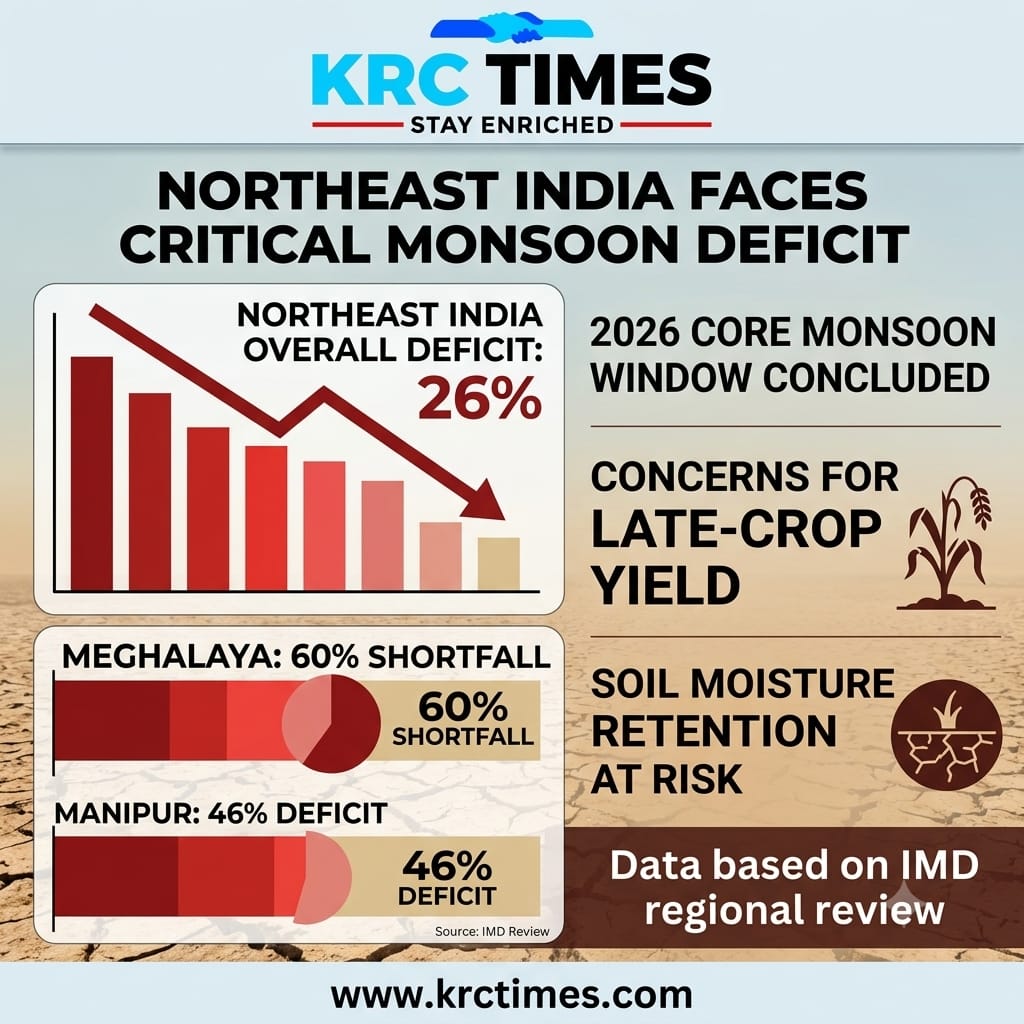
The India Meteorological Department (IMD) concluded its comprehensive review of the 2026 southwest monsoon (June 1 to September 30), revealing that East and Northeast India experienced their steepest precipitation deficits in modern recording history. Overall, Northeast India closed the core monsoon season with a 26% cumulative rainfall shortfall, recording only 74% of its Long Period Average (LPA).
State-Wise Breakdown: Meghalaya & Manipur Worst Hit
While the southwest monsoon typically brings torrential rains to the region, precipitation remained highly erratic and subdued across most Northeastern states:
- Meghalaya (-60%): Recorded the sharpest decline in the country, slipping into the “large deficient” category. 10 out of its 11 districts registered severe deficits, receiving just around 1,077.1 mm against seasonal norms.
- Manipur (-46%): Faced acute shortfalls across both valley and hill districts, registering a 45–46% deficit that hampered primary paddy cultivation cycles.
- Arunachal Pradesh (-44%): Substantial deficit across the Himalayan river basins, affecting catchment reservoirs.
- Assam (-28%): Below-normal precipitation throughout the Brahmaputra and Barak basins, alternating between localised dry heatwaves and isolated short-burst showers.
- Mizoram (-19%) & Tripura (-16%): Remained on the lower boundary of the normal-to-deficit threshold.
- Exceptions (Sikkim & Nagaland): Bucked the regional trend, registering +10% and +6% above-normal rainfall, respectively.
Divergence from IMD Seasonal Forecasts
In its Long-Range Forecast issued in late May, the IMD had anticipated a near-normal monsoon over Northeast India (pegged at 94% to 106% of the LPA). However:
- Persistent anti-cyclonic circulations, weak Arabian Sea/Bay of Bengal branch interaction over the eastern subcontinent, and unfavourable Madden-Julian Oscillation (MJO) phases shifted the primary rain-bearing monsoon troughs away from the hills.
- This resulted in a sharp negative departure (-26%), marking the season among the driest recorded since 1901.
Agricultural and Ecological Implications
- Sali Paddy Stress: In Assam and Manipur, where rainfed Sali (winter rice) depends on sustained August–September rainfall for panicle initiation and flowering, prolonged dry intervals have created moisture stress in non-irrigated belts.
- Soil Moisture Depletion: Agricultural departments have raised concerns for the impending Rabi (winter) crop season (mustard, pulses, winter vegetables), as residual soil moisture in post-monsoon clay-loam fields is well below baseline levels.
- Hydrological & Tea Yield Concerns: The Barak and Surma basin feeders, alongside secondary tributaries of the Brahmaputra, recorded lower-than-average discharge, affecting mini-hydro plants and late autumn tea flush quality across the gardens of upper Assam and southern Assam (Barak Valley).
Outlook Ahead
The IMD Regional Meteorological Centre (RMC), Guwahati, noted that with the southwest monsoon entering its withdrawal phase across northern and eastern India in early to mid-October, Northeast India must rely on post-monsoon northeastern winds and Western Disturbances to replenish groundwater before the dry winter sets in. Agro-meteorological advisories have recommended that farmers adopt moisture-conservation techniques and micro-irrigation where feasible.