


The Centre is also moving towards biometric verification for cross-border movement within a 10-km border belt as part of changes to the existing Free Movement Regime (FMR)
 KRC TIMES Manipur Bureau
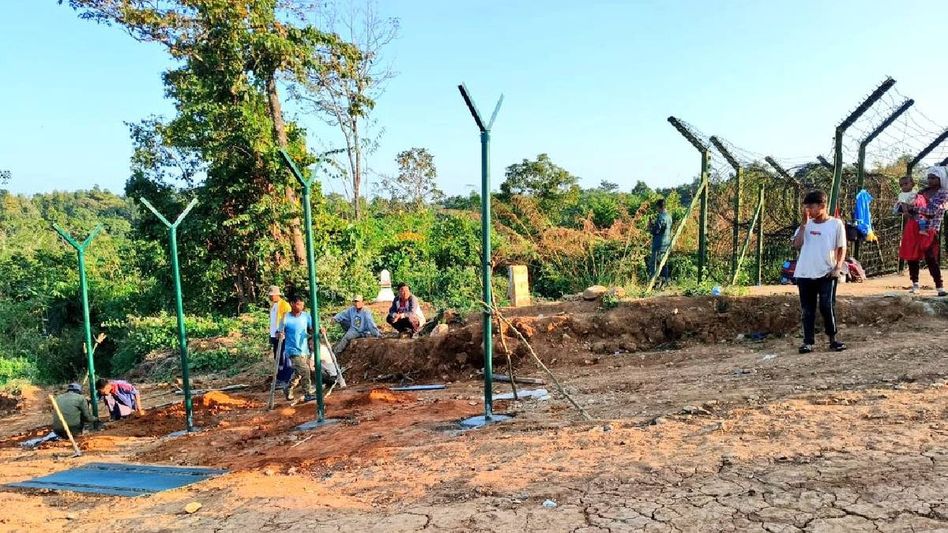
Imphal | Manipur Governor Ajay Kumar Bhalla has reviewed the progress of the Centre’s ?31,000-crore India-Myanmar border fencing project, stressing the need to complete the work within the stipulated timeframe.
The review took place during a security meeting at Lok Bhavan on Thursday, where officials also discussed law and order in border areas and measures to strengthen security arrangements.
The project covers the 1,643-km international boundary shared by Arunachal Pradesh, Mizoram, Manipur and Nagaland. Officials highlighted challenges including land acquisition, difficult terrain, boundary disputes and opposition from sections of local communities.
Colonel Dev, Commanding Officer of the Border Roads Task Force (BRTF), briefed the meeting on the progress of the fencing project. The Border Roads Organisation (BRO) is responsible for executing the construction work.
The meeting was attended by the state’s chief secretary, security adviser, director general of police, additional chief secretaries, the home commissioner and senior officials from Assam Rifles and the BRTF. District officials from Ukhrul, Churachandpur, Chandel and Tengnoupal also presented updates on security conditions and construction activities in their respective areas.
Progress along the international boundary
The India-Myanmar border stretches across four northeastern states, with 520 km in Arunachal Pradesh, 510 km in Mizoram, 398 km in Manipur and 215 km in Nagaland.
According to administrative information presented during the review, 1,472 km of the international boundary has been demarcated, while around 171 km remains unresolved because of legal and geographical complications. Boundary-related difficulties have also affected work in parts of Manipur’s Chandel district.

In the Moreh sector, 9.214 km of fencing, along with a parallel patrol road, has been completed. Work has also been authorised for an additional 20.862 km stretch.
Electronic surveillance under trial
Alongside physical fencing, authorities are exploring technology-based surveillance systems to strengthen monitoring along vulnerable sections of the border.
Assam Rifles is implementing two pilot projects under the Hybrid Surveillance System (HSS), one each in Manipur and Arunachal Pradesh. Each pilot covers a one-kilometre stretch to assess the effectiveness of virtual fencing and electronic surveillance.
Depending on the outcome of the trials, the system is proposed to be extended to an additional 83 km of the border.
The Centre is also moving towards biometric verification for cross-border movement within a 10-km border belt as part of changes to the existing Free Movement Regime (FMR). The proposed arrangements could significantly affect how residents of border communities cross the international boundary.
Terrain and local opposition pose challenges
Officials identified difficult mountainous terrain, delays in land acquisition, opposition from Naga and Mizo organisations and occasional militant attacks as major obstacles to the project’s implementation.
During a visit to Kamjong district on October 21, Manipur Director General of Police Mukesh Singh and other senior police officials met representatives of Assam Rifles and the Border Security Force (BSF) to assess the security situation and improve coordination among the forces.
The team also interacted with representatives of Kuki and Naga civil society organisations and assured them of government support for restoring peace in the area.
The border fencing project is intended to strengthen surveillance and curb infiltration, smuggling and other illegal activities. However, its timely completion will depend not only on construction progress but also on resolving land and boundary disputes, addressing local concerns and maintaining security in the border regions.



