When formal appeals, memoranda, and political delegations fail to elicit tangible safeguards, the populace turns to symbolic disruption
 Biswadeep Gupta
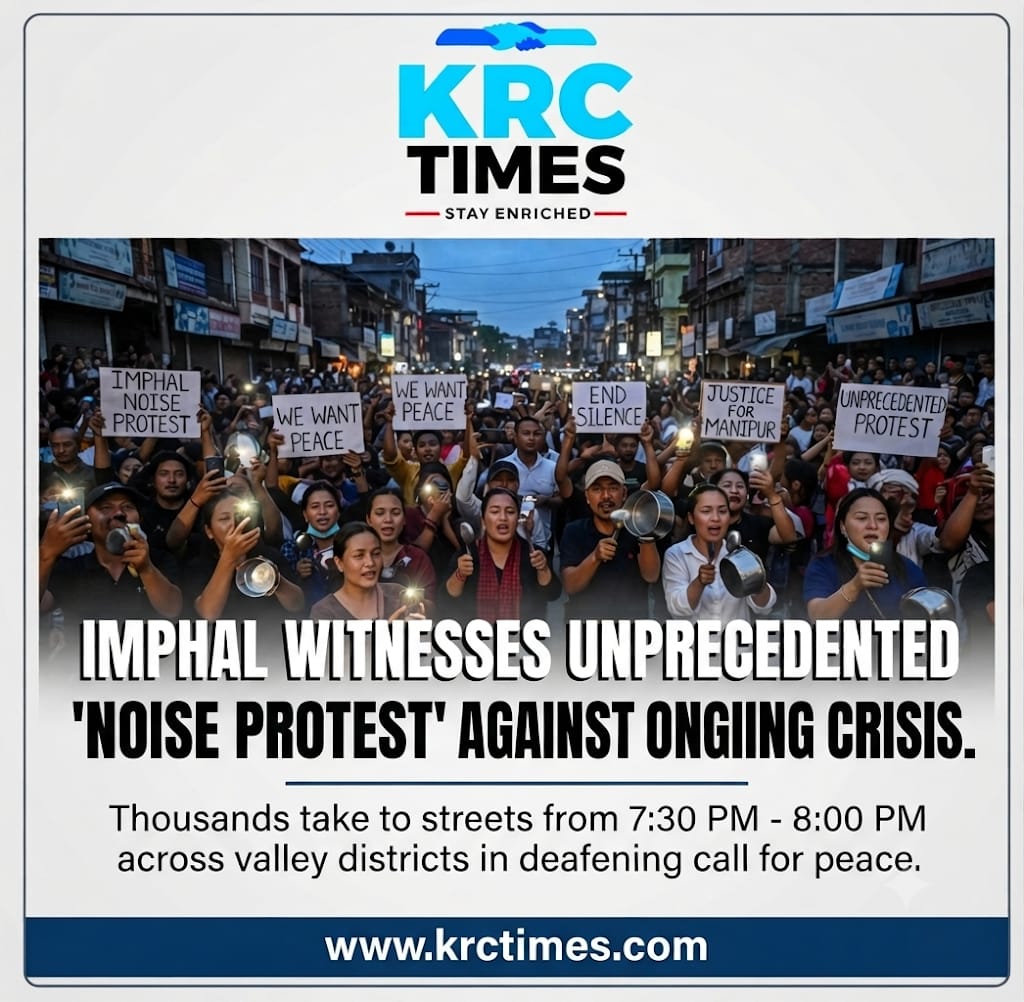
The recent outbreak of a synchronised “noise protest” across Manipur’s five valley districts, spearheaded by the Federation of Haomee (FoH), marks a profound shift in civil expression against the prolonged ethnic conflict. Thousands of citizens took to the streets, banged utensils, struck electric poles, blared vehicle horns, and briefly plunged neighbourhoods into darkness to register their deep-seated frustration over continuing violence and administrative inaction.
The noise protest march in Imphal has witnessed an unprecedented turnout, with mothers carrying infants on scooters and children walking alongside their parents. Carried out in a highly disciplined manner, without a hint of violence, the demonstration is historic, peaceful, and truly one of a kind.
This mobilisation was triggered by mounting public outrage over recurring killings and an escalating sense of nsecurity, prompting citizens to demand concrete state and central accountability. Between 7:00 PM and 8:00 PM of 23rd October 2026, residents in Imphal and surrounding valley areas transformed the night air with discordant noise—beating drums, striking metal plates and poles, and organising vehicle rallies.

Prominent civil society voices underscored critical political demands, including the abrogation of the Suspension of Operations (SoO) pact with specific militant groups, the updating of the National Register of Citizens (NRC) in Manipur, and a definitive end to escalating civilian vulnerabilities. As crowds swelled and marched toward historical landmarks like the Western Gate of Kangla Fort, heavy security barricades met the demonstrators, resulting in police firing tear gas shells and smoke bombs to disperse the crowds.
When an entire society resorts to banging utensils and striking iron poles in the dead of night, it signals a complete breakdown of conventional dialogue between the governed and the governing. The “noise protest” witnessed across Imphal was not merely a spontaneous outburst of public annoyance; it was a carefully channelled manifestation of collective exhaustion. For months, the valley districts have lived under the heavy shadow of prolonged strife—marked by displaced populations, interrupted livelihoods, and a recurring cycle of violence that defies easy political resolution.
When formal appeals, memoranda, and political delegations fail to elicit tangible safeguards, the populace turns to symbolic disruption. The message behind the noise is piercingly simple: if words and pleas are met with official apathy, the silence must be broken by sound.
However, heavy barricades around cultural and historical flashpoints like Kangla Fort highlight a troubling security reflex. Suppressing democratic dissent—even when expressed unconventionally through cacophony rather than placards—risks further alienating an already aggrieved populace.
Addressing this public anguish requires the administration to recognise that frustration stems from structural security deficits. Tackling core demands regarding transparency, law enforcement efficacy, and border and internal security protocols is vital to restoring public trust. Civil society groups like the Federation of Haomee reflect deep-seated community anxieties, meaning that rebuilding a credible bridge between state leadership and local stakeholders requires transparent engagement rather than reactive crowd-control measures.

At the same time, while citizens have a democratic right to express anguish, maintaining civic order prevents situations from devolving into structural friction with security forces, ensuring that the core message of peace is not lost in urban gridlock or minor clashes.
For months, both the valley and hill districts have lived under the heavy shadow of prolonged strife—marked by displaced populations, interrupted livelihoods, and a recurring cycle of violence that defies easy political resolution.
“The time has come for a wake-up call for all stakeholders: there is no alternative to peace, and both the State and Central governments are duty-bound to achieve this goal and fulfil their constitutional responsibilities.”
Whether this demonstration will finally push the Manipur conflict toward a resolution remains to be seen. Yet with elections looming, the message to political parties is undeniable: rethink your strategy and demonstrate real leadership. Policymakers are at a critical crossroads, and the voters’ ultimatum is clear—bring peace before seeking votes.