

f Eisenkot succeeds within his 28-day window (with a potential 14-day extension available from the President), it will officially end Netanyahu’s prolonged tenure and dramatically reconfigure Israel’s domestic and foreign policy landscape.
 KRC TIMES Desk
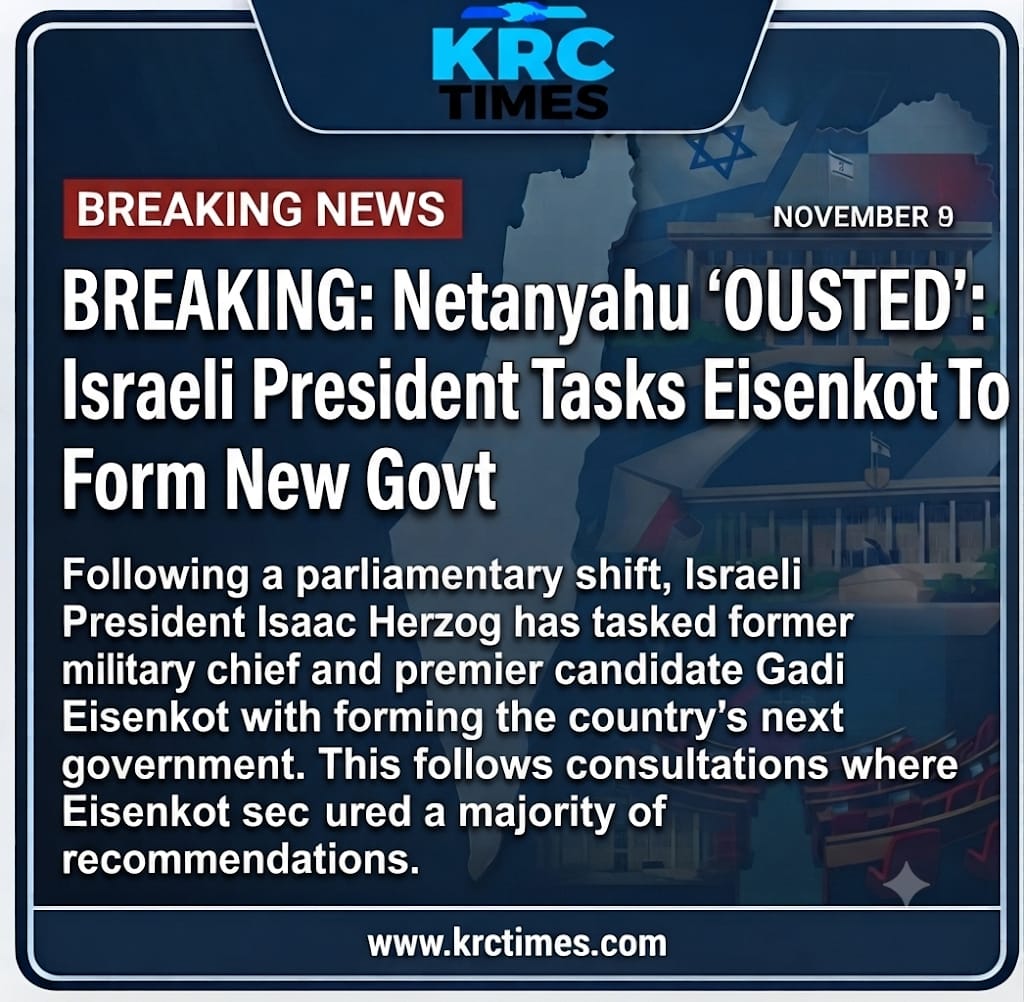
In a monumental political earthquake shaking the Israeli establishment, President Isaac Herzog officially tasked opposition leader and Yashar party head Gadi Eisenkot with forming the country’s next government.
The decisive move comes after parliamentary consultations revealed that the former military chief secured recommendations from 67 members of the 120-seat Knesset, significantly outpacing incumbent Prime Minister Benjamin Netanyahu, whose right-wing bloc plummeted to 46–53 seats.
A High-Stakes Mandate
Accepting the mandate at the President’s Residence, Eisenkot was handed a 28-day constitutional clock to forge a viable governing coalition. Declaring that Israel faces an unprecedented “time of emergency,” Eisenkot vowed to take “creative and unconventional political acts” to bridge deep national divides.
“Israel does not have the privilege of wasting time or repeating endless rounds of elections,” Eisenkot stated. “No one will be able to fulfill all the promises they made, and all of us will need to compromise.”
A Major Blow to Likud
The development marks a severe setback for Benjamin Netanyahu, Israel’s longest-serving prime minister, whose grip on power has been severely undermined. Following the electoral shift, Netanyahu’s coalition fell well short of the 61-seat threshold required for a parliamentary majority.
Struggling to retain political survival, Netanyahu previously called for a “national unity” government and launched aggressive public challenges—unsuccessfully—accusing Arab parties of undermining the electoral process.
The Road Ahead: Complex Coalitions
Eisenkot faces an uphill battle to turn his parliamentary recommendations into a stable governing coalition:
- The Arithmetic: While Eisenkot’s bloc and potential outside allies mathematically clear the threshold, bridging ideological chasms remains daunting.
- The Hurdles: Key coalition partners heavily oppose relying on Arab-led factions, while ultra-Orthodox parties demand exemptions from mandatory military service—a policy Eisenkot’s centrist platform vehemently opposes.
- The Outreach: In a surprise pivot, Eisenkot left the door open to elements of the right, pointedly inviting members of Likud and the Religious Zionist Party to join a national emergency government under his leadership.
If Eisenkot succeeds within his 28-day window (with a potential 14-day extension available from the President), it will officially end Netanyahu’s prolonged tenure and dramatically reconfigure Israel’s domestic and foreign policy landscape.