AI should be used to challenge assumptions, simulate opposing viewpoints, and stress-test ideas, rather than to bypass the heavy lifting of intellectual labour. The hard work of learning—the messy, frustrating, irreplaceable struggle of wrestling with a blank page or a complex problem—is precisely what builds human capability
 5E for Success
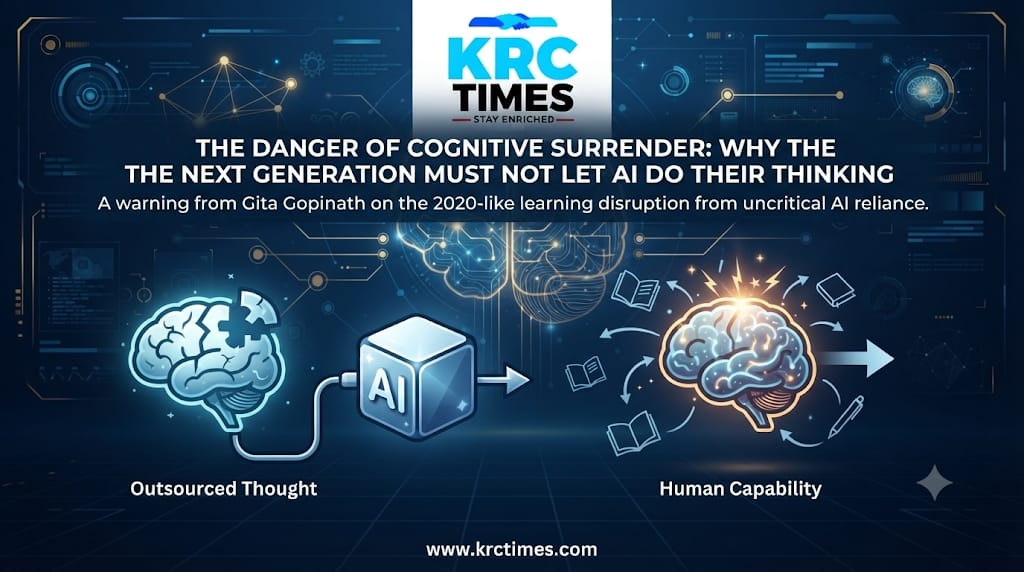
The digital age has gifted humanity an unprecedented co-pilot. With a few keystrokes, generative artificial intelligence can draft emails, summarize complex legal text, write code, and synthesize global research in seconds. But as former IMF First Deputy Managing Director Gita Gopinath recently warned during a podcast appearance, this dazzling utility carries a hidden, profound risk: cognitive surrender.
Drawing an evocative parallel to the 2020 COVID-19 pandemic—when millions of students suffered massive, disruptive learning losses—Gopinath cautioned that uncritical reliance on AI threatens to create a similar generation of hollowed-out skill sets. Her message to 25-year-olds entering the workforce is a sharp reality check: AI is a force multiplier for experts, but a total substitute for the uninitiated.
To understand why this warning matters, look past the corporate hype of the ongoing tech boom.
The Illusion of Competence
When a veteran researcher or an experienced strategist uses an AI model, they are exercising deep domain expertise. They possess the mental scaffolding required to cross-examine the output, spot hallucinations, discard superficial logic, and refine the final product. The AI acts as an accelerator because the human already knows what a good outcome looks like.
For a young professional or student who has not yet built that foundation, however, the dynamic is entirely inverted. When you outsource the struggle of problem-solving, writing, and critical analysis to an algorithm before mastering the basics, you are not working smarter—you are bypassing the cognitive friction required to build a brain.
Learning is inherently structural. It requires wrestling with difficult concepts, making mistakes, failing, and recalibrating. If an algorithm absorbs all that friction on your behalf, it doesn’t just do your work; it robs you of your development. You become an editor of machine outputs rather than an author of original thought.
The Economic Fallout
Gopinath’s caution extends beyond individual competence to the broader macro-economic landscape. As global markets pour trillions into AI infrastructure, corporate boardrooms are eager to chase productivity gains. Yet, true productivity requires a workforce capable of innovation, oversight, and deep problem-solving—not merely workforces that know how to prompt a chatbot.
If a generation enters the economy having outsourced its critical thinking to software, companies will eventually find themselves facing a severe deficit of deep institutional knowledge and genuine expertise. Automation without foundation leads to systemic fragility.
Reclaiming the Human Edge
The takeaway is not to reject artificial intelligence—such a stance is both futile and regressive. Instead, the mandate for the modern professional is one of disciplined intent.
AI should be used to challenge assumptions, simulate opposing viewpoints, and stress-test ideas, rather than to bypass the heavy lifting of intellectual labour. The hard work of learning—the messy, frustrating, irreplaceable struggle of wrestling with a blank page or a complex problem—is precisely what builds human capability.
As technology continues to accelerate, our greatest competitive advantage will not be how fast our tools can think for us, but how well we can think for ourselves. Surrender that capacity, and we risk losing far more than efficiency; we risk losing our intellectual independence.