


India is going through a churn in the educational system in which old equations are being challenged
 KRC TIMES Desk
Madhavan Narayanan
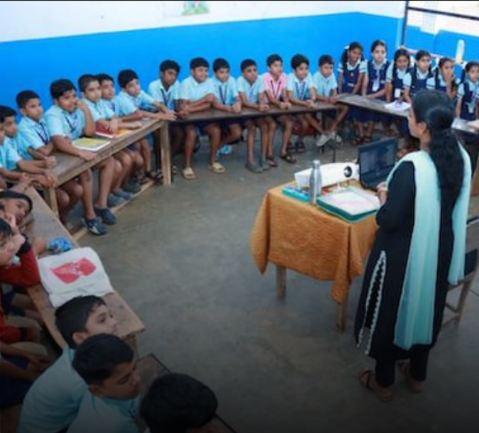
Where does teaching end and learning begin? Or should that be the other way around? I asked myself these profound questions last week as news arrived from Kerala of a small step with revolutionary intent. Ramavilasom Vocational Higher Secondary School at Valakom decided to remove the concept of ‘backbenchers’ by introducing a circular seating arrangement in classrooms.
Human beings are quite inertial it takes some fresh inspiration to turn things around. As it happens, the south Kerala school was jolted by a Malayalam movie, Sthanarthi Sreekuttan, to do away with traditional rows of benches and bring in single rows along the four walls of a classroom where every kid looks like a side-bencher.
The movie’s ideas have also crossed borders. While a Punjab school jumped eagerly on the idea, a circular from the education department in Tamil Nadu ran into rough weather. Tamil Nadu has insisted on implementing a somewhat semi-circular arrangement resembling the Tamil letter pa as a symbol of open minds after some social media protests on the ground that it was impractical.
However, the idea of innovative seating is not new to Tamil Nadu, which introduced circular seating on the floor for activity-based learning two decades ago. The ideas were inspired by experiments at the Krishnamurti Foundation (which runs the Rishi Valley School, among others) and the Montessori method that emphasises peer learning and collaboration to help children grow on their own.
Tamil Nadu had then enforced circular floor seating in more than 38,000 primary schools and swapped large blackboards for teachers to smaller ones for kids with six-student teams seated in circles overseen by teachers-turned-mentors.
Classroom design involves pedagogy, pragmatism and politics. The plot of the Malayalam movie centres around struggles, aspirations and identity conflicts in classrooms. I spent my high school years on a backbench, and my seat-mates went on to become highly educated entrepreneurs. That is understandable because we were classified as tall students, not laggards.
Where I come from, backbenchers were often too-clever-by-half students who would raise questions or offer comments that would embarrass teachers or trigger adolescent giggles from classmates. Understandably, the same rule applied in the British House of Commons. In BBC’s cult comedy, Yes, Minister, Jim Hacker, the troubled and troubling politician in the title role, is often worried about what parliamentary backbenchers would say about his proposals.
But it must be acknowledged that in primary schools across India, backbenchers have often been stigmatised, and thus, the movie has triggered a healthy debate. One man’s ‘stakeholder’ can sometimes be another’s ‘vested interest’, leading to a ‘class struggle’ distinct from the Marxist variety.
We are into new-age pedagogy under which the Aam Aadmi Party even framed a ‘happiness curriculum’ to cheer kids in Delhi’s government schools when it was in power. A classroom has historically been a theatre of sorts, but not every teacher is a good performer. Nor is every student an eager audience. Some need the teacher to reach across, in which case the circular arrangement is a good thing.
I have childhood memories of being awestruck by a visit to my father’s high school in rural Tamil Nadu. His school, built by a wealthy zamindar, had galleries that made the classroom a mini amphitheatre. By being perched above, the backbencher would look down on the teacher, perhaps sending a more-than-equal message, while the teacher could actually look each student in the eye and address them suitably.
Krishna Palepu, an acclaimed professor from Harvard Business School, once explained to me that HBS had seating arrangements to help students learn better. His MBA students were usually experienced professionals, often hailing from business families and his role often involved facilitating them to learn from each other rather than being a grandstanding pedagogue.
HBS classrooms, especially for case studies, use a tiered, curved seating arrangement with continuous writing surfaces designed to help interaction and discussion-based learning.
Tina Grotzer, principal research scientist on education at Harvard University, wants students to change their seating arrangements now and then during a semester because fixed patterns can make “dialogic possibilities” more difficult. All of this should help us understand Mark Twain’s insightful quote: “I have never let my schooling interfere with my education.”
The better teachers try their best to outwit Twain so that they can shift schools to match the humourist’s self-service menu, in line with Maria Montessori’s reverse-swing pedagogy. Environmental psychologist Robert Sommer says a teacher should be able to justify the arrangement of desks and chairs on the basis of goals. He talks about the lighting and the blackboard view with the sensitivity of a movie director composing a scene.
A German study of fourth-graders once tried to examine whether different seating arrangements led to students asking more questions. The results showed questions were more frequent when the children were seated in a semicircular arrangement than in rows. That should certainly evoke smiles in India, where a currently popular ad for computers targeting interactive students features a spoilsport teacher who screams: “Just by-heart it!”
One thing is clear: India is going through a churn in the educational system in which old equations are being challenged. And schools are just not what they used to be.

Know More – Apply Here