The sharpest takeaway from the 2025 figures is the concentration of high unemployment in island territories, coastal tourism hubs, and Northeastern states
 5E for Success
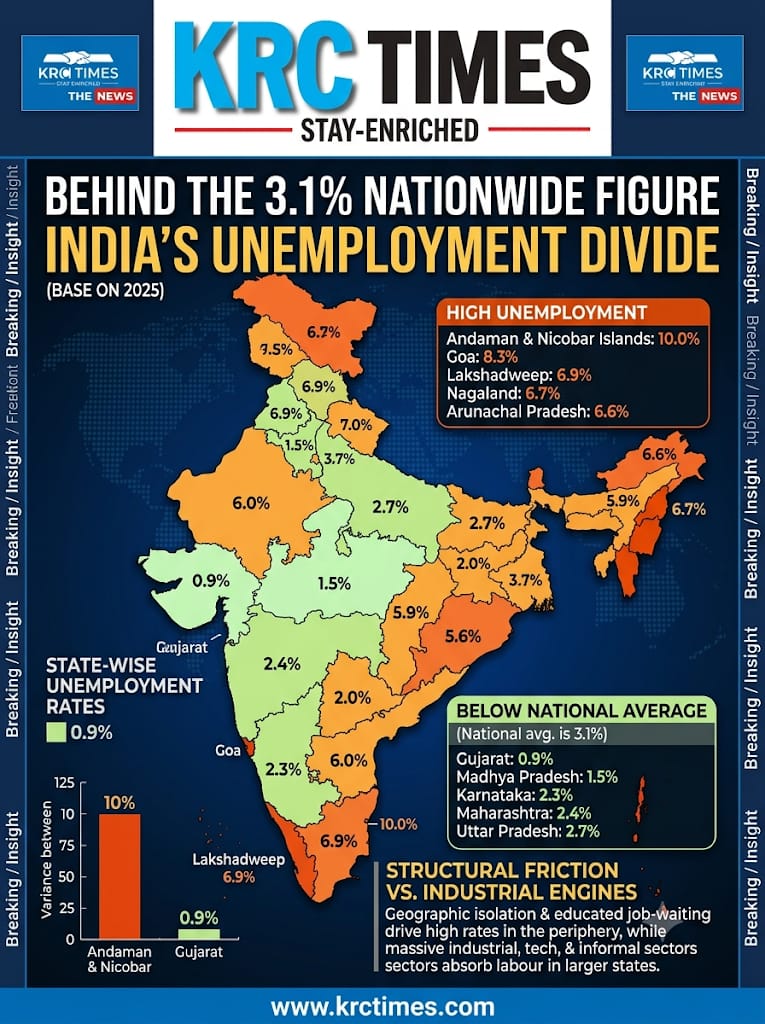
At first glance, India’s labour market in 2025 paints a picture of robust macroeconomic stability. With the national headline unemployment rate settling at a modest 3.1%, the aggregate data suggests that the world’s most populous nation is largely absorbing its massive workforce.
However, a granular look beneath the national average reveals a starkly fragmented reality. Rather than a single unified labour market, India operates as a patchwork of distinct economic zones—where joblessness ranges from near-zero in industrial and agrarian heartlands to high single digits in geographically isolated and service-dependent regions.

5 Advantages of KRC 5E for Success MDP course, powered by KRC Foundation.
Employability training
Internship
Earn while you learn (Work Experience Certificate, subject to selection and performance)
Projects
KRC Membership & Placement assistance.
Send your resume to get a free profiling session and selection.
Email resume: 5eforsuccess@gmail.com
WP: 9330830083
1. The Periphery vs. The Heartland: Geography as Destiny
The sharpest takeaway from the 2025 figures is the concentration of high unemployment in island territories, coastal tourism hubs, and Northeastern states:
- Andaman & Nicobar Islands: 10.0%
- Goa: 8.3%
- Lakshadweep: 6.9%
- Nagaland: 6.7%
- Arunachal Pradesh: 6.6%
The Analytical Takeaway:
These regions suffer from what economists call structural and geographic friction. In island territories like Andaman & Nicobar and Lakshadweep, as well as mountainous states like Nagaland and Arunachal Pradesh, difficult terrain and connectivity bottlenecks limit the growth of large-scale manufacturing or labour-intensive industries.
Furthermore, states like Goa (8.3%) and the Northeastern states generally boast higher literacy rates and higher per-capita income or social indicators. Paradoxically, this often leads to higher educated unemployment. A better-educated youth demographic tends to wait for formal, white-collar, or government jobs rather than settling for low-paying informal work. In Goa and the islands, heavy reliance on seasonal tourism also creates cyclical volatility in job availability.
2. The Engines of Absorption: Why Big States Stay Below Average
In contrast, several of India’s largest and most populous states recorded unemployment rates well below the 3.1% national mark:
- Gujarat: 0.9%
- Madhya Pradesh: 1.5%
- Karnataka: 2.3%
- Maharashtra: 2.4%
- Uttar Pradesh: 2.7%
The Analytical Takeaway:
While all five states sit below the national average, they achieve low unemployment through two very different economic models:
- Industrial and Tech Powerhouses (Gujarat, Maharashtra, Karnataka):
Gujarat’s remarkably low 0.9% rate reflects its deep manufacturing base, thriving MSME ecosystem, port-led infrastructure, and strong culture of self-employment and entrepreneurship. Similarly, Karnataka (2.3%) and Maharashtra (2.4%) benefit from diverse economic engines—combining high-value IT, finance, and modern services in urban centres (Bengaluru, Mumbai, Pune) with expansive industrial corridors and agricultural hinterlands.
- Agrarian, Public Works, and Informal Absorption (Madhya Pradesh, Uttar Pradesh):
In states like Madhya Pradesh (1.5%) and Uttar Pradesh (2.7%), low unemployment figures are heavily driven by high absorption in agriculture, massive state-led infrastructure and construction drives, and a vast informal sector. In lower-income agrarian states, few workers can afford to remain officially “unemployed” (actively seeking work while earning nothing). Instead, surplus labour is absorbed into family farms, gig work, or daily-wage construction.
3. The “Quality vs. Quantity” Conundrum
In labour economics, a low unemployment rate in a developing economy does not automatically equate to prosperity. The 2025 numbers highlight a classic developmental paradox:
- Disguised Unemployment: A 1.5% rate in Madhya Pradesh or 2.7% in Uttar Pradesh often masks underemployment—where too many workers are engaged in low-productivity agricultural or informal tasks because formal industrial jobs remain scarce.
- The Reservation Wage Effect: Conversely, a 6.7% rate in Nagaland or 8.3% in Goa partly reflects higher “reservation wages”—where families have enough social or financial cushion to support young graduates while they hold out for aspirational jobs that match their qualifications.

The Bottom Line: No “One-Size-Fits-All” Policy
The 2025 regional breakdown makes it clear that a single national employment policy cannot solve India’s labour challenges:
- For the High-Unemployment Periphery (Islands, Goa, Northeast): Policy must focus on economic diversification—moving beyond tourism and public-sector jobs toward digital services, remote-work infrastructure, high-value food processing, and sustainable eco-industries that can absorb educated youth without requiring massive factory footprints.
- For the Large Populous States (UP, MP, Gujarat, Maharashtra, Karnataka): The challenge is not merely creating jobs, but transitioning workers—moving labour out of low-productivity informal and farm work into higher-wage, formal manufacturing and modern service roles. Ultimately, India’s 3.1% headline number is a testament to the resilience of its informal and regional economies—but the state-by-state map is a reminder that where a job seeker lives still dictates the opportunities they can access.
Promotional | NEIR Teacher Excellence Award