


Special Report: The Starlink Regulatory Stand-off in India
 KRC TIMES Desk
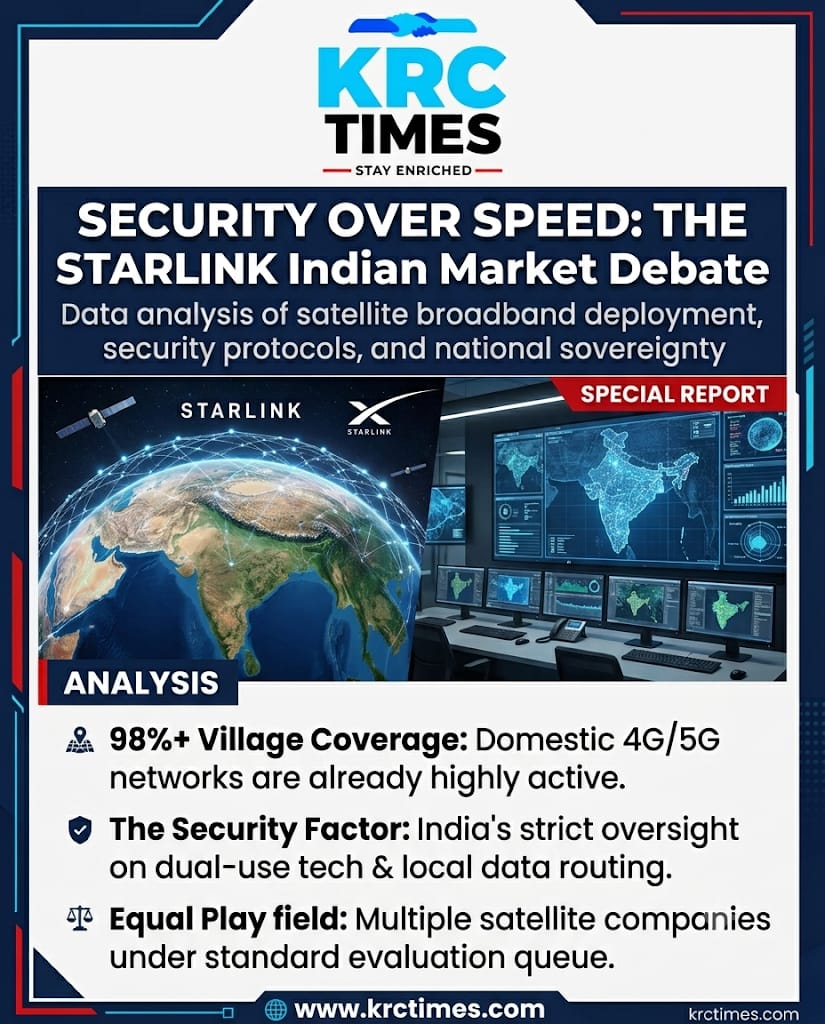
A public debate has emerged over satellite broadband deployment in India following assertions by Elon Musk that domestic “oligarchs” are hindering Starlink’s licensing. An analysis of the data, regulatory frameworks, and national security precedents reveals that the delays are not rooted in monopolistic protectionism, but rather in India’s regulatory compliance norms, consumer economics, and geopolitical risk assessments.
Key Findings & Analytical Breakdown
The Market Reality: Affordability and Existing Penetration
- Tariff Economics: Domestic telecom operators (notably Reliance Jio and Bharti Airtel) provide mobile data at some of the lowest tariffs globally—averaging under ₹5 per gigabyte (compared to global averages exceeding ₹250/GB).
- Rural Coverage: Claims that foreign satellite internet is urgently required to close widespread digital connectivity gaps overlook current terrestrial coverage. Of India’s ~6.4 lakh villages, over 98% already have active 4G/5G mobile broadband coverage, leaving roughly 1.7% (~11,250 villages) without direct access.
- Cost Disconnect: At standard global pricing models ($100–$500 hardware plus monthly subscriptions), Starlink remains primarily an enterprise, institutional, or niche luxury product rather than a viable mass-market rural consumer solution for Indian households.
National Security & Geopolitical Precedents
- Dual-Use Technology Concerns: Satellite constellations such as Starlink operate as dual-use infrastructure capable of shifting geopolitical and military outcomes, as seen in the Ukraine conflict and Iranian civil unrest.
- Sovereign Control: Indian security agencies require strict visibility over telecommunications traffic originating from and terminating within Indian territory. Unmonitored satellite uplinks pose critical threats, highlighted by incident reports where satellite communication hardware was seized alongside weapons caches in sensitive conflict areas like Manipur.
- Data Sovereignty: Regulatory protocols mandate local gateways, end-to-end data localization, and compliance with interception frameworks under the Indian Telecommunications Act—standards Starlink must formally satisfy.
Regulatory Parity: Equal Scrutiny Across Applicants
- The Ministry of Communications has clarified that Starlink is not being singled out. Three major entities in the satellite spectrum domain—including Starlink, Bharti-backed Eutelsat OneWeb, and Reliance’s Jio Space—are undergoing security assessments and clearance protocols.
- Spectrum allocation remains subject to rigorous guidelines regarding administrative vs. auction-based distribution to prevent regulatory arbitrage.
Macroeconomic Resilience & External Narrative Pressures
- Narrative campaigns suggesting international capital hesitation contrast sharply with domestic market dynamics. Despite substantial net Foreign Institutional Investor (FII) outflows in recent years, Indian domestic institutional investors and retail systematic investment plans (SIPs) have anchored the equity markets.
- The regulatory approach reflects India’s long-standing policy: commercial access to critical digital infrastructure is contingent upon local regulatory alignment, data security, and national sovereignty.
Conclusion & Outlook
The delay in Starlink’s Indian launch is fundamentally a policy confrontation between a foreign tech giant attempting to bypass standard regulatory oversight and a sovereign state enforcing strict security, data localisation, and telecom compliance. Commercial operations will likely proceed only once SpaceX commits to transparent local gateway hosting and lawful security architecture.

