

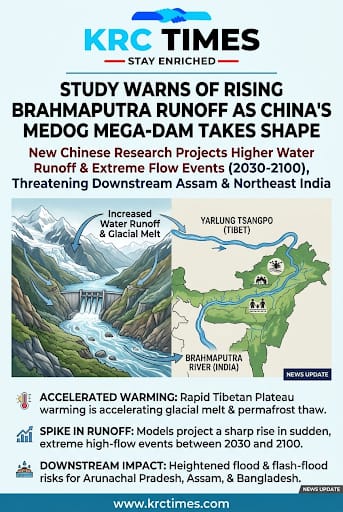
he findings indicate that rapid environmental changes and infrastructure developments will drastically alter water runoff patterns, posing severe downstream flood and flash-flood threats to Northeast India
 KRC TIMES National Bureau
NEW DELHI / GUWAHATI
A disturbing new research study has issued a stark warning regarding the future hydrology of the Brahmaputra River basin, pointing to accelerated climate warming on the Tibetan Plateau and the construction of China’s massive Medog mega-dam.
The findings indicate that rapid environmental changes and infrastructure developments will drastically alter water runoff patterns, posing severe downstream flood and flash-flood threats to Northeast India—particularly Arunachal Pradesh and Assam—as well as Bangladesh between 2030 and 2100.
Key Findings of the Research
- Accelerated Warming on the Tibetan Plateau: Rapid temperature increases in the region are driving accelerated glacial melt and the thawing of permafrost.
- Spike in Extreme Runoff Events: Hydrological models project a sharp, continuous rise in sudden, extreme high-flow events spanning the decades from 2030 to 2100.
- Severe Downstream Vulnerabilities: The altered flow regime significantly heightens the risk of catastrophic floods, erratic discharges, and flash-floods across Arunachal Pradesh, Assam, and Bangladesh.
- Geopolitical & Environmental Concerns: As China advances construction on the massive Yarlung Tsangpo (Brahmaputra) hydropower project in Medog, downstream nations face mounting ecological and water-security challenges.
Implications for Northeast India
For states like Assam and Arunachal Pradesh—which already grapple with devastating annual monsoon floods—the prospect of erratic, climate-amplified surges driven by upstream dam regulation and glacial retreat underscores an urgent need for enhanced cross-border data sharing, advanced early-warning systems, and robust regional disaster-mitigation frameworks.