


Address the Crisis of Demographic Trust
 KRC TIMES Desk
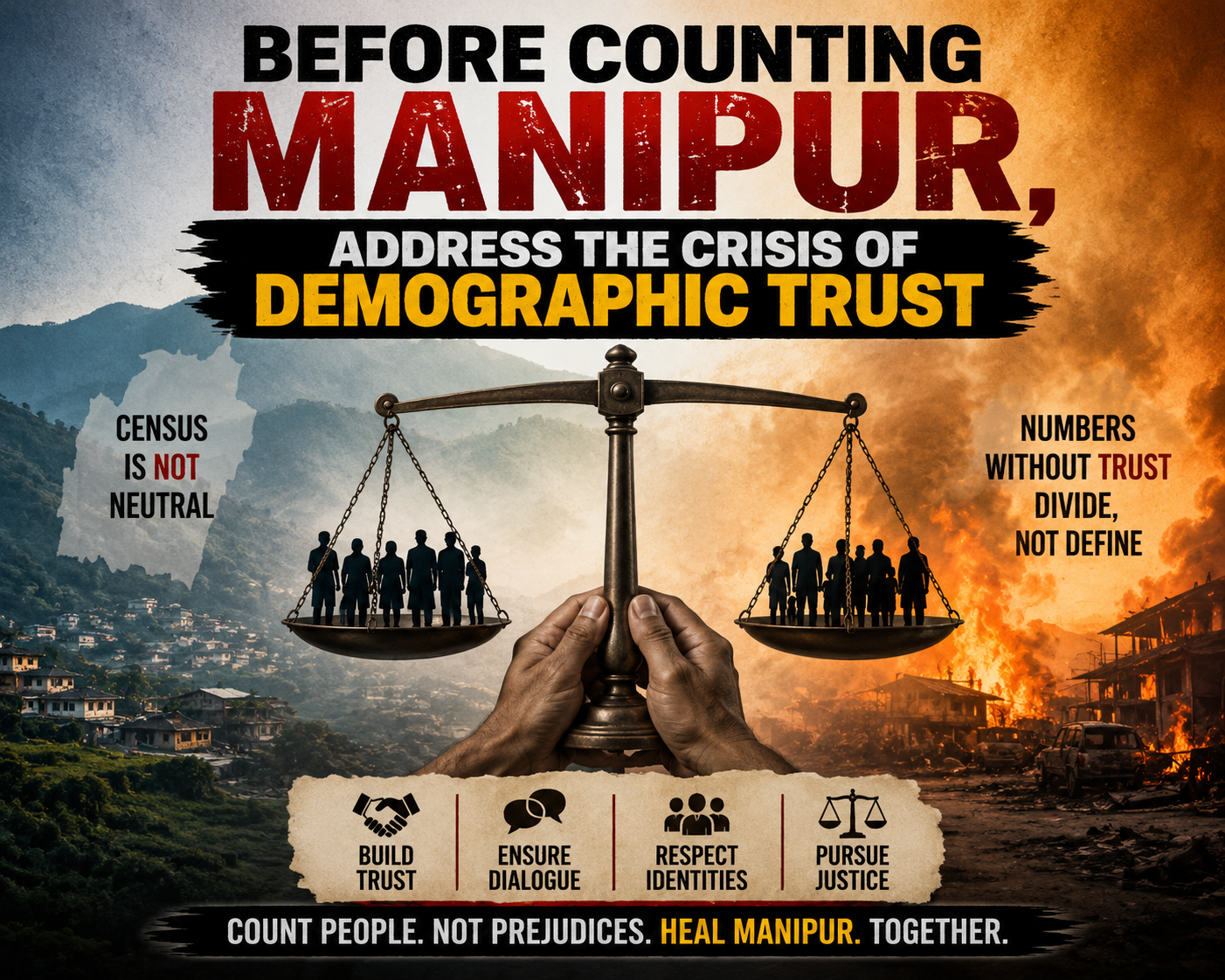
The controversy over conducting the Census before an exercise such as the National Register of Citizens (NRC) in Manipur should not be reduced to a dispute over enumeration schedules. Beneath the immediate demand lies a much deeper crisis of trust over displacement, migration, land, identity, political representation and the ability of the state to protect the interests of its indigenous communities.
That is why the protests surrounding the NRC-before-Census demand deserve a political response rather than merely an administrative one. Manipur undoubtedly needs a Census. Reliable population data are essential for public policy, welfare programmes, infrastructure planning and allocation of resources.
No serious argument can be made against counting people. The more difficult question is whether the demographic picture produced at a time when thousands of people remain displaced by conflict can provide a reliable basis for decisions that may have consequences well beyond the immediate Census exercise.
This distinction is at the heart of the present controversy. A Census in a State Still Living Through Displacement Manipur has been living with the consequences of the violence that erupted in May 2023. Thousands of people have been uprooted from their homes and continue to live away from their original places of residence.

That creates an unusual demographic situation. A family displaced from one district and living in another may be counted where it currently resides. On paper, that may be entirely consistent with the methodology of population enumeration. But the resulting figures could nevertheless present a demographic geography shaped by displacement rather than normal settlement patterns. This is not a technical distinction without consequences.
Population figures eventually become part of the foundation on which governments plan infrastructure, allocate resources and formulate public policy. In politically sensitive states, demographic data can also acquire significance in discussions over representation, delimitation and reservation.
For a state fractured by prolonged conflict, therefore, the question is not simply how many people are present at a particular location on the day of enumeration. It is also about whether the numbers can accurately represent the state’s ordinary demographic structure. That concern deserves a serious institutional examination.
It should not, however, be allowed to become a reason for casting suspicion on entire communities. Displacement is a consequence of conflict, and displaced citizens do not cease to be citizens because they are temporarily living elsewhere. The challenge is to ensure that administrative data do not unintentionally turn the consequences of displacement into a permanent demographic reality.
The Bigger Anxiety Behind the NRC Demand The demand for an NRC before the Census has emerged from a wider debate about who belongs to Manipur, how migration is regulated and how indigenous communities can protect their land and political interests. These are sensitive questions, but sensitivity cannot be an excuse for avoiding them.
Over the years, Manipur has witnessed debates over land ownership, forest administration, constitutional safeguards, migration, tribal status and the protection of indigenous interests. Some of these debates have been deeply contested. Different communities have advanced competing interpretations of history, law and political rights Yet the cumulative effect is important.
When several unresolved questions remain open for years, a new administrative decision rarely remains confined to its immediate subject. The Census has consequently become connected, in the public imagination, with much larger fears about demographic change and political marginalisation. For many of those protesting, the demand is therefore not simply about an enumeration exercise.
It is about whether the indigenous population will retain sufficient demographic and political security to shape its own future. That anxiety may contain claims that require verification. Some allegations may prove exaggerated or unsupported. But dismissing the entire concern as politically motivated or communal would be equally unwise.
A government does not have to accept every claim made by protesters to recognise the legitimacy of their underlying fear. Demography and Political Representation The political implications of population data are another reason the issue has acquired such intensity.
Population figures can influence the distribution of administrative resources and, depending on constitutional and statutory processes, become relevant to questions surrounding electoral representation, delimitation and reservation. This naturally makes demographic change a politically sensitive subject.
Manipur has historically experienced periods of relatively high population growth. According to figures cited in the debate, the state’s decadal population growth was 35.04 per cent in 1961, 37.52 per cent in 1971 and 24.50 per cent in 2011, compared with India’s 17.64 per cent growth during 2001-11. Such figures, by themselves, do not establish the cause of population change.

Send your resume:
biswa@jigyasu.co.in
krcfoundation@gmail.com
Population growth can result from fertility, migration, mortality patterns, administrative reclassification and several other factors. That is precisely why the debate should move from political assertion to credible data. If there are concerns about migration, the answer should be verification.
If there are concerns about undocumented residents, the answer should be lawful identification mechanisms. If there are concerns about displacement, the answer should be accurate demographic accounting. And if there are concerns about political representation, the answer should be a transparent constitutional discussion. Fear cannot substitute for ev- idence. But evidence is also not a substitute for political sensitivity.
Why Political Leadership Failed to Read the Warning Signs Perhaps the most striking aspect of the current episode is not that the NRC-before-Census demand emerged. It is that political leaders appeared to respond only after the issue had already reached the streets. By the time administrative action was taken to cancel a scheduled Census training programme in Lilong on August 19, protests and public mobilisation had already gathered momentum. Students had demonstrated.
Women’s groups had participated. Organisations had submitted memorandums and appeals. A general strike had been called. These developments should have been treated as warning signs. The cancellation may have helped prevent an immediate confrontation, but it also raises a broader question: why was political dialogue not initiated when the concerns were first becoming visible?
Good governance is not simply the ability to retreat from a contentious decision after protests erupt. It is the ability to identify potentially explosive issues early enough to create a space for consultation. Manipur has experienced enough conflict to know the cost of allowing public distrust to deepen. In such an environment, even a routine administrative exercise can acquire political meaning.
That is why the government should have anticipated the reaction rather than waiting for it. Delhi Cannot Always Be the First Stop The reported move by BJP Manipur leaders and legislators to approach the party’s central leadership in New Delhi reflects the importance of the issue. Matters relating to the Census and any possible NRC process inevitably involve the Union government and cannot be resolved entirely at the state level.
Seeking central intervention is therefore understandable. But it also highlights a recurring problem in Manipur’s politics. Too often, political leaders appear to become most active after a local issue has transformed into a crisis. Delegations travel to Delhi, memorandums are submitted and appeals are made to the Centre — after public anger has already intensified. Delhi may ultimately have to take a decision.
But Imphal must first listen. Elected representatives are not merely messengers between the people and the Centre. They are also the first political interface between citizens and government. Their responsibility is to engage communities before confrontation becomes inevitable.
They must explain government policy, test public sentiment, challenge misinformation, negotiate where possible and communicate genuine concerns to the Centre before an administrative controversy becomes a street movement. Political leadership is measured as much by crisis prevention as crisis management. What the Government Should Do Now The immediate priority should be to create a credible mechanism for dialogue.
The Centre and the Manipur government should engage political parties, civil society organisations, student bodies, women’s organisations, community representatives and constitutional experts. The objective should not be to produce an immediate agreement on NRC. Instead, it should be to separate the different questions currently bundled together under the slogan. led together under the slogan.
What exactly are the concerns regarding Census methodology? How should internally displaced persons be recorded? What safeguards exist to prevent temporary displacement from distorting demographic understanding? What evidence exists regarding undocumented migration?
What constitutional and legal mechanisms already exist to protect indigenous land and political interests? Could additional safeguards be considered? And what, if any, relationship would popul tion data have with future questions of representation? These questions should be answered publicly and in accessible language. A transparent process would also help distinguish genuine concerns from misinformation.

That is particularly important because demographic anxieties can rapidly become communal narratives if governments fail to communicate clearly. NRC Must Be Evidence-Based, Not Emotion-Driven There is also a responsibility on those leading the agitation. Demanding an NRC cannot mean treating migration as synonymous with membership of a particular ethnic or religious community.
Nor can demographic concerns justify hostility towards citizens who have been displaced by conflict. Any identification exercise must operate within the Constitution and established law. Claims regarding illegal migration should be investigated through evidence and due process.
Citizenship cannot be determined by political rhetoric or street mobilisation. Likewise, the Census should not become a vehicle for turning one community’s demographic presence into another community’s political accusation. Manipur’s social fabric is already fragile. Any political campaign built around demographic insecurity carries the risk of deepening divisions unless it is anchored in facts and constitutional safeguards.
The objective should be protection, not exclusion. The Question Is Bigger Than the Census The most important lesson from the present controversy is that Manipur’s demographic debate cannot be solved by discussing Census procedures alone. The NRC-before-Census demand has become a political expression of a much wider insecurity. It reflects fears that displacement may permanently alter settlement patterns.
It reflects concerns about migration and undocumented populations. It reflects anxiety over land and indigenous protections. It reflects uncertainty about future political representation. And, above all, it reflects a growing perception among sections of society that the government has not responded adequately to these questions. That perception cannot be dismissed simply because some of the claims behind it may be contested.
At the same time, the government must resist the temptation to respond to public pressure by making decisions without adequate legal and factual examination. There is a middle path — consultation, verification and constitutional safeguards. That is the path Manipur needs. The state should not be forced to choose between conducting a Census and listening to its citizens. It can do both. But before asking people to trust the numbers, the government must explain how those numbers will account for displacement and how they will be protected from being misinterpreted.
The Census should count citizens accurately. An NRC, if pursued, should establish status through law and due process. Political representation should be determined through constitutional mechanisms. And indigenous concerns should be addressed through enforceable safeguards rather than political assurances.
None of these objectives are inherently incompatible. What is incompatible is attempting to govern a deeply divided and conflict-affected society without addressing its underlying crisis of confidence. Manipur does not merely need to know how many people live within its borders. It needs confidence that the institutions responsible for counting, governing and representing its people understand the extraordinary circumstances in which those numbers are being produced. That is why the present agitation should not be viewed merely as a confrontation over a Census timetable.
It is a warning about the distance that has developed between government institutions and a section of the public. The answer should not be another administrative order, another delegation to Delhi or another temporary withdrawal. It should be sustained political engagement. Before Manipur counts its people, its leaders must listen to them.
And before demographic numbers are allowed to shape the state’s political future, the government must ensure that those numbers are understood in the context of displacement, conflict and constitutional rights. That is the real issue beneath the NRC-before-Census debate — not whether Manipur should be counted, but whether its people can trust the process by which they are counted.