


What is unfolding in the city is not merely a sanitation problem; it is a test of collective responsibility and administrative accountability
 KRC TIMES Desk
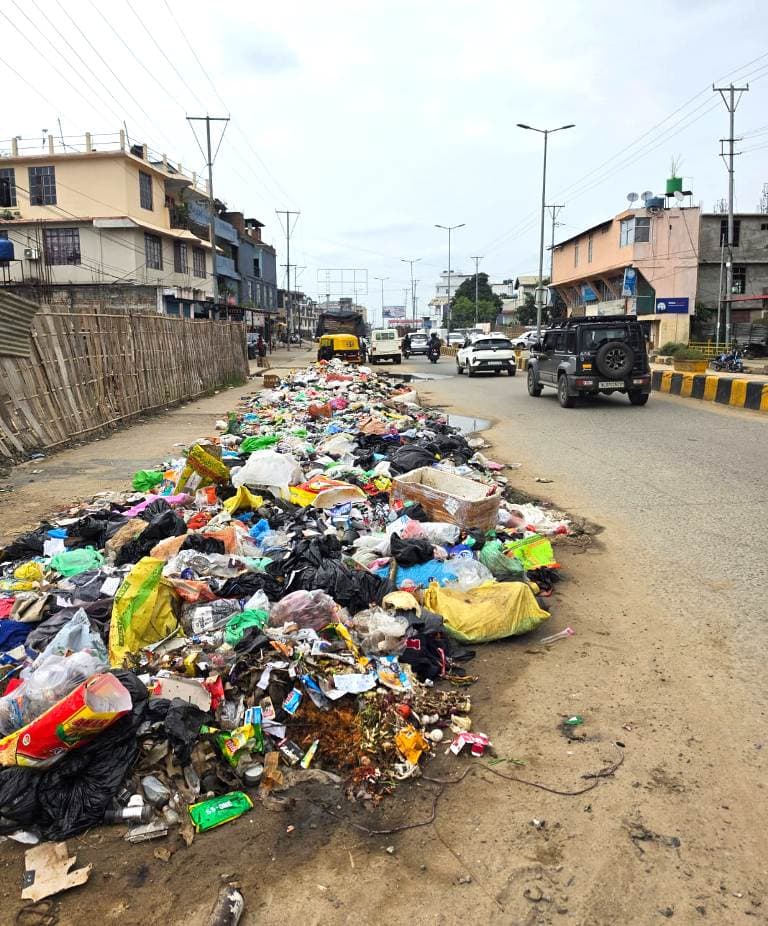
Dimapur, Nagaland’s commercial capital and one of the Northeast’s fastest-growing urban centres, is confronting a challenge that extends far beyond overflowing garbage bins and clogged drains. The mounting waste crisis has become a stark reminder of how urban governance can falter when civic institutions, public administration, and citizens fail to work in tandem. What is unfolding in the city is not merely a sanitation problem; it is a test of collective responsibility and administrative accountability.
Across several localities, heaps of uncollected garbage have become a familiar sight. Drains that once carried stormwater have either disappeared under encroachments or become choked with waste. During the monsoon season, the consequences are even more severe, with waterlogging, foul odours, and heightened public health risks becoming part of everyday life. Understandably, public frustration is growing, and much of it is directed at the Dimapur Municipal Council (DMC), the agency entrusted with maintaining urban sanitation.
The criticism of the DMC is not without basis. Questions have repeatedly been raised about the poor utilisation of resources meant for waste management. Vehicles and machinery acquired under government programmes, including those linked to the Swachh Bharat Mission, have failed to deliver the expected transformation in the city’s cleanliness. Allegations that equipment intended for garbage disposal was diverted for other purposes have further eroded public confidence. At the same time, there appears to be a glaring mismatch between administrative staffing and operational needs. A city struggling under mountains of waste requires sanitation workers, drivers, and field personnel-not an overabundance of desk-bound clerical staff.
Yet focusing solely on the municipal council risks ignoring an equally important reality. The garbage crisis is not the product of institutional failure alone. It is also the outcome of widespread disregard for civic responsibility. Many drains have become dumping grounds for household waste, plastic packaging, and construction debris. Encroachments on drainage channels have reduced the city’s ability to manage rainwater and waste alike. Littering remains common, despite repeated appeals and awareness campaigns.
No urban administration, however efficient, can maintain cleanliness if citizens continue to undermine basic sanitation practices. Civic sense cannot be legislated into existence; it must be cultivated through awareness, discipline, and community participation. A clean city is not created by municipal workers alone. It is built when residents recognise that every piece of litter thrown onto a street eventually returns as a public health hazard.

Send your resume:
biswa@jigyasu.co.in
krcfoundation@gmail.com
The consequences of this collective failure are already evident. Dimapur’s previous dumping ground became so environmentally hazardous that it had to be shut down. The replacement site now faces the risk of following the same trajectory. Communities living near the new disposal area have begun expressing concerns about pollution, contamination, and disease. Without scientific waste management systems-including segregation, recycling, composting, and environmentally sound disposal methods-the city is merely shifting its garbage problem from one location to another.
This is where the role of the wider civil administration becomes indispensable. Urban sanitation cannot be viewed as the exclusive responsibility of the municipal council. District authorities, health officials, environmental agencies, and law enforcement bodies all have a stake in ensuring that waste management systems function effectively. The challenge requires coordinated action across departments, backed by clear accountability mechanisms.
The administration must ensure that resources allocated for sanitation are used for their intended purpose. Encroachments on drains and public spaces must be addressed through firm enforcement. Public awareness campaigns need to move beyond slogans and become sustained efforts that encourage behavioural change. Schools, community organisations, business establishments, and resident groups should all be involved in creating a culture of cleanliness and environmental responsibility.
Dimapur’s waste crisis also highlights a broader urban challenge confronting many growing towns across India. Rapid expansion without adequate planning places immense pressure on civic infrastructure. When governance fails to keep pace with urbanisation, problems such as waste accumulation, drainage collapse, and environmental degradation become inevitable. The city’s current predicament should therefore serve as a warning-not only for Dimapur but for other urban centres facing similar pressures.
The path forward is clear. The DMC must prioritise sanitation as its core mandate, ensuring that machinery is functional, manpower is adequate, and waste collection is efficient. Citizens must acknowledge their role in keeping public spaces clean and cease practices that contribute to the problem. Above all, the civil administration must act as a coordinating force, bringing together different agencies to ensure that responsibility is shared rather than shifted.
Dimapur’s future cannot be secured through blame alone. The city needs a renewed partnership between government institutions and the people they serve. Clean streets, functioning drains, and a healthier environment will emerge not from isolated efforts but from collective action. The real challenge before Dimapur is not simply managing waste-it is rebuilding a culture of accountability where governance and citizenship work hand in hand.
Only then can the city reclaim not just its cleanliness, but also the dignity and quality of life that its residents deserve.