


In an age of endless images and instant information, perhaps the greatest danger is not ignorance but indifference
 KRC TIMES Desk
A newspaper is more than a record of events. It is, metaphorically, a second skin. It absorbs the reader’s anger, anxiety, indifference and helplessness. More importantly, it creates a space where citizens respond to what is happening around them. That response-or the absence of it-can sometimes tell us as much as the news itself.
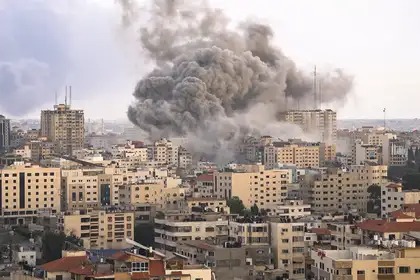
The debate over Gaza has exposed an unsettling absence of response. For many younger readers, wars such as Vietnam belong to another historical age. The language of protest, resistance and political dissent associated with Vietnam appears distant, almost museum-like. Gaza, meanwhile, has become another item in the relentless flow of information.
This distance is troubling.
The Vietnam War generated an extraordinary cultural and intellectual response. Musicians such as Joan Baez and Bob Dylan gave the conflict a human voice. Intellectuals such as Noam Chomsky challenged the structures of power behind it. Paediatrician Benjamin Spock became an unlikely figure of the anti-war movement. The war was not merely reported; it was debated, interpreted and experienced through music, literature, politics and protest.
The response to Gaza has been markedly different.
Many people know the technical details of weapons and military aircraft. They follow maps, operations and battlefield developments. Yet the human beings behind the statistics often disappear from the conversation. The deaths of children become numbers; destroyed homes become images; displacement becomes a figure in a report.
That transformation is central to understanding contemporary violence.
The violence of the 21st century is increasingly mediated through numbers. Thousands killed. Millions displaced. Hundreds of buildings destroyed. Such figures are necessary, but numbers alone cannot communicate suffering. They can record the scale of a tragedy while simultaneously making it feel distant and impersonal.
This is where journalism faces one of its greatest challenges.
The South African Truth and Reconciliation Commission, associated with Archbishop Desmond Tutu, offered a different model. Its proceedings were communicated across languages and communities, turning spectators into witnesses. People were not simply informed about apartheid; they were compelled to confront testimony, confession, responsibility and violence. Information became an ethical encounter.

That sense of witnessing appears increasingly fragile in the age of digital information.
The problem is not simply that people have forgotten history. Memory itself has changed. Vietnam, the Holocaust, the Bangladesh genocide and Rwanda remain powerful historical references, but for generations born long after these events, they can seem remote. Historical memory can preserve the past, but it can also turn it into something safely contained in textbooks, documentaries and anniversaries.
Gaza demonstrates the danger of that distance.
When violence is encountered primarily through screens and statistics, suffering can become abstract. The constant circulation of images can paradoxically produce numbness. A tragedy that is witnessed every day can begin to feel like background noise.
Hannah Arendt’s phrase, “the banality of evil”, acquires a disturbing contemporary resonance here. Violence does not always arrive in a form that shocks us into action. It can become routine, bureaucratic and statistical. Its horror can be hidden behind terminology, military briefings and casualty figures.
This is why language matters.
To say that thousands have died is necessary. But journalism must also ask: Who were they? What were their lives? What families did they leave behind? What dreams, relationships and ordinary routines were destroyed? Without such questions, the body count risks becoming a form of erasure.
Numbers must speak.

They must carry stories, biographies and memories. A statistic should not be allowed to conceal the individual. Every number represents a person who had a history, a family and a place in a community.
This is not an argument against facts or data. It is an argument for placing information within the human context that gives it meaning.
The great historical tragedies of the past were accompanied by storytelling, testimony and resistance. They forced societies to confront uncomfortable questions about power and responsibility. The challenge today is to recover that moral dimension without romanticising the past or pretending that contemporary violence is identical to earlier wars.
The newspaper still has an important role in that effort.
Its task is not merely to count the dead but to make the dead visible. It must connect information with knowledge, memory with experience, and statistics with human lives. It must create witnesses rather than passive spectators.
In an age of endless images and instant information, perhaps the greatest danger is not ignorance but indifference.
Gaza should therefore compel us to reconsider not only how we understand violence, but also how we communicate it. If numbers become silent, memory becomes hollow. And when memory loses its human voice, even extraordinary suffering can pass before our eyes without leaving a mark.
The newspaper remains one of the few public spaces where that silence can still be challenged.

