


Gor said he had been impressed by the security arrangements put in place by the central and Jammu and Kashmir governments and by the systems designed to protect ordinary people
 KRC TIMES Desk
T N Ashok
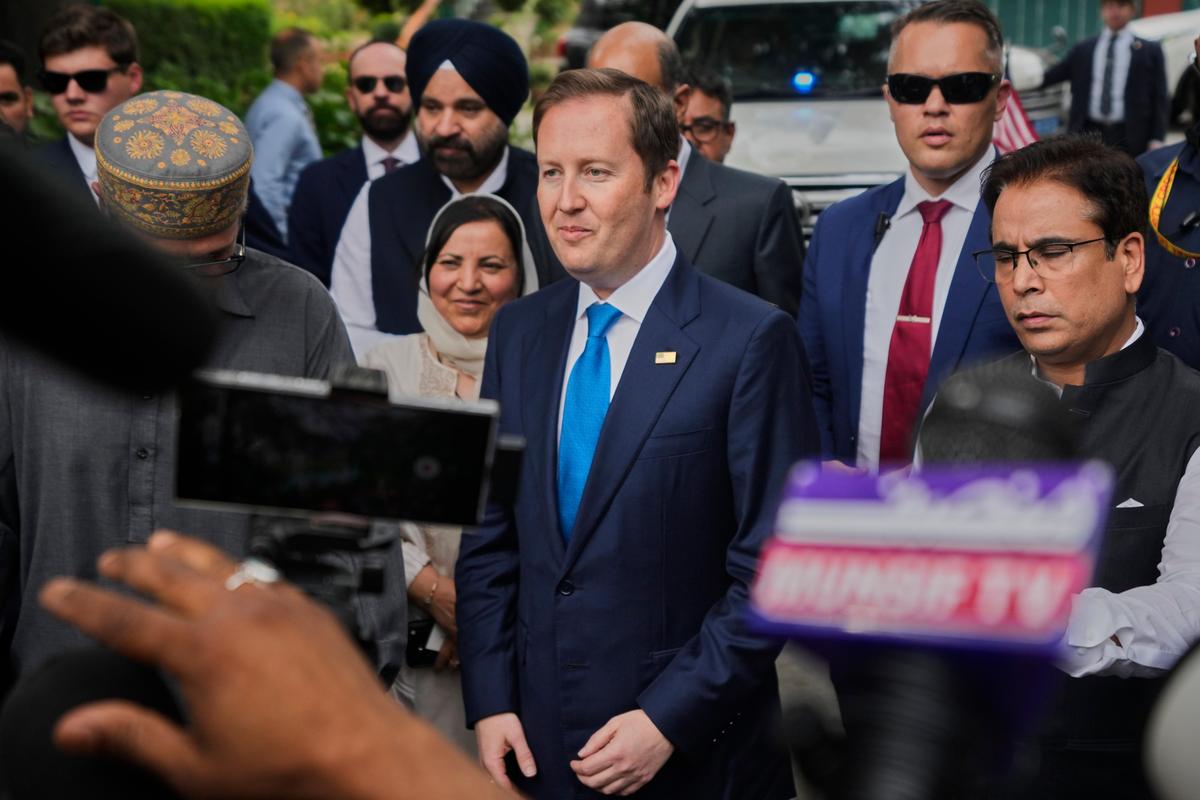
US Envoy Sergio Gor’s visit to Srinagar describing J&K as an integral part of India is a moment that redefines US government perception of the decades old Indo Pak dispute on Kashmir as his choice of words about India’s sovereignty over the region goes far beyond terming it as one of the most beautiful places he has ever seen. Jammu and Kashmir, Gor said, was an “important part of India.”
For a territory that has been at the centre of seven decades of Indian-Pakistani rivalry, the words were unusually direct. They were also followed by something more tangible: Gor said Washington would review its travel advisory for Jammu and Kashmir, raising the prospect that the United States could finally lower the highest warning it has maintained for the region.
The distinction matters. The U.S. State Department calls its warning Level 4 – “Do Not Travel,” not a “D-level” threat. The warning has covered Jammu and Kashmir because of terrorism and civil unrest and has specifically identified Srinagar, Gulmarg and Pahalgam as places where violence could occur.
Gor’s visit therefore comes at an intriguing moment. The question is no longer simply whether Kashmir is safe enough for American tourists. It is whether Washington’s assessment of Kashmir’s political and security environment is beginning to catch up with the transformation India says has taken place on the ground.
Gor said he had been impressed by the security arrangements put in place by the central and Jammu and Kashmir governments and by the systems designed to protect ordinary people. That is important because the American advisory is not merely a travel brochure’s warning. It is a formal assessment of risk by the world’s most powerful diplomatic and intelligence establishment. If that assessment changes, the consequences will extend beyond tourism.

Send your resume:
biswa@jigyasu.co.in
krcfoundation@gmail.com
American tourists have never been a large component of Kashmir’s foreign-tourist market. In 2019, according to data cited from the Jammu and Kashmir Crime Investigation Department, about 26,662 foreign tourists from 106 countries visited the Valley; Americans numbered approximately 731. That makes the American traveller a useful barometer rather than a major source of tourist revenue.
The broader tourism numbers tell a more dramatic story. Kashmir has moved from years in which militancy and shutdowns kept visitors away to a period of extraordinary mass tourism. Jammu and Kashmir recorded about 2.36 crore tourist visits in 2024, while the number of foreign visitors rose to more than 65,000.
Yet Washington continued to tell Americans not to go. Indeed, the Level 4 warning predates Donald Trump’s return to the White House. In July 2024, the State Department placed Jammu and Kashmir at Level 4, citing terrorism and civil unrest. The Pahalgam massacre of April 2025, in which 26 people were killed, mostly tourists, gave Washington an even stronger reason to retain the warning. That makes Gor’s intervention more significant. He is not simply announcing that Kashmir has become picturesque again. He is suggesting that the security equation deserves another look.
Why Washington may be changing its calculation; The most obvious reason is the changed security environment. Since the abrogation of Article 370 in 2019, New Delhi has pursued an aggressive strategy of suppressing militant networks, tightening intelligence coordination and expanding physical security around tourist centres. The restoration of mass tourism became one of the most visible indicators of that effort.
But the Pahalgam attack exposed the limits of declaring victory. The killing of tourists demonstrated that even a heavily secured tourist economy could be penetrated. What appears to have impressed Gor is something slightly different: the capacity of the state to respond.
A security assessment is rarely based on whether a place has experienced violence. It asks whether governments can prevent attacks, respond to them, protect foreigners and restore order when something goes wrong. Gor’s comments suggest that American officials are examining precisely those capabilities.
There is another reason. Washington’s strategic relationship with New Delhi has changed dramatically. India is no longer viewed in Washington simply through the prism of its relationship with Pakistan. It is an increasingly important strategic partner in the Indo-Pacific, a defence partner and a counterweight to China.
Kashmir consequently has less room to remain an isolated India-Pakistan problem in American strategic thinking. That does not mean Washington has formally abandoned its longstanding position that Kashmir is disputed. The current State Department advisory still describes the territory as disputed among India, Pakistan and China. But Gor’s language about Jammu and Kashmir being an important part of India represents a striking diplomatic emphasis.
The episode has a recent precedent. In February, the U.S. Trade Representative’s office published a map of India that showed Pakistan-administered Kashmir and Aksai Chin within Indian territory. It was striking because Washington had traditionally avoided cartographic formulations that appeared to endorse India’s territorial claims. The map disappeared from the USTR’s social-media account within days. The deletion restored the ambiguity. Gor’s statement, however, cannot simply be deleted from the diplomatic record.

Together, the two episodes suggest a Washington wrestling with two impulses: avoiding unnecessary confrontation with Pakistan while simultaneously accommodating India’s insistence that Jammu and Kashmir is an integral part of the country.
The roots lie in the chaotic autumn of 1947. At Partition, the princely state of Jammu and Kashmir had the option of acceding to either India or Pakistan. Maharaja Hari Singh initially hesitated. In October, armed tribesmen and Pakistani nationals entered Kashmir. Hari Singh sought Indian military assistance and signed the Instrument of Accession to India. Indian troops were flown into Srinagar and pushed back the attackers.
This is where the Indian narrative of Nehru’s “mistake” begins. Critics argue that Jawaharlal Nehru should have allowed the Indian Army to continue its advance until the entire princely state was recovered instead of accepting a ceasefire and taking the dispute to the United Nations. They regard the decision as having frozen a battlefield problem into an international dispute.
The historical reality is more complicated. Nehru acted amid British military influence, the advice of Governor-General Lord Mountbatten and the danger of a wider India-Pakistan war. India went to the United Nations in January 1948. The Security Council subsequently adopted Resolution 47, which called first for Pakistan to secure the withdrawal of tribesmen and Pakistani nationals who had entered Kashmir to fight, followed by conditions for a plebiscite.
The crucial first step was never completed. The ceasefire line eventually hardened into what became the Line of Control, LoC, leaving Pakistan administering the territory it calls “Azad Jammu and Kashmir” and India calling it Pakistan-occupied Kashmir. Seven decades later, the unresolved geography remains.
The irony across the Line of Control; The latest irony is that the sharpest political discontent may now be emerging inside Pakistan-administered Kashmir itself.
For years, Islamabad presented “Azad Kashmir” as the liberated alternative to Indian-administered Kashmir. But the region has witnessed sustained protests over electricity prices, shortages of subsidised wheat, political representation and what residents describe as excessive influence by Pakistan’s political and military establishment.
The grievances have a striking economic logic. Mangla Dam, built in Pakistan-administered Kashmir, transformed the region’s rivers into a major source of electricity for Pakistan. Residents have argued that a territory bearing the environmental and social costs of major hydroelectric projects should not have to pay high electricity tariffs for power generated from its own resources. The Joint Awami Action Committee has become the vehicle for much of this discontent.
The unrest has increasingly become a challenge to Pakistan’s political management of the territory. Elections in 2026 were accompanied by violence, clashes and allegations of political manipulation. Reuters reported more than 30 deaths in clashes around the regional election period.

