


From My Father’s Words to My Battlefield
 KRC TIMES Desk
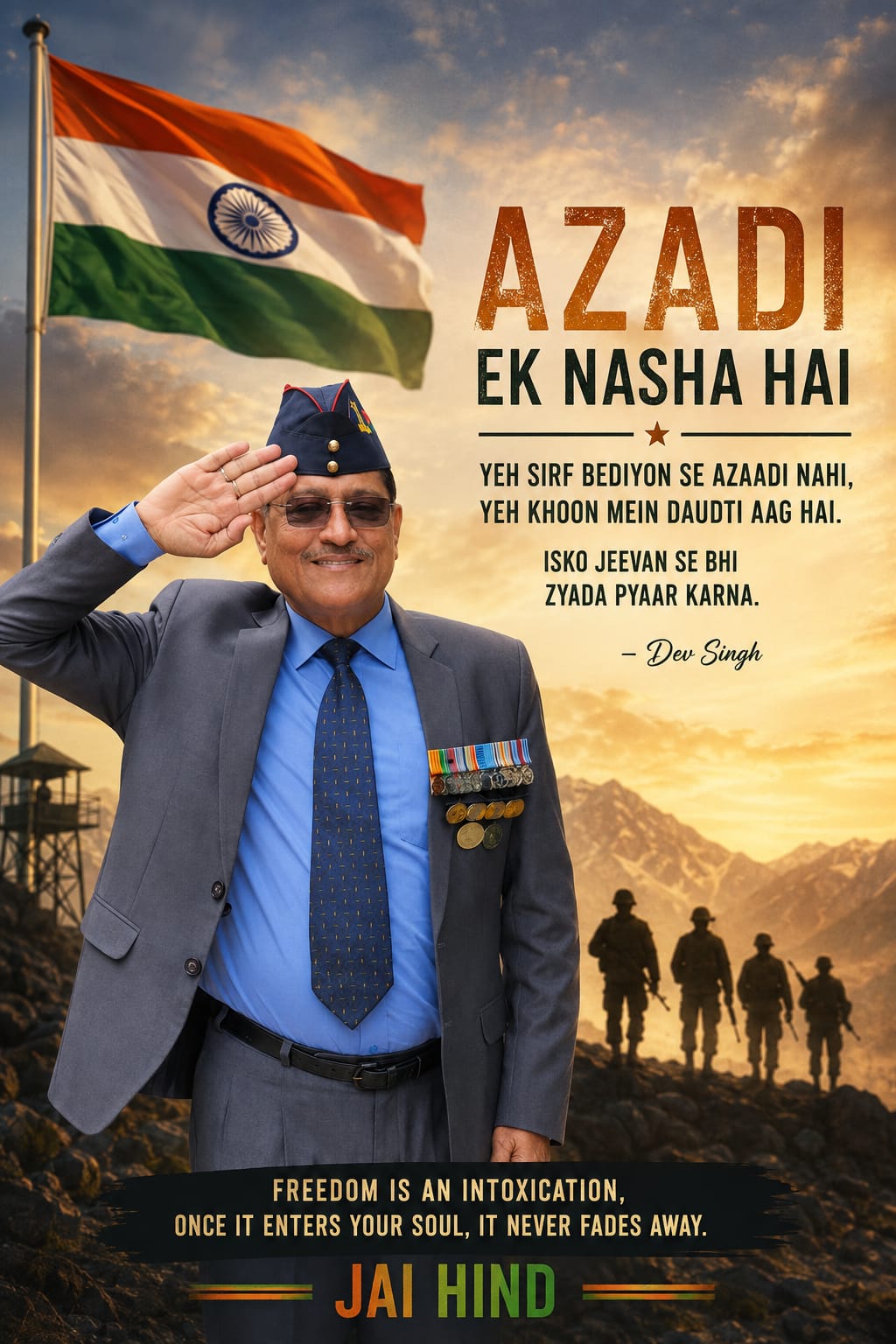
Col (Dr.) Ashwani Kumar, MiD, VSM (Retd.) @Ashk Machhanvi.
The Father’s Words.
The scars of Partition were still fresh on the soul of India. Millions had crossed newly drawn borders amidst bloodshed and uncertainty, rebuilding shattered lives from the ashes of displacement. The young nation was struggling not only to heal its internal wounds but also to defend its hard-earned freedom. Within less than two decades of Independence, India had already fought the 1947- 48 war in Jammu & Kashmir and suffered the humiliation of Chinese aggression in 1962. The message was unmistakable, freedom had been won, but its protection demanded constant vigilance, sacrifice, and national resolve.
For the Singh family, Independence was not merely a political event, it was the fulfillment of a cherished dream. Dev Singh had grown up listening to his father, a respected teacher and a supporter of the freedom movement, speaking about life under British rule. Around the evening hearth, he would narrate how ordinary Indians lived under restrictions while power and privilege remained concentrated in the hands of a few loyal to the colonial administration, men decorated with titles such as Rai Sahib, Diwan Bahadur, and other honorary distinctions. Those stories left a deep impression on young Dev.
Born into an educated family that valued learning, self-respect, and service to society, Dev came to believe that Independence was not merely the transfer of power but the opening of a new era where every Indian could dream, aspire, and rise through merit. The freedom won by one generation, he felt, had to be protected and strengthened by the next.
Yet Dev also understood that freedom was fragile. Partition, the conflict in Jammu & Kashmir, and the Chinese invasion had shown that sovereignty could never be taken for granted. Freedom had been earned through sacrifice, but its preservation demanded courage, vigilance, and an unwavering sense of duty. It was this belief that drew him towards military service and eventually to the newly raised Special Frontier Force.

The year was 1964. Dev Singh had joined as an Assistant Commandant in the Special Frontier Force. During a brief period of leave, he returned home to Fatehgarh Churian, Punjab. On a misty winter morning, dressed in a freshly pressed uniform and carrying the quiet confidence of a soldier, he prepared to leave for a special mission directly from home on duty in Leh Ladakh sector.
As he packed his belongings, a memory from an earlier operational briefing resurfaced in his mind. Before a sensitive mission, he had once asked his Commander:
“Sir, once the mission is completed, where are we to report back? My men would like to know the recovery plan and rendezvous point.”
The Commander had looked at him steadily before replying:
“Dev, these are special operations. Once you are airborne and dropped into the mission area, as far as I am concerned, you are struck off my effective strength. If you return, we shall welcome you back with honour. If you do not, the nation will remember your sacrifice, and we will look after your family.”
The words had remained etched in his memory.
Standing in the courtyard that morning, Dev knew this mission could be no different. The situation on India’s frontiers was becoming increasingly dangerous, and he fully understood the risks of covert operations. He might return home to watch his children grow into responsible men, or he might never see them again.
His concern was not for himself.
It was for the future of his sons.
If destiny allowed him to return, he would guide them personally. But if fate decided otherwise, he wanted to leave behind something far more valuable than property, wealth, or inheritance. He wanted to leave behind a belief—a guiding principle that would shape their lives forever.
He believed that nations are not preserved by armies alone. They survive because ordinary citizens understand the value of freedom and remain willing to defend it. Before departing, he decided to teach his sons the most important lesson of his life.
He called all three boys and made them stand before him. Looking into the eager eyes of his eldest son, S. K. Singh, barely fourteen years old, he spoke with quiet conviction:
“Beta, yaad rakhna, Azadi ek nasha hai. Yeh sirf bediyon se azaadi nahi, yeh khoon mein daudti aag hai. Isko jeevan se bhi zyada pyaar karna.” (“Son, remember, freedom is an intoxication. It is not merely freedom from chains; it is a fire that runs through the blood. Love it more than life itself.”)
Those words, spoken softly in the courtyard of a modest home in Punjab, burned into young Kumar’s heart forever. As Dev stepped out and boarded a tonga for the railway station, he encountered his ageing father, a retired headmaster. Unaware of the dangerous mission awaiting his son, the old man embraced him warmly and blessed him.
Dev touched his father’s feet, folded his hands, and continued his journey. The lesson of that winter morning would travel far beyond the courtyard of Fatehgarh Churian.
The Brothers in Service.
The Singh family was woven into the Tricolor. The eldest son, S. K. Singh, joined the Indian Air Force in 1972, soaring into the skies their father once pointed towards with pride.
The middle brother joined the Police, dedicating his life to maintaining law and order within the nation.
The youngest, Kumar, marched into the Indian Army and was commissioned in 1982 as a Second Lieutenant in a prestigious Infantry Battalion.
For their mother, it was a life of pride mixed with constant worry.
For their father, it was destiny fulfilled.
Three sons.
Three uniforms.
One purpose.
Service to India.
The Making of a Soldier of Kumar.
Kumar’s rise was not easy.
Born into a middle class family familiar with borrowed bicycles, shared textbooks, and modest means, he carried an uncommon fire within him. Hard training at the Academy strengthened his body, but it was his father’s words that strengthened his spirit.
Whenever exhaustion tested him, he remembered:
“Azadi ek nasha hai.”
His instructors admired his determination.
His comrades respected his sincerity.
His soldiers would later say:
“Sahab ka dil bhi mazboot hai aur awaaz bhi.”
(“The Sahib’s heart and voice both inspire confidence.”)

Send your resume:
biswa@jigyasu.co.in
krcfoundation@gmail.com
He was posted to Jammu & Kashmir. There, amidst mountains, rivers, and the ever-present threat of conflict, he learned the true meaning of leadership.
The First Test – Poonch (1985)
The night was bitterly cold.
Snow covered the ridgelines near Poonch. Visibility was poor.
The enemy had been testing Indian resolve through infiltration and firing along the Line of Control.
That night, infiltrators attempted to overrun a strategically important post near the Poonch River.
Radio communications crackled with urgency.
A platoon position had become isolated.
Enemy fire was intense.
Many would have waited for daylight.
Captain Kumar did not.
Gathering a small team, he crawled nearly six hundred metres through hostile fire to reach the threatened position.
Bullets tore through the darkness.
Mortar fragments ripped into the snow around them.
Yet Kumar kept moving.
Upon reaching the post, he reorganized the defenders, restored morale, and launched a counter-action that inflicted heavy casualties on the infiltrators.
By dawn, the enemy had withdrawn.
The Indian Tricolor continued to fly proudly over the position.
His courage inspired every soldier present. This was all in local and National News. For his conspicuous bravery and leadership under fire, he was recommended for the second highest gallantry award Kirti Chakra.
When his mother later asked him what had happened, he simply smiled and replied:
“Bas Maa, duty thi.”
(“Nothing special, Mother. It was my duty.”)
Sri Lanka – Operation Pawan (1988).
By the late 1980s, duty called across the seas.
Major Kumar was deployed with the Indian Peace Keeping Force in Sri Lanka.
The jungles of Vavuniya and Cheddikulam were unforgiving.
Dense vegetation concealed danger.
Every track could lead to an ambush.
Every silence could be deceptive.
The enemy knew the terrain.
The soldiers did not.
Yet they moved forward.
In one fierce operation, troops became pinned down under heavy militant fire.
Without hesitation, Major Kumar led a rescue mission through hostile jungle terrain.
The firefight was intense.
Casualties seemed inevitable.
But courage often changes the course of battle.
Under his leadership, the trapped troops were extracted safely.
Many lives were saved.
His gallantry and leadership once again earned recognition he was recommended for the third highest award Vir Chakra.
Some of his comrades would later say that he fought not merely as a soldier but as a man driven by an ideal.
When he later wrote home, his letter contained only one line:
“Azadi ka nasha mujhe har goli se zyada taqat deta hai.”
(“The intoxication of freedom gives me more strength than any bullet.”)
Kargil and the Desert Front (1999).
By 1999, Kumar had risen to the rank of Lieutenant Colonel.
The young officer of Poonch had become a seasoned soldier.
When the Kargil conflict erupted, his heart yearned to be with his men in the mountains. He volunteered to be with the unit but due to his service he could not be posted back to the unit. Instead, fate placed hm in the harsh deserts of Rajasthan, commanding an intelligence organization responsible for monitoring enemy activities along the southern frontier.
The desert was merciless.
By day it burned.
By night it froze.
Water was precious.
Sandstorms erased tracks within minutes.
Yet intelligence remained critical.
Kumar often reminded his officers:
“Wars are won long before the first shot is fired.”
Within weeks, he compiled a comprehensive intelligence book covering infiltration routes, enemy deployment patterns, logistics corridors, and operational vulnerabilities.
The document proved invaluable to higher headquarters.
His contribution strengthened operational preparedness across the sector.
His work ensured that commanders possessed timely and accurate information during one of India’s most critical military campaigns.
For his distinguished service during Operation Vijay, his name was recommended for recognition at the highest level.
Yet when the news reached him, he remembered neither the recommendation nor the recognition.
He remembered only one voice.
His father’s voice.
“Azadi ek nasha hai.”
The Legacy of a Soldier.
Peace eventually returned.
Medals and commendations adorned Kumar’s chest.
But he remained the same humble soldier who had once stood before his father in Fatehgarh Churian.
Around bonfires and in officers’ messes, he would often tell younger officers:
“Mere pita ne kaha tha, Azadi ek nasha hai. Aur main maanta hoon, yeh nasha hi mujhe zinda rakhta hai.”
(“My father told me that freedom is an intoxication. I believe it is that intoxication which keeps me alive.”)
He retired with honour.
Not merely carrying rank.
Not merely carrying medals.
But carrying a belief.
A belief that had guided him through every battlefield, every hardship, and every challenge.
The Mission Continues.
Today, when young people ask Kumar what freedom means, he does not deliver long lectures.
He simply points towards the fluttering Tricolor and says:
“Value your freedom. Someone paid for it with blood, sacrifice, and silent suffering.”
Then he adds:
“A soldier never truly retires. Only his battlefield changes.”
In his later years, Kumar found another mission. Having served on battlefields, borders, conflict zones, and intelligence assignments, he now dedicates himself to guiding the younger generation. Through his writings, lectures, social initiatives, and public interactions, he encourages young Indians to join the Armed Forces, embrace discipline, build character, and place national service above personal gain.
He often tells the youth:
“A nation is not built by governments alone. It is built by disciplined citizens, courageous soldiers, dedicated teachers, honest workers, and young men and women willing to put the nation before themselves.”
At Sharda Sarvagya Peeth and other forums, Kumar reminds young minds that while the sword protects the nation’s borders, knowledge protects its civilization.
Many who meet him are surprised by the passion with which he still speaks about service.
To them, Kumar smiles and says:
“My uniform may have changed, but my duty has not.”
For Kumar, retirement was never the end of service.
It was merely a transition from one battlefield to another from the trenches of war to the trenches of awareness, education, culture, and national consciousness.
The mission entrusted to him by his father and by the nation remains unfinished.
Even today, whenever he remembers that cold winter morning in Fatehgarh Churian, he can hear his father’s voice echoing through the years:
“Beta, Azadi ek nasha hai.”
Those words became his guiding philosophy in Poonch, Sri Lanka, the deserts during Operation Vijay, and throughout a lifetime of service.
Thus lives Kumar, son of Dev Singh, brother of warriors, soldier of India, and guide to a new generation.
His medals may rest in display cases, but his spirit remains on active duty.
His task is not yet complete, and he intends to serve the nation until his last breath.
For he firmly believes:
“Azadi ek nasha hai. Aur yeh aisa nasha hai jo ek baar chadh jaaye, toh kabhi utarta nahin.”
That was the lesson of late Dev Singh.
That became the life of Kumar.
And that remains the duty of every Indian.
Jai Hind.
About the Author
Col (Dr.) Ashwani Kumar, MiD, VSM (Retd.), popularly known by his pen name “Ashk Machhanvi”, is a decorated veteran with distinguished service in the Indian Army, Military Intelligence, and the Cabinet Secretariat. A recipient of the Mention-in-Despatches (MiD) and Vishisht Seva Medal (VSM), he has served in challenging operational environments including Jammu & Kashmir, the North-East, Sri Lanka, and along India’s borders. An accomplished writer, historian, strategist, and speaker, he continues to dedicate himself to national service through research, public discourse, youth motivation, and the promotion of India’s civilizational heritage. His writings reflect the values of patriotism, sacrifice, leadership, and the enduring spirit of the Indian soldier.
Disclaimer
This narrative is based on the author’s personal experiences, family history, military service, and recollections. While rooted in real events, certain names, conversations, sequences, and details have been adapted or reconstructed for literary presentation. The story is intended to honour the spirit of patriotism, sacrifice, and service to the nation and should not be construed as an official account or representation of any government, military, or other organization.