

THE RIVER THAT CALLS YOU BACK”
 North East Integration Rally
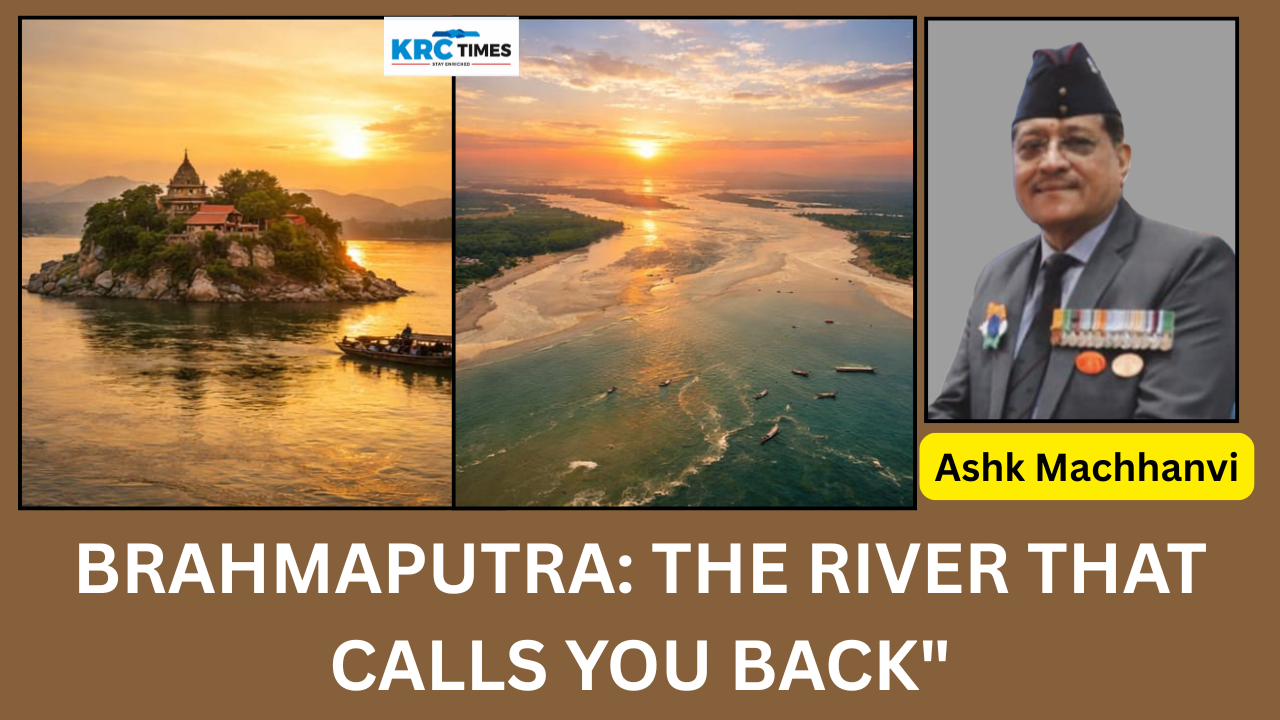
Ashk Machhanvi
In the high silence of the trans-Himalayan plateau, where wind moves like prayer and mountains hold the memory of creation, a thin silver stream is born near the Angsi Glacier close to the sacred region of Mount Kailash.
At first it is only a whisper of water. The monks of the highlands call it Yarlung Tsangpo, the river from the upper world. It travels quietly across Tibet, watching centuries pass like drifting clouds. It does not yet know that it will become one of the greatest rivers of Asia.
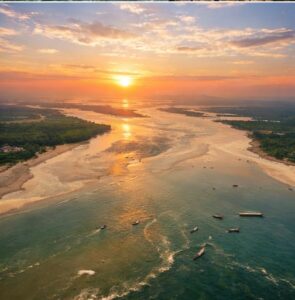
When it enters India through the mountains of Arunachal Pradesh, it gathers strength. It is called Siang, then Dihang. By the time it reaches the vast plains of Assam, it has become something else entirely, wide as a sea, restless as a warrior, ancient as myth. Here it receives the name that will stay with it forever:
Brahmaputra River the Son of Brahma.
The River Born of the Creator.
Ancient sages believed no ordinary origin could explain such a river. They said Lord Brahma released sacred waters from his kamandalu to nourish the eastern lands. Thus came the Brahmaputra, a rare river in India with a masculine identity, powerful and unpredictable.
It was also called Lauhitya in old scriptures, the red river of dawn. Monks believed its waters carried purification. Warriors believed it guarded the frontier of dharma. And then came a story from the age of Rama. When Rama Stood by the River.
In the traditions of the eastern hills, it is said that after defeating Ravana, Lord Rama journeyed through distant lands before returning to Ayodhya. When he reached the roaring eastern river, sages requested his blessing. Rama stood at dawn, facing the rising sun, and offered prayers. The waters calmed.From that day, people believed the river would remain fierce but protective, a guardian of the eastern lands.
Even now, small lamps float on its waters during festivals, carrying prayers as if still answering Rama’s call.
The Lovers of the Two Banks.
Long before bridges spanned the river, when it was known as Lauhitya, a hill princess named Anindita lived on its northern bank. Across the waters lived Devavrata, a young warrior-scholar. They met only once at a spring gathering. But once was enough.
They began sending messages through the river, small bamboo tubes carrying palm-leaf notes. “Are you well?” “The river is calm today.” “I saw the same moon you must have seen.” Then one monsoon, the river flooded beyond memory. Weeks passed with no message. Believing him lost, the princess crossed the raging Brahmaputra at night. The boat nearly overturned, but she refused to turn back.
“Even if the river takes me,” she said, “it will carry me where my heart already lives.” She reached the opposite bank at dawn and found him alive, though wounded. Their reunion became legend. A sage who witnessed them declared: “This river separates only the uncertain. For the steadfast, it becomes a bridge.”
The kingdoms united. Their story lived on in whispers along the banks. Even today, elders tell young couples that love tested by the Brahmaputra becomes unbreakable.
The River of War.
Centuries later, the river would again choose its side. In 1671, during the Battle of Saraighat, the Ahom kingdom faced a powerful Mughal fleet. The commander Lachit Borphukan knew the river like a living ally. The battle was fought on water. Currents, channels, and courage turned the tide. The Ahom forces prevailed. Many believed the river itself had fought for them. To this day, Lachit is remembered as a hero and the Brahmaputra as his silent companion in victory.
The River of Islands and Faith.
In Assam, the river spreads into vast channels. It creates and destroys land at will. On its banks lies Majuli, one of the world’s largest river islands, home to monasteries where monks sing ancient hymns. Floods come. Villages shift. Yet life continues. Fishermen cast nets at dawn. River dolphins surface briefly, then vanish. The Brahmaputra feeds millions while reminding them of nature’s power.
An Episode from a Soldier’s Memory.
There is a story often told among soldiers posted in the North-East. One monsoon night, a convoy needed to cross the Brahmaputra by ferry. The river was swollen, currents fierce. Halfway across, the engine failed. Silence fell except for the sound of water striking metal. An old soldier folded his hands and whispered: “Let us cross safely. We will return with respect.”
Within minutes, the engine restarted. The ferry moved again. They reached the opposite bank safely.
Later the old soldier said, “This river listens. But it remembers. Once you cross it, you belong to it.”
From that day, a belief spread among the troops: If you cross the Brahmaputra once, you must cross it seven times. Otherwise, it will call you back with another posting. Many laughed. Yet over the years, postings returned them again and again to the same river.
The River’s Journey to the Sea.
From Assam, the Brahmaputra enters Bangladesh, where it is called Jamuna. It merges with the Ganga and Meghna and finally empties into the Bay of Bengal after nearly 2,900 kilometers. Its waters that began as Himalayan ice end in the vast ocean, carrying with them stories of gods, lovers, warriors, monks, and soldiers.
Author’s Note.
I first met the Brahmaputra as a young soldier posted in the North-East in April 1992. We crossed it in ferries, boats, and bridges sometimes in calm, sometimes in danger. Among soldiers there is a quiet belief, Cross it once, and you will cross it seven times. Otherwise, you will be posted there again.
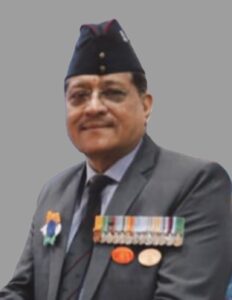
In my own service, I returned to its banks more than once. Each time felt less like coincidence and more like a summons. Standing by the river at dawn, mist rising, one feels history flowing past, Rama’s blessing, lovers’ courage, Lachit’s battle, and the silent prayers of soldiers.
For me, the Brahmaputra is not just a river.
It is a companion.
A witness.
A river that calls you back.
And somewhere in its endless journey from glacier to sea, it carries every story it has ever touched without forgetting a single one.
Disclaimer:
This is a literary narrative blending history, folklore, mythology, and personal reflections. Some episodes are creative interpretations for storytelling. References to the Brahmaputra River and the Battle of Saraighat are broadly based on known sources, views expressed are the author’s personal and not official.