


Iran – Israel – US Pause That Could Explode Again
 KRC TIMES Desk
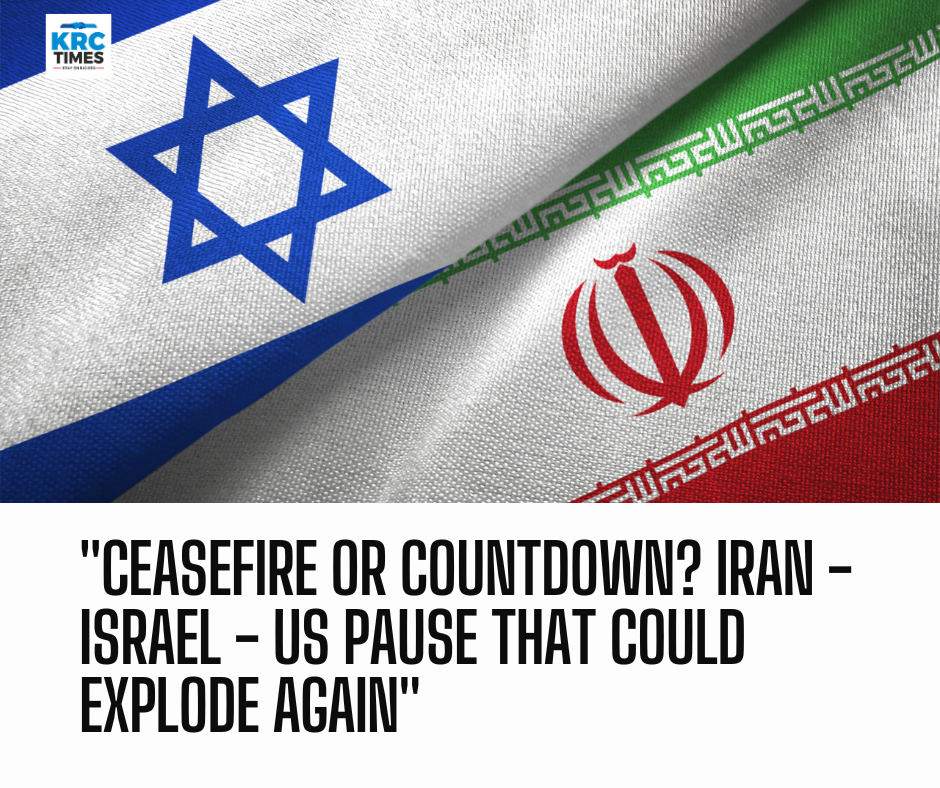
A Silence That Masks Strategic Tension.
The guns have fallen silent for now. The recently announced ceasefire involving Iran, Israel, and the United States has brought a temporary halt to what threatened to spiral into a wider regional war. Oil markets have steadied, the Strait of Hormuz has reopened to cautious traffic, and diplomatic channels long frozen are flickering back to life. Yet beneath this fragile calm lies an uncomfortable truth, this is not peace. It is a pause, calculated and compelled, where each actor is using the silence not to reconcile, but to recalibrate.
A Tactical Pause, Not a Political Settlement.
At first glance, the ceasefire appears to be a diplomatic success. A two-week halt in hostilities, achieved under intense international pressure and back channel negotiations, suggests that escalation fatigue has set in. The United States has managed to arrest a rapidly deteriorating situation without committing to a deeper military engagement. Iran has avoided sustained strikes on its strategic assets while preserving its posture of resistance. Israel, for its part, has secured a temporary lull after demonstrating its capacity for precision and reach.
Each side can claim a measure of tactical gain. But this is precisely what makes the ceasefire precarious, it satisfies immediate needs without resolving underlying contradictions. The central flaw lies in its temporariness it is designed not as a settlement, but as a window for repositioning.

The Trust Deficit: The Core Challenge.
At the heart of this uncertainty lies a profound trust deficit. Iran and the United States have spent decades locked in hostility marked by sanctions, covert actions, and strategic suspicion. Israel views Iran’s regional ambitions and nuclear trajectory as existential threats, while Iran sees Israel as an extension of Western coercive power.
Such entrenched perceptions cannot be reversed in a matter of weeks. Trust, once eroded, requires sustained engagement and verifiable commitments both of which remain absent in the current framework.
Diverging Strategic Objectives.
The ceasefire brings together actors whose long term goals are fundamentally incompatible,
Iran seeks sanctions relief, regional legitimacy, and security guarantees.
United States aims to prevent escalation while curbing Iran’s nuclear ambitions.
Israel remains focused on neutralizing Iran’s military and strategic capabilities.
These competing objectives ensure that the ceasefire is not a convergence of vision, but a temporary alignment of necessity.
Coercive Diplomacy at Play.
This ceasefire has not emerged from mutual trust but from calibrated pressure. The United States has combined diplomacy with implicit military threats. Iran has balanced defiance with restraint, avoiding actions that could trigger overwhelming retaliation. Israel has maintained deterrence without escalating into full-scale war.
Such coercive diplomacy can produce temporary results, but it rarely yields lasting peace. It creates compliance, not consensus.
The Proxy Factor: A Constant Threat.
The Middle East’s security landscape is shaped not just by states, but by a network of non-state actors. Groups such as Hezbollah and the Houthis operate with varying degrees of autonomy, capable of triggering escalation independent of state decisions.

Even if Iran, Israel, and the United States adhere to the ceasefire, a single provocation by a proxy actor could derail the fragile arrangement. This diffusion of control makes sustained peace far more difficult.
Who Gains? A No-Loss Equation.
From a strategic standpoint, the ceasefire is best understood as a “no-loss” outcome rather than a win-win, United States avoids deeper military entanglement and stabilizes global markets.
Iran preserves its strategic assets and avoids escalation under pressure.
Israel gains operational pause while maintaining deterrence.
None of the actors achieve their core objectives, but all avoid immediate setbacks. It is a compromise born of compulsion, not consensus.
Global Implications: Temporary Relief, Lingering Risk.
For the global economy, particularly energy markets, the ceasefire offers short-term stability. The reopening of the Strait of Hormuz reduces immediate supply concerns. However, this stability is fragile. Any breakdown in the ceasefire could quickly translate into market volatility, highlighting the interconnected nature of regional conflicts and global economics.
Lessons from History: A Pattern of Fragility.
Past ceasefires in the region have often served as intermissions rather than resolutions. They create space for recovery and recalibration but rarely address the root causes of conflict.
Without a structured roadmap addressing nuclear concerns, regional security, and sanctions, the current ceasefire risks following the same trajectory, temporary calm followed by renewed confrontation.
What Will Determine Success?.
For the ceasefire to evolve into lasting peace, three critical elements are required:
Sustained Dialogue beyond crisis management
Confidence-Building Measures to reduce mistrust
Balanced Diplomacy combining pressure with credible incentives.
At present, these elements remain weak or absent, limiting the prospects for long-term success.
To sum up, a Pause Before the Next Move
Ultimately, this ceasefire is a strategic intermission, not a resolution. It reflects both the limits of military escalation and the constraints of diplomacy under pressure.
The silence of guns offers temporary relief, but beneath it lies continued preparation military, political, and strategic. Whether this pause leads to peace or merely precedes another round of conflict will depend on what follows in the coming days.
For now, the world watches a fragile calm aware that in the Middle East, silence is often not the end of conflict, but the beginning of the next phase.
This is not peace. It is a countdown.
Author’s Note.
This article is written not in the comfort of abstraction, but from the hard realism of a soldier’s understanding of conflict and its consequences. Ceasefires, in military vocabulary, are seldom endpoints, they are pauses where strategies are redrawn, capabilities reassessed, and intentions recalibrated.

What appears as peace to the world often remains, on the ground, a tense silence loaded with possibility. The present Iran – Israel & US ceasefire must therefore be viewed with clarity, not optimism. It is easy to celebrate the absence of fire, it is far more difficult to acknowledge the persistence of friction. History has repeatedly shown that when core issues remain unresolved, ceasefires merely defer confrontation, they do not dissolve it.
From an operational and strategic perspective, this pause reflects compulsion rather than convergence. No side has yielded its fundamental position. No side has secured its ultimate objective. And therefore, no side is at peace.
There is, however, a larger lesson, one that policymakers must not ignore. Military power can shape the battlefield, but it cannot, by itself, shape a lasting peace. That responsibility lies in political courage, diplomatic maturity, and the willingness to move beyond zero sum thinking qualities that remain uncertain in the present context.
As someone who has witnessed the cost of conflict, I would caution against mistaking silence for stability. The true test of this ceasefire lies not in its announcement, but in what follows, whether it becomes a bridge to resolution or merely a brief halt before renewed hostilities. In war, pauses are deceptive. The wise prepare for what comes after them.