


Which Way to a Solution?
 KRC TIMES Desk
Pradip Dutta Roy
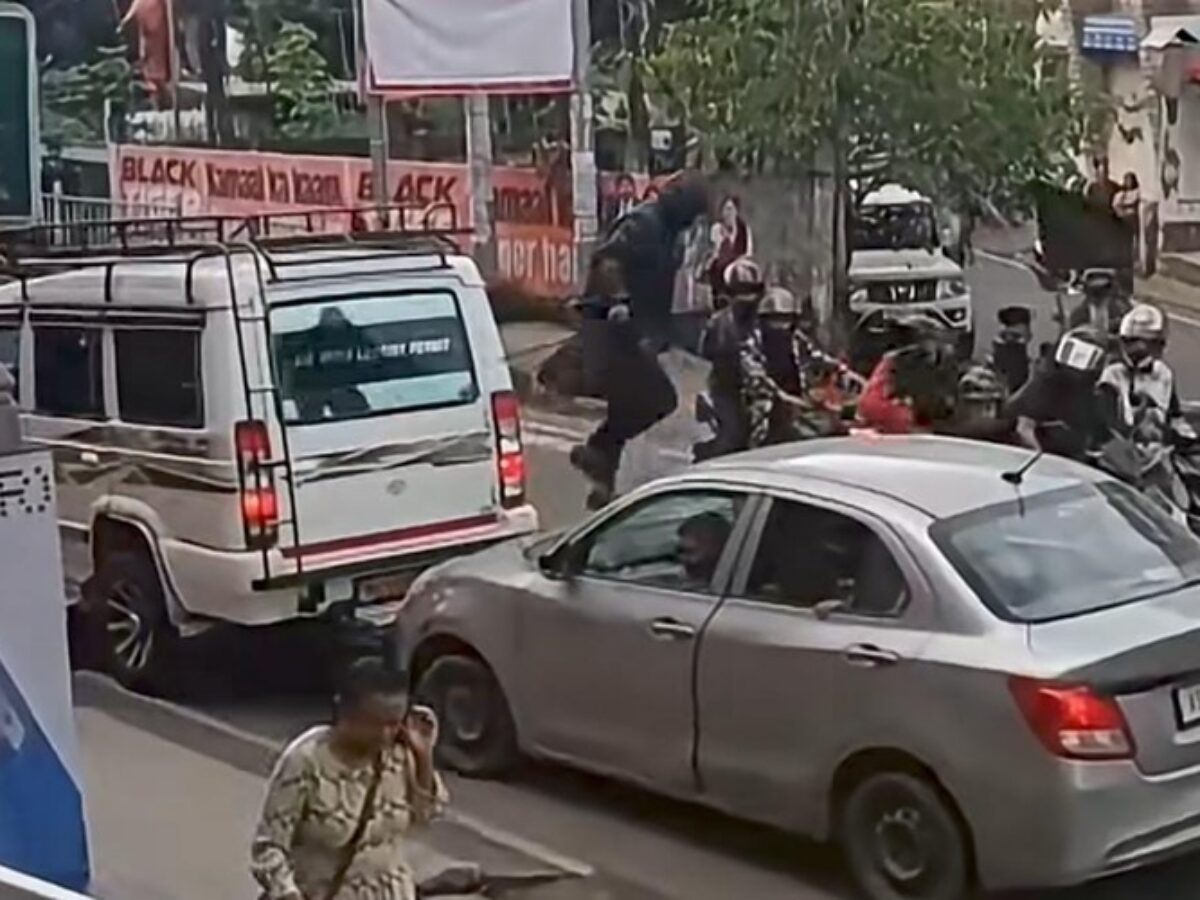
On 19 August, the Khasi Students’ Union (KSU) organised a protest march in Shillong. The allegation was that the state government had been ignoring their previously declared demands. Among their demands was the provision for a public hearing before establishing a cement factory. They also demanded amendments to laws concerning the safety and security of the residents of Meghalaya and laws relating to migrant workers.
However, the march organised against the government unnecessarily turned violent. The participants allegedly attacked local pedestrians and 31 tourist vehicles from Assam. We are aware of what happened subsequently. Following blockades and counter-blockades along the Assam-Meghalaya border, government intervention, and the arrest of KSU leaders, the situation is currently under control, although an undercurrent of tension still persists.
However, amid all this turmoil, one issue appears to have received no response from either the Meghalaya or Assam governments. On that day, participants in the procession also vandalised the statues of Netaji Subhas Chandra Bose and Swami Vivekananda at R.R. Colony in Shillong. Although the glass covering in front of Swamiji’s statue was shattered by stone-pelting, the statue itself was not directly damaged. But Netaji’s bust was actually broken and thrown to the ground. Not only that, it was reportedly kicked around like a football.
Although the Meghalaya government has made no response on the matter, the state’s Department of Arts and Culture has reportedly assured that the two statues would be restored, beautified and reinstalled.
One may naturally wonder what was the purpose of carrying out such acts, which apparently had no connection with the demands of the procession, and why the government has remained silent on the matter. In reality, behind the insult to these eminent personalities lies an attitude and politics rooted in hostility towards so-called outsiders and the local Bengali population.

Such incidents have repeatedly been carried out by organisations like the KSU, and Meghalaya’s history and popular politics have played a major role behind them.
Let us turn briefly to history to understand the matter:
According to the 2011 Census, Meghalaya’s total population was approximately 30 lakh, of whom around 26 lakh were members of Scheduled Tribes and about 4 lakh were non-tribal people. In percentage terms, non-tribals constituted approximately 13.8 percent of the population. The non-tribal population includes Bengalis, Nepalis, Hajongs, Biyates, Koch, Rajbanshis, Boros, Dimasas and others. There are also smaller numbers of Punjabis, Sikhs, Biharis and Marwaris. According to the 2011 Census, the Bengali population in Shillong was around 2.32 lakh, accounting for approximately 6.4 percent of the total population.
The migration of non-tribal people, particularly Bengalis, into Shillong took place mainly in several phases:
1. During British colonial rule
In 1874, Shillong was declared the capital of the Chief Commissioner’s Province of Assam and became one of the major centres of British civil and military administration. Because educated, skilled and hardworking human resources were essential for administrative and economic purposes, people were brought to Shillong from different parts of India.
Bengalis were brought in for clerical work, teaching, accounting, business and other professions; Nepalis for the military, animal husbandry, carrying goods and transportation; and Marwaris, Sindhis and Gujaratis for commerce. People from various other communities also migrated to Shillong to meet different requirements.
As a result, even before Independence, Shillong and its surrounding areas had developed into a multi-ethnic and modern urban centre.
2. Partition in 1947 and the subsequent period
The manner in which the Indian subcontinent was divided by the stroke of the Radcliffe Line left countless people displaced from their ancestral homes. A large number of them, particularly Hindu Bengalis, were forced to flee to India. Some of them found refuge not only in West Bengal, Tripura and Assam, but also in Meghalaya.
This movement continued into the 1950s. The Relief and Rehabilitation Colony in R.R. Colony, where the aforementioned statue of Netaji was installed, was established in 1956 through a government initiative to rehabilitate refugees who had arrived from erstwhile East Pakistan.
3. The 1960s
Against the backdrop of continuing violence in East Pakistan, refugees also occasionally sought shelter in Meghalaya during this period. However, a large proportion of those who arrived during this phase belonged to the Garo, Hajong and other indigenous tribal communities.
4. 1971 and thereafter
There is no clear evidence regarding whether, and to what extent, migration into Meghalaya took place in 1971 and thereafter. Yet organisations such as the KSU have used this issue to label the entire Bengali community of Meghalaya as “illegal immigrants” or “Bangladeshis” and have continued to pursue politics on that basis.
Meghalaya emerged as a new state in 1972. Subsequently, it received recognition as a Sixth Schedule state. From then onwards, the grounds for conflict between tribal and non-tribal communities began to develop.

Send your resume:
biswa@jigyasu.co.in
krcfoundation@gmail.com
The special rights granted to tribal communities under the Sixth Schedule created a major question—not merely how to prevent further migration of non-tribals, but also how those non-tribal communities who had been living in this region for generations could be incorporated into the process of state-building.
The principal factors behind this concern included demographic apprehensions. There were also concerns regarding land rights, particularly because special powers concerning land were granted under the Sixth Schedule. At the same time, following the creation of the new state, the political power of tribal communities increased, and they became more influential.
In addition, the dominance of non-tribal communities in various local employment and economic sectors—such as government jobs, business and commerce, transportation and different professions—became another source of conflict.
Rapid urbanisation and the economic rise of Shillong, the capital, further intensified direct competition and conflict.
However, two other factors must also be mentioned. First, continued migration from Assam, West Bengal, Bihar, Nepal and other regions; and second, the impact of the “foreigner expulsion” or “Bengali expulsion” movements that took place in Assam during the 1970s and 1980s.
The tensions between tribal and non-tribal communities first took the form of an ethnic conflict in 1979. One of its principal targets was Meghalaya’s Bengali community.
Although the conflict began over the immersion of a Kali idol in the local Laban-Villa area, it gradually spread throughout the state. The Khasi Students’ Union was at the forefront of the movement. More than 30 Bengalis were killed in the riots. Houses and business establishments were vandalised, set on fire and looted. A large number of people were forced to take shelter in relief camps.
In the aftermath of the riots, between 25,000 and 40,000 people were reportedly forced to leave the state permanently and settle elsewhere.
Since then, similar incidents have been repeated, with only the target community changing.
In 1987, members of the local Nepali community became the targets of attacks by tribal miscreants. Around 20 people were killed, several thousand were displaced, and houses, shops and commercial establishments were extensively attacked.
In 1992, local Biharis became the targets of attacks. More than 20 innocent citizens were killed, and around a thousand people were displaced. In addition, incidents occurred in Langpih on the Assam-Meghalaya border in 2010; in Shillong’s Punjabi Lane in 2018, where Dalit Sikhs were attacked; and in Ichamati, near the India-Bangladesh border, in 2020, where three people were killed and around a hundred Bengalis were displaced.
One point deserves mention here. Although the overall population increased, the proportion of non-tribals in Meghalaya’s total population declined between 1980 and 2011. The Bengali population declined from 8.95 percent to 7.84 percent, while the Nepali population declined from 4.59 percent to 1.84 percent.

Yet Bengalis and other non-tribal communities have made significant contributions to the development of modern Shillong and the state as a whole. Through Bengali initiative, Laban Boys’ School was established in Shillong in 1923 and New Colony School in 1964. Bengalis also played an important role in Shillong Law College, the first medical store and clinic, and various professional services during the 1960s.
The foundations of various businesses, transportation services and administrative activities were also laid by non-tribal communities. But there has never been any example of non-tribal communities exercising domination over the indigenous tribal population. Rather, they participated alongside the tribal communities in the socio-economic development of the state.
At one point, there was a very close relationship of mutual cooperation between the two communities, and such cooperation still exists at the grassroots level.
A review of the overall course of events makes it clear that the concerns of tribal communities regarding non-tribals were not entirely without basis. However, if the government and the intellectual community had demonstrated goodwill and maintained an impartial approach, the problem could certainly have been resolved through dialogue.
Unfortunately, since the 1979 riots, hardly any of the miscreants responsible for the killing and assault of non-tribals, or for setting fire to their properties, have received any significant punishment. Instead, non-tribals have gradually been labelled as “Dkhars” (outsiders) and “Bangladeshis”, and have increasingly been reduced to second-class citizens.
It is clear that successive governments in Meghalaya have failed—whether for political reasons, out of fear, or deliberately—to bring such perpetrators to justice. They have also failed to restrain the unethical activities of organisations such as the KSU.
Only in the aftermath of the present incident have some senior KSU leaders been brought within the ambit of the law, which is a rare exception. Some have argued that if the blockade along the Assam border had continued for a prolonged period, the state would have faced shortages of essential goods and an economic crisis. Therefore, the Chief Minister was compelled to take such measures.
As a result, non-tribal people living in Meghalaya have been living under an invisible sense of fear for many decades. For more than four decades, their lives have been marked by uncertainty, insecurity and the constant need for self-protection. Many may have chosen silence as the safer option, creating an invisible shield of silence around themselves. Circumstances that could genuinely reassure them have never been created.
At present, tribal communities have 80 percent reservation in government employment. To compete for the remaining 20 percent of posts, proficiency in a local tribal language is required, which naturally places non-tribals at a disadvantage. Consequently, the representation of non-tribals in government employment is now extremely small.

Non-tribals who operate small business establishments are required to approach the District Council authorities for renewal of their trade licences, and these applications are reportedly kept pending on various pretexts and excuses. Thus, there is hardly any genuine level playing field for competition.
A few years ago, prominent citizens of Shillong submitted a memorandum to the present Chief Minister, Conrad Sangma, earnestly requesting the establishment of a separate Minority Development Department for the protection and development of Meghalaya’s non-tribal communities. However, there appears to have been no significant progress on this matter to date.
Our Constitution guarantees every citizen the right to life and security and the right to live with dignity. It must be acknowledged that these rights of Meghalaya’s non-tribal communities have been violated for decades. If this situation continues, others too may gradually be forced to leave the state in the future.
Since the failure of the state government in this regard is evident, intervention by the Central Government is urgently necessary. There is no other alternative.
An initiative may perhaps be taken to rebuild the broken statues. But as citizens of this country, will any initiative also be taken to restore among Meghalaya’s non-tribal communities their confidence in their own existence and in their right to live with dignity in their own homeland?
The views expressed are solely those of the author.The author is the founding president of the student organisation AKSAR and an advocate of the Gauhati High Court.