


Balancing Technological Progress with Cultural Roots
 KRC TIMES Desk
A.bhisnoi
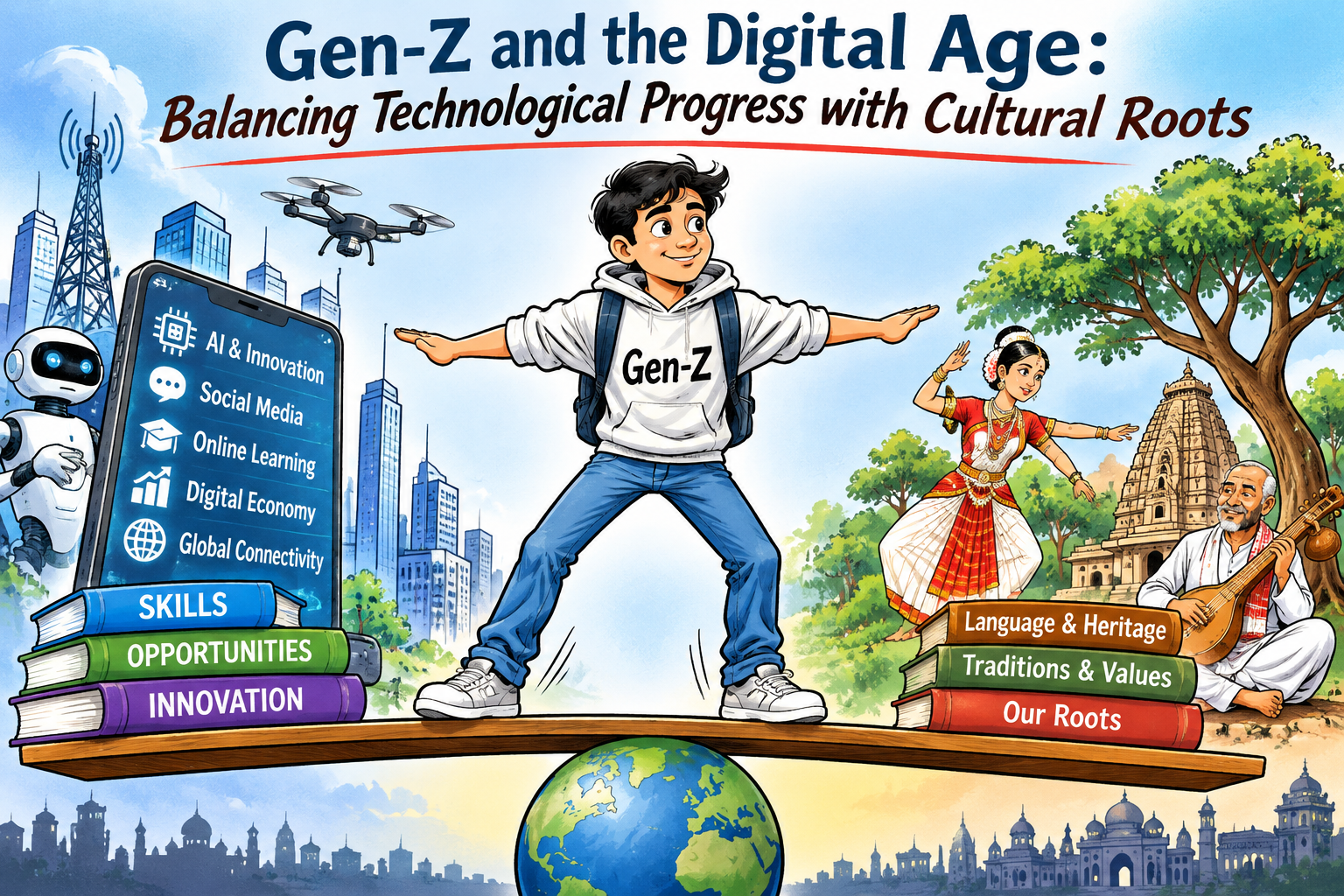
The digital revolution has transformed the way young people learn, communicate, work and participate in society. For Generation Z, smartphones, social media and artificial intelligence are no longer merely tools of convenience; they are integral to everyday life. Yet, as technology increasingly shapes human relationships and public discourse, an important question arises: can the younger generation embrace the opportunities of the digital age without losing its cultural roots and sense of social responsibility?
The answer lies in striking a balance between technological advancement and enduring human values. India’s civilisational traditions offer a framework for this balance through the concept of Panch Parivartan, which emphasises five areas of social transformation: Samajik Samrasta (social harmony), Kutumb Prabodhan (family awareness and strengthening), Paryavaran Sanrakshan (environmental protection), Swadeshi (self-reliance) and Nagrik Kartavya (civic duties).
These principles need not remain abstract ideals or be confined to traditional settings. Properly interpreted, they can provide useful guidance for a generation navigating artificial intelligence, global connectivity and rapidly changing social relationships.
Technology has democratised access to information and created unprecedented opportunities for young people to express themselves. Social media can amplify marginalised voices, challenge discrimination and bring communities together around common causes. At the same time, misinformation, online hostility and superficial digital activism have exposed the limitations of connectivity without responsibility. A viral hashtag may generate attention, but it does not necessarily produce meaningful social change.
This makes Samajik Samrasta particularly relevant. Social harmony does not demand uniformity of opinion; it requires respect for differences and recognition of human dignity. Gen-Z can use digital platforms to challenge stereotypes, counter discriminatory narratives and encourage constructive conversations across communities. However, such engagement must be grounded in fact-checking, responsible communication and a willingness to disagree without hostility. The real test of digital citizenship is whether the values expressed online are reflected in everyday conduct.
The changing nature of digital engagement also raises questions about family relationships. Excessive screen time and constant online interaction can weaken meaningful personal connections. Kutumb Prabodhan offers an opportunity to restore the importance of family dialogue, intergenerational understanding and shared responsibilities.
Young people can play a constructive role in bridging the digital divide within families. They can help older relatives access online public services, identify cyberfraud and protect personal information. At the same time, elders can pass on cultural memory, traditional knowledge and practical wisdom. Digital technology can also help preserve regional languages, folk traditions, oral histories, indigenous practices and family archives. The objective should be to use technology to strengthen relationships rather than allow it to replace personal interaction.
Environmental responsibility is another area where the digital generation can make a meaningful contribution. Social media has increased awareness of climate change, pollution and biodiversity loss, but awareness must translate into measurable action. Paryavaran Sanrakshan calls for sustained participation in protecting natural resources and maintaining ecological balance.
Digital tools can help young people organise waste-management campaigns, monitor water conservation, document biodiversity and support ecosystem restoration. Schools, colleges and community organisations can use technology to track local environmental initiatives and assess their outcomes. The success of such programmes should be measured not by online engagement but by tangible results, including reduced waste, conserved water and the protection of native vegetation.
The environmental cost of the digital economy also deserves attention. Frequent replacement of electronic devices, growing electronic waste and the enormous resources required to maintain technological infrastructure have significant ecological consequences. Responsible consumption, device repair, longer product life and proper disposal must therefore become part of digital citizenship.
The principle of Swadeshi also acquires a wider meaning in an interconnected world. Self-reliance should not be confused with isolation from global developments. Rather, it should encourage the development of indigenous capabilities, local enterprise and technologies suited to India’s diverse economic and cultural needs.
Gen-Z can contribute by connecting local artisans and small businesses with wider markets, helping traditional enterprises adopt digital tools and developing products and services for regional-language consumers. Artificial intelligence can support research, translation, design and entrepreneurship, while digital marketing can create new opportunities for traditional crafts and local industries.
Swadeshi, in this context, is not simply about choosing domestically produced goods. It is also about developing technological competence, generating employment and building the capacity to innovate. India must aspire to become a creator and developer of technology rather than remain primarily a consumer of systems developed elsewhere. Its young population has a significant role in realising that ambition.
Equally important is Nagrik Kartavya, which emphasises that citizenship involves responsibilities alongside rights. Digital platforms have created new opportunities for public participation, but online criticism alone cannot resolve local problems. Young citizens can use technology to identify civic deficiencies, document public concerns, coordinate community initiatives and engage with administrative authorities.
Issues such as poor waste management, unsafe roads, inadequate public facilities, accessibility barriers and gaps in digital inclusion require sustained local action. Campus initiatives, volunteer networks and community-based digital campaigns can help connect citizens with institutions. What matters is the transition from raising concerns to following up on solutions and holding the relevant authorities accountable.
Artificial intelligence adds another dimension to these responsibilities. It offers enormous possibilities in education, research, productivity and innovation, but its outputs are not always accurate or impartial. AI systems can reproduce existing biases, generate misleading information and facilitate impersonation or deceptive content. Their use must therefore be guided by transparency, privacy protection and human accountability.

Panch Parivartan can offer an ethical framework for navigating these emerging challenges. Social harmony requires resisting fabricated narratives and discriminatory digital content. Family awareness involves protecting relatives from cyberfraud, impersonation and online exploitation. Environmental protection demands greater awareness of the ecological costs of technological consumption. Swadeshi encourages indigenous innovation and locally relevant digital solutions, while civic responsibility requires users to verify information, protect privacy and remain accountable for decisions assisted by artificial intelligence.
Digital literacy must consequently go beyond knowing how to operate devices and applications. It must include the ability to evaluate information, recognise technological limitations and understand the wider social consequences of digital behaviour. Before relying on AI-generated information or sharing online content, users should ask whether it is verifiable, whether it respects privacy and human dignity, and whether its intended use serves a constructive purpose.
However, individual responsibility cannot replace institutional safeguards. Technology companies, educational institutions and policymakers must also ensure transparency, data protection, fairness and appropriate regulation. A responsible digital ecosystem requires both informed users and accountable institutions.
Ultimately, the relevance of Panch Parivartan lies in its ability to connect personal conduct with collective well-being. Its principles will have little meaning if they remain confined to slogans, hashtags or occasional campaigns. They must find expression in everyday choices and sustained community participation.
Generation Z stands at a unique intersection of technological opportunity and social transformation. It possesses the tools to communicate globally, innovate locally and mobilise communities at an unprecedented scale. The challenge is to use these advantages with wisdom and responsibility.
A generation that can combine digital intelligence with cultural awareness, innovation with environmental consciousness and individual ambition with civic commitment can contribute meaningfully to India’s future. The objective should not be to choose between tradition and modernity, or between cultural identity and global connectivity. It should be to make them complementary.
The screen may be in the hand, but the values guiding its use must remain rooted in the heart. That is how Gen-Z can turn the possibilities of the digital age into lasting social progress.

